

Ethernet Frame Format MCQs: 12 Solved Preamble and SFD Questions
Choose an answer first, then use the byte count, bit pattern or timing inequality to check it. These 12 solved MCQs cover Ethernet frame boundaries, sizes and MAC addresses.
KnowledgeGate Team
Exam prep & CS education
Updated 2 Nov 20268 min read

Candidates often memorise 7-byte preamble, 1-byte SFD and 64-byte minimum separately, then count the wrong fields when a question mixes frame boundaries, MAC addressing and collision detection. These 12 solved Ethernet frame-format questions test field boundaries, byte counts and timing.
Choose an option before reading each explanation. Then check the deciding bit, byte count or timing inequality instead of memorising the answer letter. Preamble and SFD determine the boundary, frame size connects the field map to collision timing, and MAC questions turn bit patterns into address classifications. Use CS Fundamentals for the wider subject route.
1. Ethernet frame map: the values to lock before the MCQs
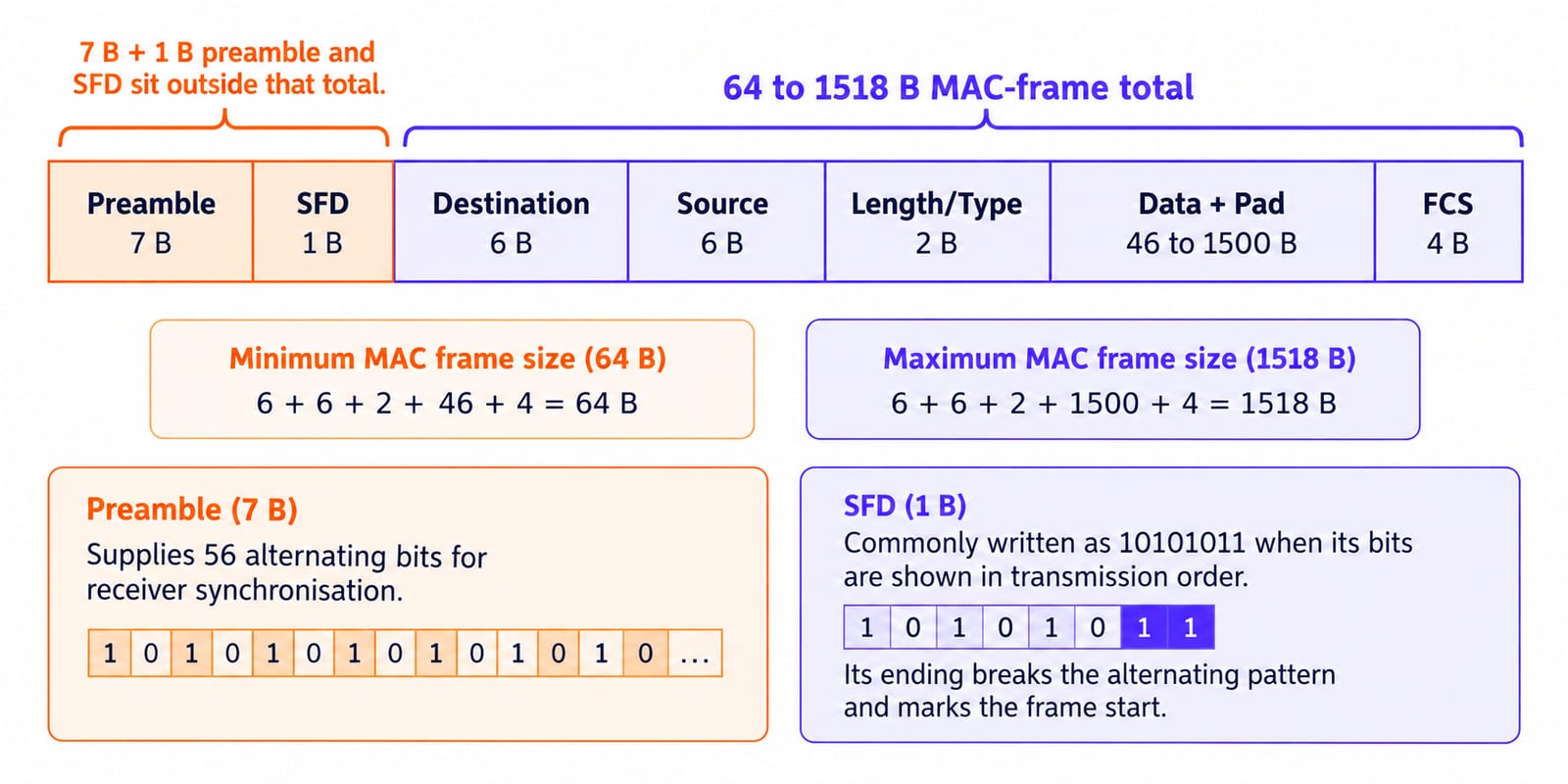
IEEE 802.3 specifies this field convention in transmission order:
Field | Size |
|---|---|
Preamble | 7 B |
SFD | 1 B |
Destination | 6 B |
Source | 6 B |
Length/Type | 2 B |
Data + Pad | 46 to 1500 B |
FCS | 4 B |
The standard 64 to 1518 B MAC-frame total begins at Destination and ends at FCS. The 7 B + 1 B preamble and SFD sit outside that total. The minimum is 6 + 6 + 2 + 46 + 4 = 64 B; the maximum is 6 + 6 + 2 + 1500 + 4 = 1518 B.
The preamble supplies 56 alternating bits for receiver synchronisation. The SFD byte is commonly written as 10101011 when its bits are shown in transmission order. Its ending breaks the alternating pattern and marks the frame start.
2. Ethernet Preamble and SFD MCQs 1-3: boundary, delimiter and byte count
Question 1
ISRO 2013.
In the Ethernet, which field is actually added at the physical layer and is not part of the frame?
A. preamble
B. CRC
C. address
D. location
Correct answer: A. preamble.
The preamble precedes the counted MAC frame for receiver synchronisation. CRC/FCS and address fields are inside the MAC frame, while location is not an Ethernet field. When the Physical Layer and exclusion from the counted frame appear together, choose the synchronisation sequence. Open the exact practice question.
Question 2
UP LT Grade Assistant Teacher 2018.
What is the value of the Start Frame Delimiter in an Ethernet frame?
A. 10101011
B. 10101010
C. 01101011
D. 10101111
Correct answer: A. 10101011.
The preamble establishes an alternating rhythm. The following one-byte SFD is 10101011 in this representation. Option B, 10101010, merely continues the alternating pattern, so it does not provide the distinctive ending that marks the boundary. Open the Ethernet module page (question unavailable).
Question 3
UGC NET 2014.
The minimum frame length for 10 Mbps Ethernet is _______ bytes and maximum is _______ bytes.
A. 64 & 128
B. 128 & 1518
C. 1518 & 3036
D. 64 & 1518
Correct answer: D. 64 & 1518.
Minimum: 6 + 6 + 2 + 46 + 4 = 64 B. Maximum: 6 + 6 + 2 + 1500 + 4 = 1518 B. Under this frame-length convention, do not add the 7 B preamble or 1 B SFD to either result. Open the exact practice question.
3. Ethernet Frame Size MCQs 4-6: runt frames and collision-window numericals
Question 4
ISRO 2017.
An Ethernet frame that is less than the IEEE 802.3 minimum length of 64 octets is called
A. Short frame
B. Small frame
C. Mini frame
D. Runt frame
Correct answer: D. Runt frame.
One octet is eight bits, so 64 octets = 64 bytes = 512 bits. A received frame below this IEEE 802.3 minimum is a runt frame. For carrier sensing, jam signalling, minimum-frame calculations and backoff, use CSMA/CD MCQs: 12 Solved Questions on Collision Detection, Frame Size and Backoff. Here the collision rule explains why the Ethernet frame floor is 64 bytes. The other phrases are not the exam term. Open the exact practice question.
Question 5
GATE 2005.
Suppose the round-trip propagation delay for a 10 Mbps Ethernet having 48-bit jamming signal is 46.4 μs. The minimum frame size is
A. 94
B. 416
C. 464
D. 512
Correct answer: D. 512.
Bits sent during the delay are (10 × 10^6 bit/s)(46.4 × 10^-6 s) = 464 bits. Add the stated jamming signal: 464 + 48 = 512 bits = 64 bytes. Option C is the trap obtained by stopping before adding the jam bits. Open the exact practice question.
Question 6
GATE 2013.
Determine the maximum length of the cable (in km) for transmitting data at a rate of 500 Mbps in an Ethernet LAN with frames of size 10,000 bits. Assume the signal speed in the cable to be 2,00,000 km/s.
A. 1
B. 2
C. 2.5
D. 5
Correct answer: B. 2.
Use 2Tp <= Tt. The transmission time is Tt = 10,000/(500 x 10^6) = 20 microseconds, so Tp <= 10 microseconds. Thus distance = (2,00,000 km/s)(10 x 10^-6 s) = 2 km. The round trip over 2 km is 20 microseconds, exactly equal to Tt; any longer cable fails the inequality. Baud Rate, Bit Rate and Ethernet Signal Representation MCQs solves the same 500 Mbps values as a rate-delay-distance exercise. Here the result is attached to the frame-size constraint: the 10,000-bit frame must remain on the wire for the full round trip. Open the exact practice question.
4. Ethernet MAC Address MCQs 7-10: broadcast, bit length and address decoding
Question 7
NIACL AO IT Specialist 2024.
What is the broadcast MAC address in a typical Ethernet frame?
A. FF:FF:FF:FF:FF:FF
B. 00:00:00:00:00:00
C. 01:01:01:01:01:01
D. 99:99:99:99:99:99
Correct answer: A. FF:FF:FF:FF:FF:FF.
Broadcast sets all 48 destination-address bits to 1. Each hexadecimal F is 1111, so 12 × 4 = 48 one-bits. The all-zero option is not the broadcast destination. Open the exact practice question.
Question 8
UGC NET 2017.
The number of bits used for addressing in Gigabit Ethernet is __________.
A. 32 bits
B. 48 bits
C. 64 bits
D. 128 bits
Correct answer: B. 48 bits.
Gigabit changes the data rate, not the ordinary MAC-address width tested here. A MAC address has 6 octets, so 6 × 8 = 48 bits. The 32-bit and 128-bit distractors resemble IPv4 and IPv6 address widths. Open the exact practice question.
Question 9
UGC NET 2022.
Which of the following is correct for the destination address 4A:30:10:21:10:1A ?
A. unicast address
B. multicast address
C. broadcast address
D. unicast and broadcast address
Correct answer: A. unicast address.
Inspect the least significant bit of the first octet. 4A is 01001010; its final, I/G bit is 0, so the address is individual or unicast. Multicast has I/G 1, while broadcast is the special all-ones address. Do not inspect the most significant bit. Open the exact practice question.
Question 10
UGC NET 2022.
Given Ethernet address 010110100001000101010101000110001010101000001111 in binary, what is the address in hexadecimal notation?
A. 5A:88:AA:18:55:F0
B. 5A:81:BA:81:AA:08
C. 5A:18:5A:18:55:0F
D. 5A:11:55:18:AA:0F
Correct answer: D. 5A:11:55:18:AA:0F.
Group without reversing: 01011010 | 00010001 | 01010101 | 00011000 | 10101010 | 00001111. Byte-wise conversion gives 5A | 11 | 55 | 18 | AA | 0F, or 5A:11:55:18:AA:0F. This matches D despite the source spacing. Six bytes must produce six hexadecimal pairs. Open the exact practice question.
5. Ethernet Address Scope MCQs 11-12: uniqueness and per-hop source fields
Question 11
GATE 2004.
A host is connected to a Department network which is part of a University network. The University network, in turn, is part of the Internet. The largest network in which the Ethernet address of the host is unique is:
A. the subnet to which the host belongs
B. the Department network
C. the University network
D. the Internet
Correct answer: D. the Internet.
Under the standard exam assumption, a universally administered 48-bit MAC address is intended to be globally unique, so the Internet is the largest listed scope. This is identifier uniqueness, not forwarding reach. Ethernet frames are not routed end to end across the Internet, and locally administered or spoofed addresses may duplicate. Open the exact practice question.
Question 12
ISRO 2008.
In Ethernet, the source address field in the MAC frame is the _______ address.
A. original sender's physical
B. previous station's physical
C. next destination's physical
D. original sender's service port
Correct answer: B. previous station's physical.
A router removes the incoming Layer 2 frame and creates another for the next link. On Host A -> Router R -> Host B, the R-to-B frame has R's outgoing-interface MAC as source and B's MAC as destination. The source MAC is therefore the previous station's physical address, not an end-to-end field. A service port belongs to the transport layer. Open the exact practice question.
6. Trap table and a 90-second revision pass
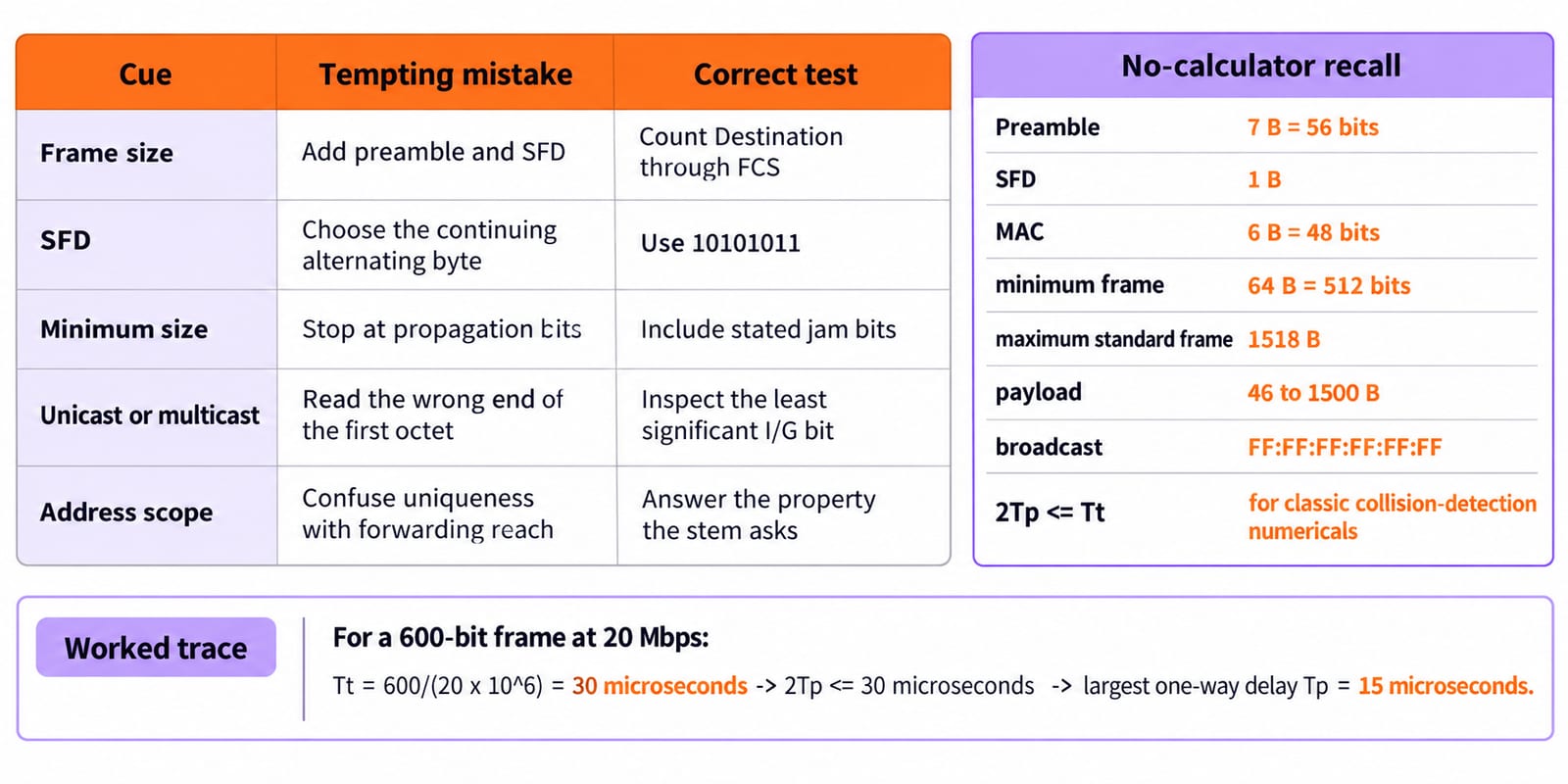
Cue | Tempting mistake | Correct test |
|---|---|---|
Frame size | Add preamble and SFD | Count Destination through FCS |
SFD | Choose the continuing alternating byte | Use |
Minimum size | Stop at propagation bits | Include stated jam bits |
Unicast or multicast | Read the wrong end of the first octet | Inspect the least significant I/G bit |
Address scope | Confuse uniqueness with forwarding reach | Answer the property the stem asks |
No-calculator recall strip: Preamble 7 B = 56 bits; SFD 1 B; MAC 6 B = 48 bits; minimum frame 64 B = 512 bits; maximum standard frame 1518 B; payload 46 to 1500 B; broadcast FF:FF:FF:FF:FF:FF; and 2Tp <= Tt for classic collision-detection numericals.
For a 600-bit frame at 20 Mbps, Tt = 600/(20 x 10^6) = 30 microseconds. Therefore 2Tp <= 30 microseconds, giving a largest one-way delay of Tp = 15 microseconds.
7. Short version and what to practise next
Exclude preamble and SFD from the 64 to 1518 B MAC-frame count used here; identify SFD as 10101011; turn rate and delay into bits before applying the collision condition; and inspect the I/G bit or all-ones pattern in MAC-address questions.
Redo the set using only the one-line rule beside each answer. Use the rule before checking the answer letter. Then use Zero to Hero Complete CS Course for a structured core-CS route from fundamentals.
Keep learning
Ethernet Frame Format Explained: Preamble, SFD, Field Sizes and Worked Calculations
Learn exactly what the 64-byte Ethernet minimum includes, how preamble and SFD appear on the wire, and how to calculate padding and transmission time.
Updated 19 Nov 20265 min readComputer Networks
Ethernet in the Data Link Layer: Frame Format, CSMA/CD, and Worked GATE Examples
Build Ethernet from its frame fields upward, then solve collision-window, back-off, efficiency, and domain-counting problems with the reasoning shown.
Updated 15 Aug 20266 min read79 viewsComputer Networks
Ethernet IEEE 802.3 MCQs: 12 Solved Questions with Explanations
Solve 12 Ethernet questions on IEEE 802.3, speed generations, hubs, MAC addresses, multicast, CSMA/CD and the first binary backoff race.
Updated 30 Oct 20267 min read76 viewsComputer Networks MCQs
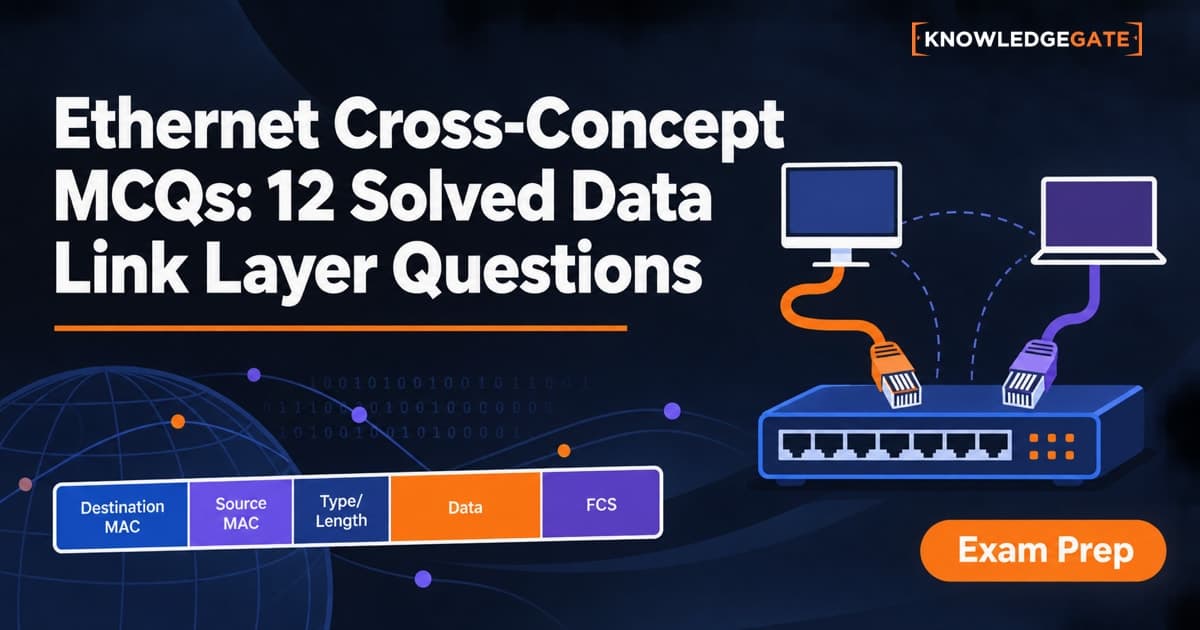
Ethernet Cross-Concept MCQs: 12 Solved Data Link Layer Questions
Solve 12 Ethernet questions spanning devices, MAC structure, CSMA/CD, STP, VLANs, collision domains, switch port accounting and frame payload conversion.
Updated 30 Aug 20267 min readComputer Networks MCQs