EMRS CS Subject Weightage: Build Revision Blocks from the Syllabus and PYQs
Turn the EMRS Computer Science syllabus and tagged past-paper questions into revision blocks. The worked model protects full syllabus coverage while letting evidence decide what comes first.
KnowledgeGate Team
Exam prep & CS education
Updated 25 Jul 20265 min read
The EMRS Computer Science syllabus is broad, so a viral marks table can look useful when revision time is short. The problem is that a table built from one paper can become stale after the next. This method turns official syllabus breadth, tagged past-paper evidence and prerequisite value into revision blocks you can recalculate. It is a priority model, not a prediction of the next paper; begin at the EMRS Computer Science preparation hub.
Start with the official EMRS syllabus, not a copied weightage table
NESTS provides separate PGT and TGT ESSE-2025 syllabus PDFs on the official syllabus hub. Use the PDF that matches the post you are applying for, and never merge the PGT and TGT lists into one scope.
For this worked PGT example, arrange the official Computer Science breadth into four study containers:
Block A: Computer Networks and web services
Block B: Python, DBMS, SQL and Python-SQL connectivity
Block C: computer systems, Boolean logic and number systems
Block D: society, law, ethics and emerging trends
They are revision containers built from the syllabus headings, not sections or marks announced by NESTS. To place this subject work inside the recruitment stages, read EMRS Computer Science: Tier 1 vs Tier 2.
Score each block with three signals and one safety guard
Use this model: Priority = 2P + S + R + U.
Pis the tagged PYQ signal: 0 hits gives 0, 1 hit gives 1, 2 to 4 hits gives 2, and 5 or more hits gives 3.Smeasures official-syllabus breadth from 1 to 3.Rmeasures prerequisite value from 0 to 2.U = 1only when the audited paper slice has zero hits. Otherwise,U = 0.
The evidence hierarchy matters. The NESTS syllabus decides what stays in scope. Verified papers order that work, while prerequisite value breaks ties. A strong PYQ signal can move a block earlier, but it cannot remove an official topic. In other words, use PYQs as evidence, not decoration, and keep the safety guard when your sample is small.
Worked example: tag 12 consecutive questions before assigning time
Take questions 51 to 62 from a tagged EMRS PGT Computer Science past paper. Log that paper's year, post and question range beside every count, because a past-paper copy is traceable evidence rather than a NESTS notification.
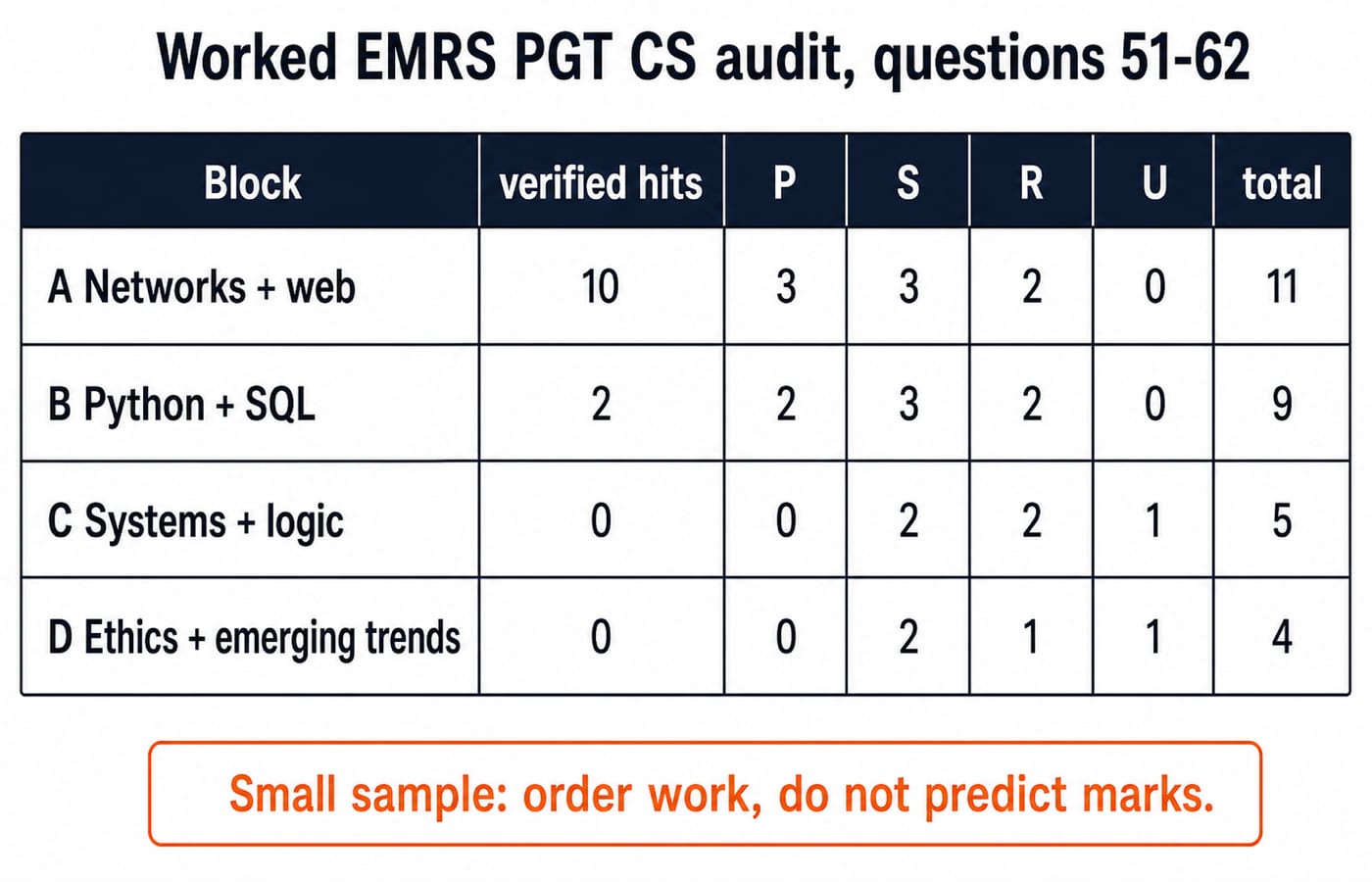
Q51, fetchall() in Python-MySQL, and Q57, an SQL join, belong to Block B. Q52 XML, Q53 optical fibre, Q54 ARPANET, Q55 PPP, Q56 domain name, Q58 tree topology, Q59 packet switching, Q60 cookies, Q61 modem and Q62 GPRS belong to Block A. Therefore A has 10 hits, B has 2, and C and D have 0 each.
These counts map A to P3, B to P2, and C and D to P0. Because C and D have zero hits, each receives U1; A and B receive U0. Apply the stated breadth and prerequisite values:
A,
P3, S3, R2, U0:2(3) + 3 + 2 + 0 = 11B,
P2, S3, R2, U0:2(2) + 3 + 2 + 0 = 9C,
P0, S2, R2, U1:2(0) + 2 + 2 + 1 = 5D,
P0, S2, R1, U1:2(0) + 2 + 1 + 1 = 4
Twelve consecutive questions show tagging, not subject weightage. Repeat the audit across every trustworthy paper before treating this order as stable.
Convert the scores into a 16-session revision cycle
Build a two-week cycle with eight 60-minute sessions each week. Give A six sessions, B five, C three and D two. That follows the score order while reserving at least two sessions for every official block, so no syllabus area drops out of the fortnight.
Use one fixed session template: 15 minutes of closed-book recall, 30 minutes of topic questions, 10 minutes updating the error log, and 5 minutes writing the next-session cue. Block A has six sessions, so spend the first three on media and devices, then topologies and switching, then protocols and web services, each with 15 questions. Use the remaining three to revisit misses and practise mixed retrieval. The pattern keeps revision active: recall, answer, diagnose, then leave a precise cue for the next sitting.
Refresh the blocks after each full paper or mock
After each verified paper or full mock, add topic tags, calculate accuracy, and introduce error rate as a new signal. Suppose B rises from 2 audited hits to 9 cumulative hits but accuracy is 55%. If another block also has 9 hits at 85% accuracy, the extra session goes to weaker Block B.
Recalculate after every 50 newly tagged questions or one full mock, whichever comes first. Move only one session per cycle unless an official syllabus change requires a complete rebuild. Then review the mock through an error log, not just its final score.
Four mistakes that make subject weightage unreliable
One paper becomes a trend. A small sample exaggerates its setter's choices. Add more verified papers before stabilising the order.
TGT and PGT get mixed. Similar labels hide post-specific scope. Tag against the correct NESTS syllabus.
One question gets counted twice. Multi-concept items inflate two blocks. Give every question one primary tag and at most one secondary tag. Only primary tags enter
P; secondary tags support prerequisite planning.A zero-hit topic disappears. A limited slice is mistaken for scope. Keep every official topic through the
Uguard.
Reject percentages with no clear denominator. Also reject tables that omit the paper year, post, stage or question range.
Short version: syllabus sets scope, evidence sets order
Map the correct NESTS syllabus, tag verified questions, then allocate sessions with a coverage floor. Re-check the live official notice before acting on any pattern detail. For EMRS-specific structure and guided preparation, continue with the EMRS Complete Bundle (Computer Science). If you are preparing across several teaching recruitments at once, the Teaching Recruitment Exams Bundle covers the wider set.
Keep learning
EMRS Teacher Selection Process: Tier-wise Weightage and Verification
Passing screening, earning merit marks and proving eligibility are separate tasks. Follow the PGT/TGT stage map with worked score examples and a practical document checklist.
5 Oct 20265 min read52 viewsEMRS
EMRS PGT Computer Science Preparation: 7 Mistakes to Fix
Watched the lectures but still repeating errors? Use seven checks to separate reading from tested understanding, repair mock-test mistakes and choose resources against actual gaps.
29 Sep 20264 min readEMRS
EMRS vs State PSC Teaching Jobs: Choose by Work Setting, Mobility and Fit
Compare an EMRS post with a named State PSC route using official clauses, personal mobility limits, syllabus overlap and a worked 100-point fit score.
Updated 7 Aug 20266 min readEMRS
EMRS Computer Science: DBMS, Networks and Cyber Safety Through One Lab Scenario
A fictional residential-school lab connects normalization, SQL, subnetting and cyber safety. Follow one sign-in from PC-B12 to the database boundary.
Updated 5 Aug 20266 min readEMRS