DVR, RIP and Split Horizon MCQs: 12 Solved Questions with Explanations
Solve 12 exam questions on distance-vector routing, RIP metrics, count-to-infinity, split horizon and routing-table updates, with every answer explained.
KnowledgeGate Team
Exam prep & CS education
Updated 13 Sep 20268 min read
RIP, distance-vector routing, count-to-infinity and split horizon are often memorised separately, so small option changes cause errors. Treat them as one mechanism: neighbours advertise costs, Bellman-Ford updates select routes, stale information creates loops, and split horizon blocks one return path. For the wider family contrast, distance vector vs link state routing sets neighbour-vector exchange against topology flooding; within DVR, the decisive moves are route calculation, RIP metric recognition and failure-loop control.
Related reading: distance vector and link state routing and MPLS forwarding.
Distance Vector Routing MCQs: neighbour exchange and route selection
A router stores its best destination costs, receives neighbour vectors, tests cost(R, neighbour) + advertised cost, and keeps the minimum. Find this mechanism in CS Fundamentals for Exams & Placements.
Question 1, TPSC 2024
What is the primary function of the Routing Information Protocol (RIP) in the context of routing protocols ?
A. Flooding
B. Shortest Path Routing
C. Distance Vector Routing
D. Link State Routing
Answer: C. Distance Vector Routing.
RIP is a distance-vector protocol that exchanges route distances with neighbours. It seeks a best route, but C names the family asked for.
Question 2, UGC NET 2017
Distance vector routing algorithm is a dynamic routing algorithm. The routing tables in distance vector routing algorithm are updated _____.
A. automatically
B. by server
C. by exchanging information with neighbour nodes
D. with back up database
Answer: C. by exchanging information with neighbour nodes.
Distance-vector routers learn iteratively from neighbour advertisements. “Automatically” is vague; neither a server nor a backup database performs this exchange.
Question 3, GATE 2021 Set 2
Consider a computer network using the distance vector routing algorithm in its network layer. The partial topology of the network is shown below.
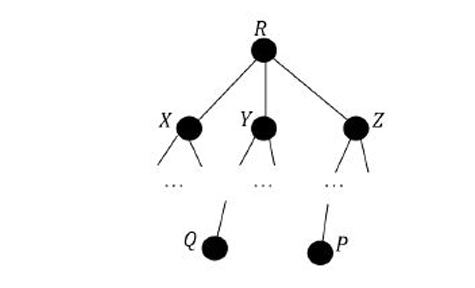
The objective is to find the shortest-cost path from the router R to routers P and Q. Assume that R does not initially know the shortest routes to P and Q. Assume that R has three neighbouring routers denoted as X, Y and Z. During one iteration, R measures its distance to its neighbours X, Y, and Z as 3, 2 and 5, respectively. Router R gets routing vectors from its neighbours that indicate that the distance to router P from routers X, Y and Z are 7, 6 and 5, respectively. The routing vector also indicates that the distance to router Q from routers X, Y and Z are 4, 6 and 8 respectively. Which of the following statement(s) is/are correct with respect to the new routing table of R, after updation during this iteration?
A. The distance from R to P will be stored as 10.
B. The distance from R to Q will be stored as 7.
C. The next hop router for a packet from R to P is Y.
D. The next hop router for a packet from R to Q is Z.
Answer: B and C.
For P: via X 3 + 7 = 10, Y 2 + 6 = 8, Z 5 + 5 = 10; choose 8 via Y. For Q: via X 3 + 4 = 7, Y 2 + 6 = 8, Z 5 + 8 = 13; choose 7 via X. Thus B and C are true.
RIP MCQs: protocol family and hop-count metric
Distance vector is the family, RIP is a protocol using it, and hop count is RIP's metric.
Question 4, practice question
Routing information Protocol (RIP) uses
A. distance vector
B. Link state
C. both
D. none
Answer: A. distance vector.
RIP advertises distance and direction information to neighbours. OSPF is link-state, so B and C do not fit.
Question 5, TPSC 2026
Which routing algorithm uses the hop count as the metric ?
A. OSPF
B. RIP
C. BGP
D. EIGRP
Answer: B. RIP.
RIP compares hop counts. OSPF uses link-state cost; BGP is path-vector; EIGRP uses a composite metric.
Count-to-infinity MCQs: recognise the failure mode
After failure, two neighbours may each believe the other has a path, raising the metric with every advertisement. This stale-route escalation is count-to-infinity. RIP bounds infinity, but the transient loop still matters.
Question 6, practice question
Count to infinity is a problem associated with?
A. Routing information protocol
B. Border gateway protocol
C. DNS while solving host name
D. Open source path first protocol
Answer: A. Routing information protocol.
RIP is distance-vector, so stale routes can count upward. BGP, DNS and Open Shortest Path First do not fit this RIP-focused association.
Question 7, GATE 2005 Information Technology
Count to infinity is a problem associated with
A. link state routing protocol.
B. distance vector routing protocol
C. DNS while resolving host name.
D. TCP for congestion control.
Answer: B. distance vector routing protocol.
Neighbour advertisements can amplify stale information after failure. This is a distance-vector problem, not a link-state, DNS or TCP problem.
Split Horizon MCQs: two-node loops and RIP infinity
Split horizon does not advertise a route through the interface that supplied it. A neighbour cannot then receive its own stale route as an alternative.
Question 8, practice question
Split horizon is the solution of which problem:-
A. High traffic because of flooding
B. Problem of Orphan packets
C. Two node loop instability
D. Find optimal path for DVR tables
Answer: C. Two node loop instability.
Split horizon stops neighbours feeding a failed route back to each other. It neither controls general flooding nor calculates minimum routing costs.
Question 9, practice question, NAT
The maximum number that is not considered to be infinite in the count to infinity problem is _______.
Answer: 15.
In RIP, 15 = finite and 16 = infinity. Metric 16 means unreachable, not expensive.
Question 10, practice question
Consider three routers A, B, and C connected as shown in the figure. The routers exchange distance vector routing information and have converged on their routing tables. Now suppose the link between A and B fails. Which of the following avoids the two-node loop instability (count-to-infinity) problem?
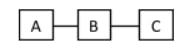
A. If B sends its routing table to C before C sends its table to B.
B. If C sends its routing table to B before B sends its table to C.
C. If A sends its routing table to both B and C.
D. There is no way to avoid the two-node loop instability problem.
Answer: A. If B sends its routing table to C before C sends its table to B.
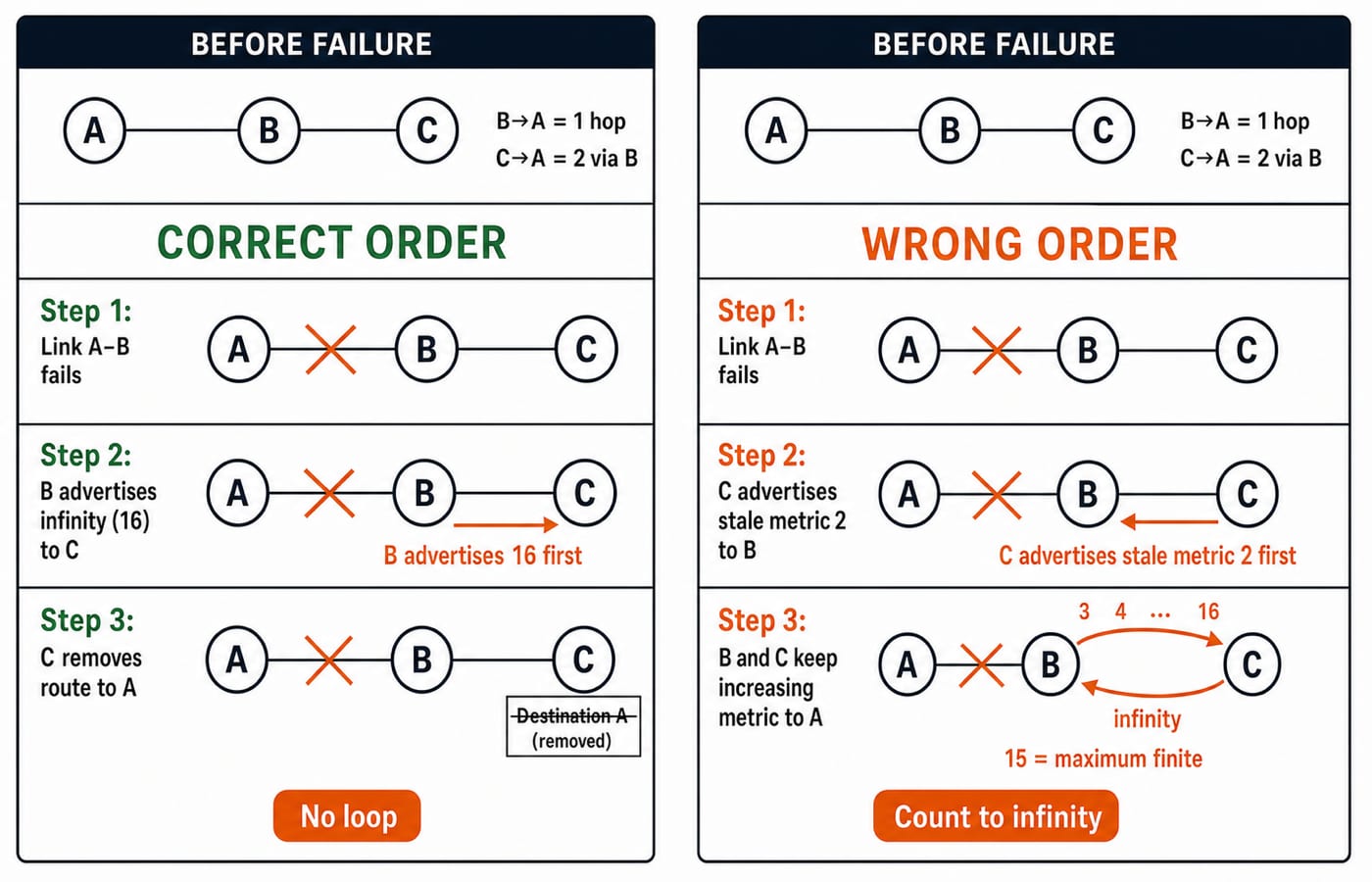
B detects the failed A-B link. If B advertises unreachable first, C removes A; if C advertises stale information first, B can accept it and start counting.
DVR Table Update MCQs: two fully worked rounds
Copy the destination order (N1,N2,N3,N4,N5) before calculating. Mixing positions causes more errors than addition.
Question 11, GATE 2011
Consider a network with five nodes, N1 to N5, as shown as below.
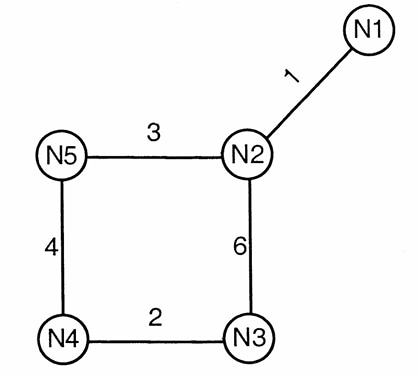
The network uses a Distance Vector Routing protocol. Once the routes have been stabilized, the distance vectors at different nodes are as follows.
N1: (0,1,7,8,4)
N2: (1,0,6,7,3)
N3: (7,6,0,2,6)
N4: (8,7,2,0,4)
N5: (4,3,6,4,0)
Each distance vector is the distance of the best known path at that instance to nodes, N1 to N5, where the distance to itself is 0. Also, all links are symmetric and the cost is identical in both directions. In each round, all nodes exchange their distance vectors with their respective neighbors. Then all nodes update their distance vectors. In between two rounds, any change in cost of a link will cause the two incident nodes to change only that entry in their distance vectors.
The cost of link N2−N3 reduces to 2 (in both directions). After the next round of updates, what will be the new distance vector at node, N3?
A. (3,2,0,2,5)
B. (3,2,0,2,6)
C. (7,2,0,2,5)
D. (7,2,0,2,6)
Answer: A. (3,2,0,2,5).
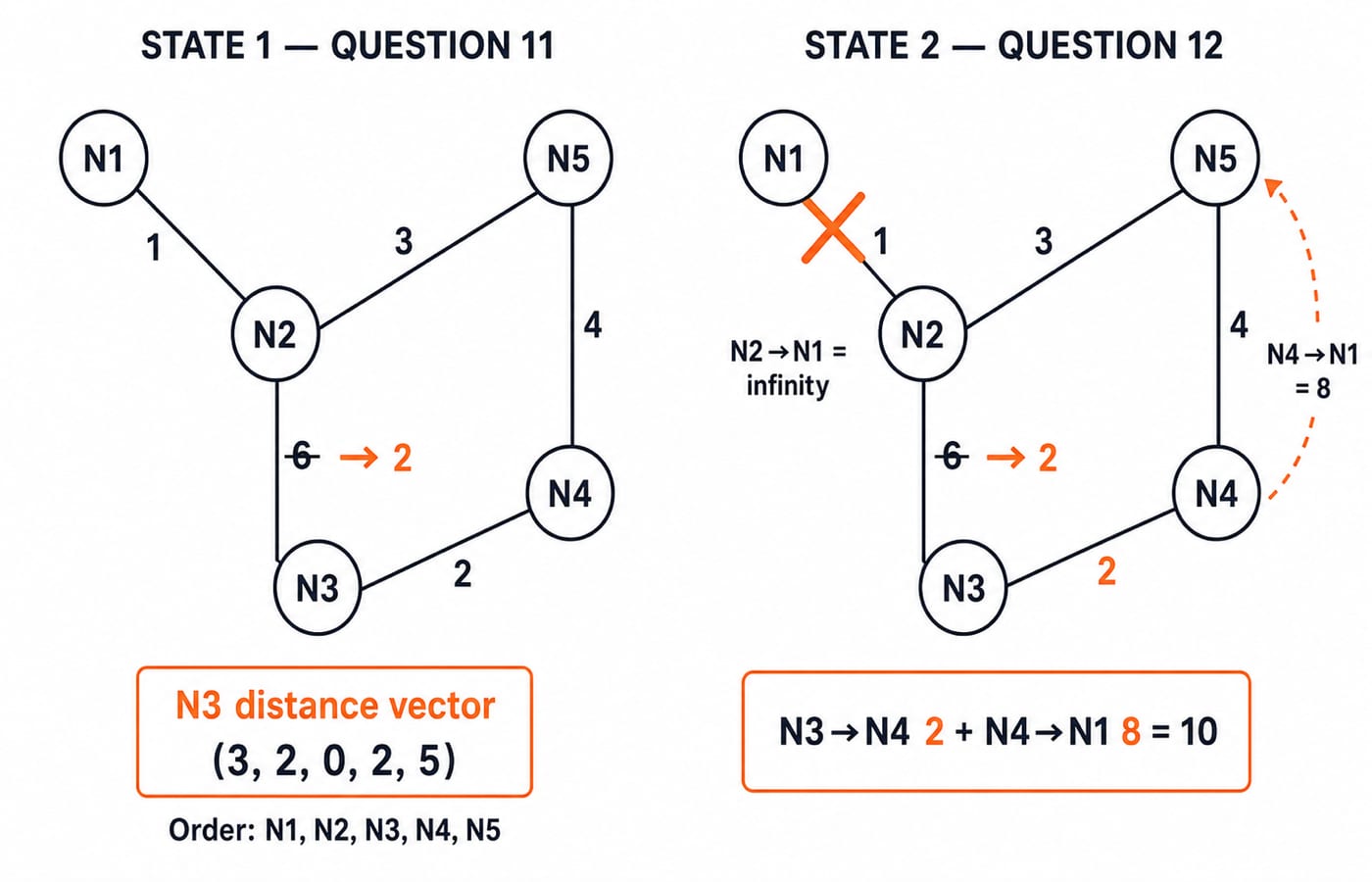
In (N1,N2,N3,N4,N5), the first four costs are 2 + 1 = 3, 2, 0, 2. For N5, 2 + 3 = 5 via N2 beats 2 + 4 = 6 via N4, giving (3,2,0,2,5).
Question 12, GATE 2011
Consider a network with five nodes, N1 to N5, as shown as below.
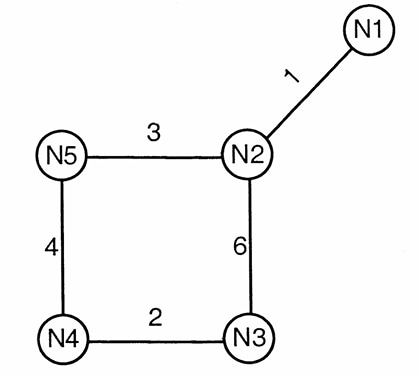
The network uses a Distance Vector Routing protocol. Once the routes have been stabilized, the distance vectors at different nodes are as follows.
N1: (0,1,7,8,4)
N2: (1,0,6,7,3)
N3: (7,6,0,2,6)
N4: (8,7,2,0,4)
N5: (4,3,6,4,0)
Each distance vector is the distance of the best known path at that instance to nodes, N1 to N5, where the distance to itself is 0. Also, all links are symmetric and the cost is identical in both directions. In each round, all nodes exchange their distance vectors with their respective neighbors. Then all nodes update their distance vectors. In between two rounds, any change in cost of a link will cause the two incident nodes to change only that entry in their distance vectors.
The cost of link N2−N3 reduces to 2 (in both directions). After the next round of updates, the link N1−N2 goes down. N2 will reflect this change immediately in its distance vector as cost, ∞. After the NEXT ROUND of update, what will be the cost to N1 in the distance vector of N3 ?
A. 3
B. 9
C. 10
D. ∞
Answer: C. 10.
N2 advertises N1 as infinity, so N3 loses its earlier cost 3 via N2. The alternative through N4 is 2 + 8 = 10.
DVR, RIP and Split Horizon MCQ traps to revise
Clue in the stem | What it should trigger |
|---|---|
neighbour vector exchange | distance vector |
RIP protocol family | distance vector |
RIP metric | hop count |
count-to-infinity | stale distance-vector route after failure |
maximum finite RIP metric | 15 |
unreachable RIP metric | 16 |
split horizon | do not advertise a learned route back on the incoming interface |
table update | add local link cost to the neighbour's advertised cost and take the minimum |
Protocol family, metric and failure control are different layers. Never treat “RIP”, “hop count” and “split horizon” as interchangeable answers. Use Computer Networks MCQs for mixed-topic practice.
DVR and RIP MCQs: the short version and next step
Recall the chain: neighbours exchange costs, RIP counts hops, failed routes can count upward, 16 is unreachable, and split horizon blocks return advertisements. Build it into a GATE plan with GATE Guidance by Sanchit Sir. For networks with other placement fundamentals, use CS Fundamentals for Placements by Sanchit Sir.
Keep learning
Computer Networks Basics & Criteria MCQs: 12 Solved Questions with Explanations
Solve 12 Computer Networks questions, then use clear explanations and worked criteria checks to separate similar terms confidently.
3 Oct 20268 min readComputer Networks MCQs
TCP Timers, RTT Estimation & SWS: 10 Solved MCQs and NATs
Solve 10 TCP exam questions covering timer roles, Silly Window Syndrome, recursive RTT estimates, Jacobson/Karels RTO and Karn's rule.
Updated 28 Sep 20267 min readComputer Networks MCQs
RSA Algorithm MCQs: 12 Solved Questions with Step-by-Step Explanations
Practise RSA key generation, modular inverses, encryption, signatures and defining equations, with concise working for conceptual and numerical answers.
25 Sep 20268 min readComputer Networks MCQs
Firewall, VPN, IDS and IPS MCQs: 11 Network Security Questions Solved
Solve 11 previous-year questions on firewalls, VPNs, IDS and IPS. Learn rule filtering, connection state, DMZ design, IPsec modes, tunnels and signatures.
Updated 24 Sep 20267 min readComputer Networks MCQs