Consider a network with five nodes, N1 to N5, as shown as below. The network…
GATE · 2011 · CS · Computer Science & IT
Consider a network with five nodes, N1 to N5, as shown as below.
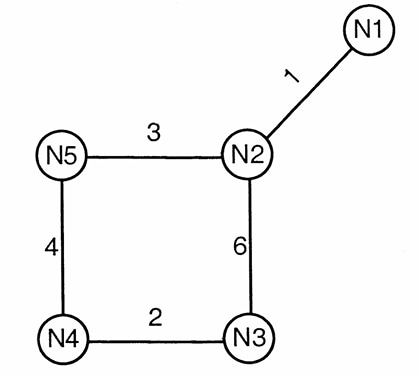
The network uses a Distance Vector Routing protocol. Once the routes have been stabilized, the distance vectors at different nodes are as follows.
N1: (0,1,7,8,4)
N2: (1,0,6,7,3)
N3: (7,6,0,2,6)
N4: (8,7,2,0,4)
N5: (4,3,6,4,0)
Each distance vector is the distance of the best known path at that instance to nodes, N1 to N5, where the distance to itself is 0. Also, all links are symmetric and the cost is identical in both directions. In each round, all nodes exchange their distance vectors with their respective neighbors. Then all nodes update their distance vectors. In between two rounds, any change in cost of a link will cause the two incident nodes to change only that entry in their distance vectors.
In Q52, the cost of link N2−N3 reduces to 2 (in both directions). After the update in the previous question, the link N1−N2 goes down. N2 will reflect this change immediately in its distance vector as cost, ∞. After the NEXT ROUND of update, what will be the cost to N1 in the distance vector of N3 ?
- A.
3
- B.
9
- C.
10
- D.
∞
Attempted by 141 students.
Sign up free to check your answer
Sign up freeLoading lesson…