Fragmentation & MTU MCQs: 12 Solved IPv4 Questions with Explanations
Solve 12 IPv4 fragmentation questions covering MTU capacity, fragment offset, re-fragmentation, loss and IP overhead. Each answer shows the working.
KnowledgeGate Team
Exam prep & CS education
14 Sep 20268 min read
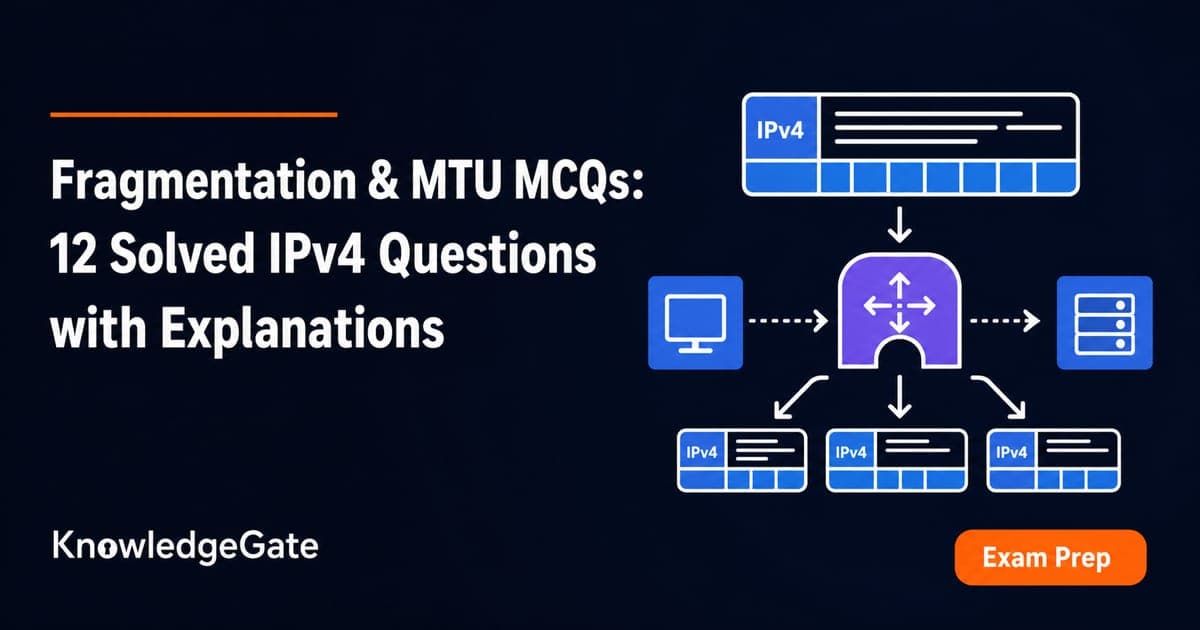
IPv4 fragmentation becomes error-prone when headers, 8-byte offsets, and destination-only reassembly meet. Separate payload, total length, and stored offset before choosing.
The 12 GATE and UGC NET questions below test four skills: counting fragments from an MTU, converting byte positions to Fragment Offset values, re-fragmenting across mismatched links, and costing IP header overhead. Work each one on paper before reading its solution, then continue with the Computer Networks MCQs collection.
IPv4 fragmentation rules and header fields
MTU limits the complete fragment. RFC 791 defines Identification, MF, and Fragment Offset. Routers may fragment, but only the destination reassembles.
Question 1: GATE 2024 Set 2, MSQ
Which of the following statements about IPv4 fragmentation is/are TRUE?
A. The fragmentation of an IP datagram is performed only at the source of the datagram
B. The fragmentation of an IP datagram is performed at any IP router which finds that the size of the datagram to be transmitted exceeds the MTU
C. The reassembly of fragments is performed only at the destination of the datagram
D. The reassembly of fragments is performed at all intermediate routers along the path from the source to the destination
Correct answer: B and C. A router may fragment when DF permits it, so A is false. Only the destination reassembles, making C true and D false.
Question 2: UGC NET December 2015, MCQ
Which of the following fields in IPv4 datagram is not related to fragmentation?
A. Type of service
B. Fragment offset
C. Flags
D. Identification
Correct answer: A. Type of service. Fragment Offset, Flags, and Identification handle fragments. Type of Service does not locate or identify them.
Question 3: GATE 2014 Set 3, MCQ
Host A (on TCP/IP v4 network A) sends an IP datagram D to host B (also on TCP/IP v4 network B). Assume that no error occurred during the transmission of D. When D reaches B, which of the following IP header field(s) may be different from that of the original datagram D? (i) TTL (ii) Checksum (iii) Fragment Offset
A. (i) only
B. (i) and (ii) only
C. (ii) and (iii) only
D. (i), (ii) and (iii)
Correct answer: D. (i), (ii) and (iii). Routers reduce TTL and recompute the checksum. Fragmentation can change Fragment Offset, so all three may differ.
MTU capacity and fragment-count MCQs
Find non-final payload with floor((MTU - header)/8) × 8, then round the fragment count up.
Question 4: GATE 2016 Set 1, NAT
An IP datagram of size 1000 bytes arrives at a router. The router has to forward this packet on a link whose MTU (maximum transmission unit) is 100 bytes. Assume that the size of the IP header is 20 bytes. The number of fragments that the IP datagram will be divided into for transmission is ___________ .
Correct answer: 13. Payload is 1000 - 20 = 980 bytes, with 80 bytes per fragment. Thus ceil(980/80) = 13: twelve payloads of 80 and one of 20.
Question 5: GATE 2025 Set 2, MCQ
Consider a network that uses Ethernet and IPv4. Assume that IPv4 headers do not use any options field. Each Ethernet frame can carry a maximum of 1500 bytes in its data field. A UDP segment is transmitted. The payload (data) in the UDP segment is 7488 bytes. Which ONE of the following choices has the CORRECT total number of fragments transmitted and the size of the last fragment including IPv4 header?
A. 5 fragments, 1488 bytes
B. 6 fragments, 88 bytes
C. 6 fragments, 108 bytes
D. 6 fragments, 116 bytes
Correct answer: D. 6 fragments, 116 bytes. IP payload is 7488 + 8 = 7496 bytes. Five 1480-byte payloads leave 96, so fragment six totals 96 + 20 = 116.
Question 6: GATE 2024 Set 1, NAT
Consider sending an IP datagram of size 1420 bytes (including 20 bytes of IP header) from a sender to a receiver over a path of two links with a router between them. The first link (sender to router) has an MTU (Maximum Transmission Unit) size of 542 bytes, while the second link (router to receiver) has an MTU size of 360 bytes. The number of fragments that would be delivered at the receiver is ________
Correct answer: 6. The 1400-byte payload becomes 520 + 520 + 360. Re-fragmentation gives 336 + 184, 336 + 184, and 336 + 24, or six fragments.
Fragment Offset and payload-range MCQs
Offset k starts at byte 8k; add payload length minus one for the last byte.
Question 7: GATE 2018, NAT
Consider an IP packet with a length of 4,500 bytes that includes a 20-byte IPv4 header and a 40-byte TCP header. The packet is forwarded to an IPv4 router that supports a Maximum Transmission Unit (MTU) of 600 bytes. Assume that the length of the IP header in all the outgoing fragments of this packet is 20 bytes. Assume that the fragmentation offset value stored in the first fragment is 0. The fragmentation offset value stored in the third fragment is _______.
Correct answer: 144. The aligned payload is floor((600 - 20)/8) × 8 = 576. Two precede fragment three, so its offset is (2 × 576)/8 = 144; the TCP header is IP payload.
Question 8: GATE 2013 and BARC 2013, MCQ
In an IPv4 datagram, the M bit is 0, the value of HLEN is 10, the value of total length is 400, and the fragment offset value is 300. The position of the datagram, and the sequence numbers of the first and the last bytes of the payload, respectively, are
A. Last fragment, 2400 and 2789
B. First fragment, 2400 and 2759
C. Last fragment, 2400 and 2759
D. Middle fragment, 300 and 689
Correct answer: C. Last fragment, 2400 and 2759. M = 0 marks the last fragment; HLEN = 10 gives 40 header bytes and 360 payload bytes. The range is 300 × 8 = 2400 through 2400 + 360 - 1 = 2759.
Full IPv4 fragmentation numericals
Track payload, total length, and offset separately.
Question 9: GATE 2015 Set 2, MCQ
Host A sends a UDP datagram containing 8880 bytes of user data to host B over an Ethernet LAN. Ethernet frames may carry data up to 1500 bytes (i.e. MTU=1500 bytes). Size of UDP header is 8 bytes and size of IP header is 20 bytes. There is no option field in IP header. How many total number of IP fragments will be transmitted and what will be the contents of offset field in the last fragment?
A. 6 and 925
B. 6 and 7400
C. 7 and 1110
D. 7 and 8880
Correct answer: C. 7 and 1110. IP payload is 8880 + 8 = 8888 bytes. Six payloads of 1480 leave 8 for fragment seven, at offset 8880/8 = 1110.
Question 10: GATE 2014 Set 3, MCQ
An IP router with a Maximum Transmission Unit (MTU) of 1500 bytes has received an IP packet of size 4404 bytes with an IP header of length 20 bytes. The values of the relevant fields in the header of the third IP fragment generated by the router for this packet are
A. MF bit: 0, Datagram Length: 1444; Offset: 370
B. MF bit: 1, Datagram Length: 1424; Offset: 185
C. MF bit: 1, Datagram Length: 1500; Offset: 370
D. MF bit: 0, Datagram Length: 1424; Offset: 2960
Correct answer: A. MF bit: 0, Datagram Length: 1444; Offset: 370. After two 1480-byte payloads, 4384 - 2960 = 1424 remains. Thus MF is 0, total length is 1444, and offset is 2960/8 = 370.
Re-fragmentation, loss and overhead MCQs
Routers fragment but do not retransmit. Later fragments need not contain TCP ports.
Question 11: GATE 2021 Set 1, MSQ
Consider two hosts P and Q connected through a router R. The maximum transfer unit (MTU) value of the link between P and R is 1500 bytes, and between R and Q is 820 bytes. A TCP segment of size 1400 bytes was transferred from P to Q through R, with IP identification value as 0x1234. Assume that the IP header size is 20 bytes. Further, the packet is allowed to be fragmented, i.e., Don’t Fragment (DF) flag in the IP header is not set by P. Which of the following statements is/are correct?
A. Two fragments are created at R and the IP datagram size carrying the second fragment is 620 bytes.
B. If the second fragment is lost, R will resend the fragment with the IP identification value 0x1234.
C. If the second fragment is lost, P is required to resend the whole TCP segment.
D. TCP destination port can be determined by analysing only the second fragment.
Correct answer: A and C. R sends 800-byte and 600-byte payloads, so the second datagram is 600 + 20 = 620 bytes. R does not retransmit; TCP at P eventually resends, and fragment two lacks the TCP header.
Question 12: GATE IT 2004, MCQ
A TCP message consisting of 2100 bytes is passed to IP for delivery across two networks. The first network can carry a maximum payload of 1200 bytes per frame and the second network can carry a maximum payload of 400 bytes per frame, excluding network overhead. Assume that IP overhead per packet is 20 bytes. What is the total IP overhead in the second network for this transmission?
A. 40 bytes
B. 80 bytes
C. 120 bytes
D. 160 bytes
Correct answer: C. 120 bytes. The first network makes payloads of 1200 and 900 bytes. They split into 400 + 400 + 400 and 400 + 400 + 100, so six headers cost 6 × 20 = 120 bytes.
Fragmentation and MTU exam traps to revise
Subtract the IP header, include transport headers in IP payload, and align non-final payloads to 8 bytes. Divide byte position by 8 for Fragment Offset, and reassemble only at the destination. Questions 1-3 explain rules, Questions 4-6 calculate counts, Questions 7-10 calculate offsets, and Questions 11-12 explain cross-layer behaviour. Next, practise Subnetting MCQs: 12 Solved IP Addressing Questions.
Fragmentation and MTU MCQs, the short next step
Redo Questions 6, 9, and 11 without looking. Use the GATE Test Series for timed practice, GATE Guidance by Sanchit Sir for sequence, or the GATE category for breadth. If you can rebuild Question 10's payload, total-length, MF, and offset values, you are ready for timed practice. Write each byte count on paper.
Keep learning
Computer Networks Basics & Criteria MCQs: 12 Solved Questions with Explanations
Solve 12 Computer Networks questions, then use clear explanations and worked criteria checks to separate similar terms confidently.
3 Oct 20268 min readComputer Networks MCQs
TCP Timers, RTT Estimation & SWS: 10 Solved MCQs and NATs
Solve 10 TCP exam questions covering timer roles, Silly Window Syndrome, recursive RTT estimates, Jacobson/Karels RTO and Karn's rule.
Updated 28 Sep 20267 min readComputer Networks MCQs
RSA Algorithm MCQs: 12 Solved Questions with Step-by-Step Explanations
Practise RSA key generation, modular inverses, encryption, signatures and defining equations, with concise working for conceptual and numerical answers.
25 Sep 20268 min readComputer Networks MCQs
Firewall, VPN, IDS and IPS MCQs: 11 Network Security Questions Solved
Solve 11 previous-year questions on firewalls, VPNs, IDS and IPS. Learn rule filtering, connection state, DMZ design, IPsec modes, tunnels and signatures.
Updated 24 Sep 20267 min readComputer Networks MCQs