Consider a computer network using the distance vector routing algorithm in its…
GATE · 2021 · CS · Set 2 · Computer Science & IT
Consider a computer network using the distance vector routing algorithm in its network layer. The partial topology of the network is shown below.
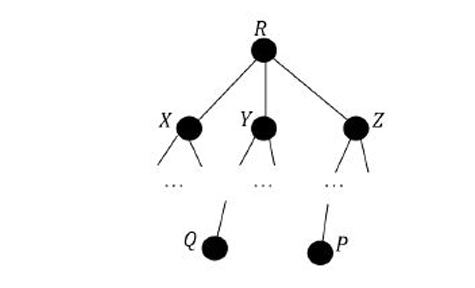
The objective is to find the shortest-cost path from the router R to routers P and Q. Assume that R does not initially know the shortest routes to P and Q. Assume that R has three neighbouring routers denoted as X, Y and Z. During one iteration, R measures its distance to its neighbours X, Y, and Z as 3, 2 and 5, respectively. Router R gets routing vectors from its neighbours that indicate that the distance to router P from routers X, Y and Z are 7, 6 and 5, respectively. The routing vector also indicates that the distance to router Q from routers X, Y and Z are 4, 6 and 8 respectively. Which of the following statement(s) is/are correct with respect to the new routing table of R, after updation during this iteration?
- A.
The distance from R to P will be stored as 10.
- B.
The distance from R to Q will be stored as 7.
- C.
The next hop router for a packet from R to P is Y.
- D.
The next hop router for a packet from R to Q is Z.
Attempted by 119 students.
Sign up free to check your answer
Sign up freeLoading lesson…