TCP Timers, RTT Estimation & SWS: 10 Solved MCQs and NATs
Solve 10 TCP exam questions covering timer roles, Silly Window Syndrome, recursive RTT estimates, Jacobson/Karels RTO and Karn's rule.
KnowledgeGate Team
Exam prep & CS education
Updated 28 Sep 20267 min read
TCP timer questions become difficult because a short stem can test four different ideas: the timer's purpose, what the EWMA coefficient weights, how an estimate changes across repeated samples, or whether Silly Window Syndrome begins at the sender or receiver. Separate sender-side tiny writes from receiver-side tiny window updates; distinguish retransmission, persist, keep-alive and TIME-WAIT; and write the RTT convention before calculating. Practise individual questions through their direct links, or open the Timers, RTT and SWS module hub for the full set. Use the GATE CS Exam Preparation Courses & Test Series page as the broader preparation route.
TCP timers, RTT estimation and SWS: the formula sheet
The retransmission timer waits for an ACK to outstanding data and triggers retransmission if the ACK does not arrive. The persist timer instead probes a receiver that has advertised a zero window, preventing flow-control deadlock if a later window update is lost. Keep-alive checks whether an idle peer still responds. TIME-WAIT lasts for twice the maximum segment lifetime, allowing old duplicate segments to expire after closure.
Under one common convention, EstimatedRTT_new=alpha×EstimatedRTT_old+(1-alpha)×SampleRTT, so alpha weights the old estimate. Common Jacobson/Karels notation writes SRTT_new=(1-alpha)×SRTT_old+alpha×SampleRTT, where alpha weights the new sample. Identify the weighted quantity before calculating.
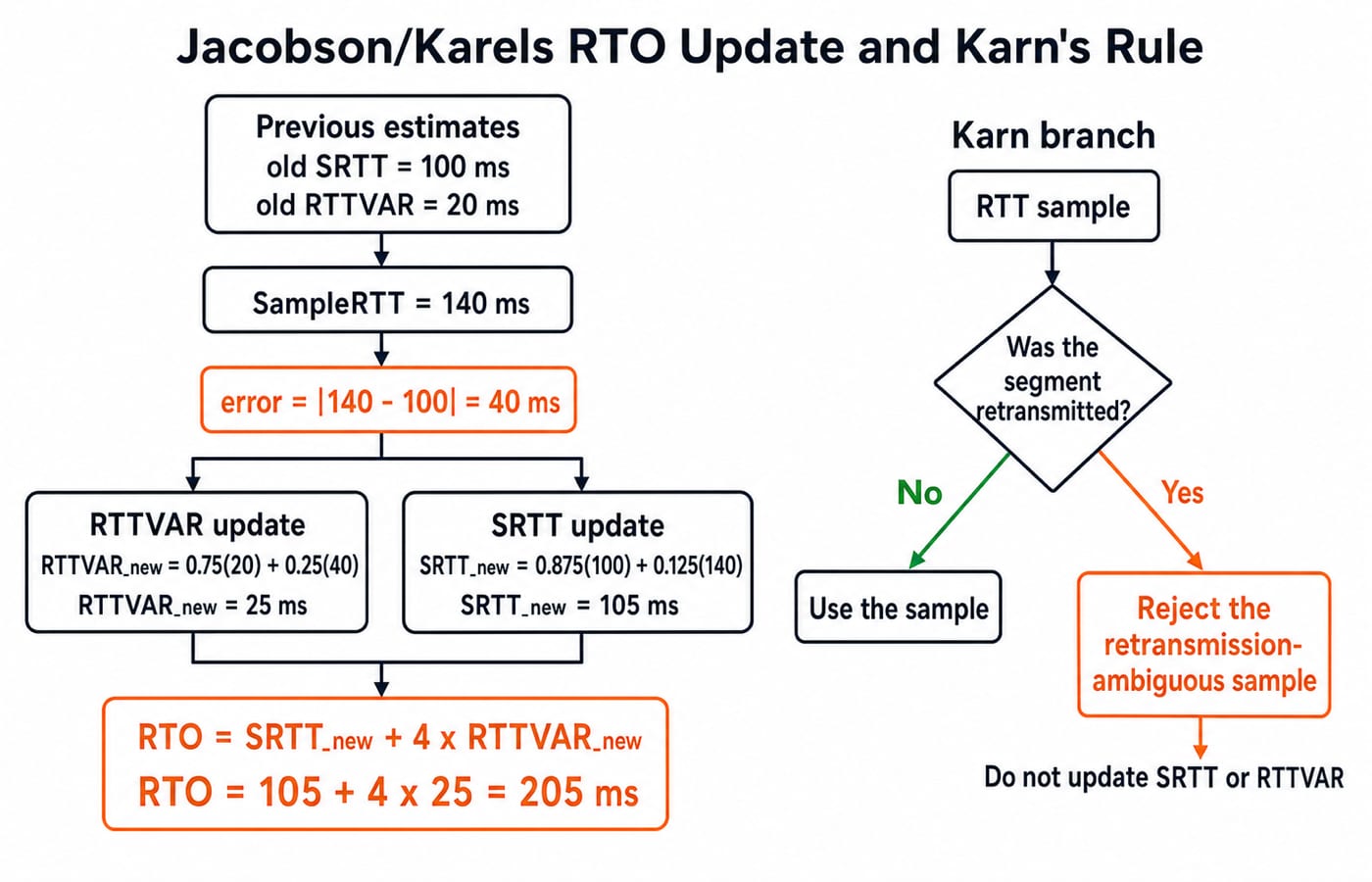
For an RTO update, first calculate the absolute sample error using the old SRTT. Update RTTVAR, then SRTT, and use RTO=SRTT+4×RTTVAR when timer granularity is negligible. Karn's rule excludes an ACK received after retransmission because its RTT sample is ambiguous.
Silly Window Syndrome MCQs: symptom and causes
Silly Window Syndrome (SWS) is a TCP efficiency failure. Tiny advertised windows or tiny application writes create tiny segments, so headers and ACK processing consume too much work for too little payload. It is not a transmission-error mechanism. Sender-side SWS begins with tiny writes, while receiver-side SWS appears when the receiver repeatedly reopens its window by tiny amounts.
Q1. SWS symptom
ISRO 2007; BEL 2007. Practise this question.
Silly Window Syndrome is related to

(a)  Error during transmission
(b) File transfer protocol
(c) Degrade in TCP performance
(d) Interface problem
Answer: (c) Degrade in TCP performance. Tiny segments waste capacity on headers and ACKs, lowering throughput. SWS is a TCP performance problem, not corruption, FTP or interface failure.
Q2. SWS causes
What are the reasons for “Silly Window Syndrome”?
a. Receiver announces advertised window as zero
 b. Client generates only one byte at a time
c. Router processes only one byte data at a time.
d. Server consumes only one byte at a time.

(a)  [a], [b], [c] are the reasons
(b)  [a], [b] are the reasons
(c)  [a] [b] [d] are the reasons
(d) [a], [b], [c], [d] are the reasons
Answer: (c) [a] [b] [d] are the reasons. Receiver-side SWS occurs when a zero window repeatedly reopens by tiny amounts. One-byte client writes cause sender SWS, one-byte server consumption causes tiny updates, and routers do not manage endpoint receive windows.
Silly Window Syndrome solution MCQ and sliding-window example
Q3. Nagle and Clark
UGC NET 2022. Practise this question.
The Solution to Silly Window Syndrome problem is/are:
A. Nagle's Algorithm
B. Clark's Algorithm
C. Jacobson's Algorithm
D. Piggy backing Algorithm
Choose the correct answer from the options given below:

(a) A and B Only
(b) A and C Only
(c) C and D Only
(d) B and D Only
Answer: (a) A and B Only. Nagle holds tiny writes while data is unacknowledged; Clark avoids tiny window updates. Jacobson estimates RTT/RTO; piggybacking combines ACKs with reverse data.
The earlier 12 solved TCP and UDP MCQs collection covers the broader transport layer: services, ports, core TCP mechanics, UDP and congestion control. This set goes deeper on timers, Silly Window Syndrome and RTT arithmetic.
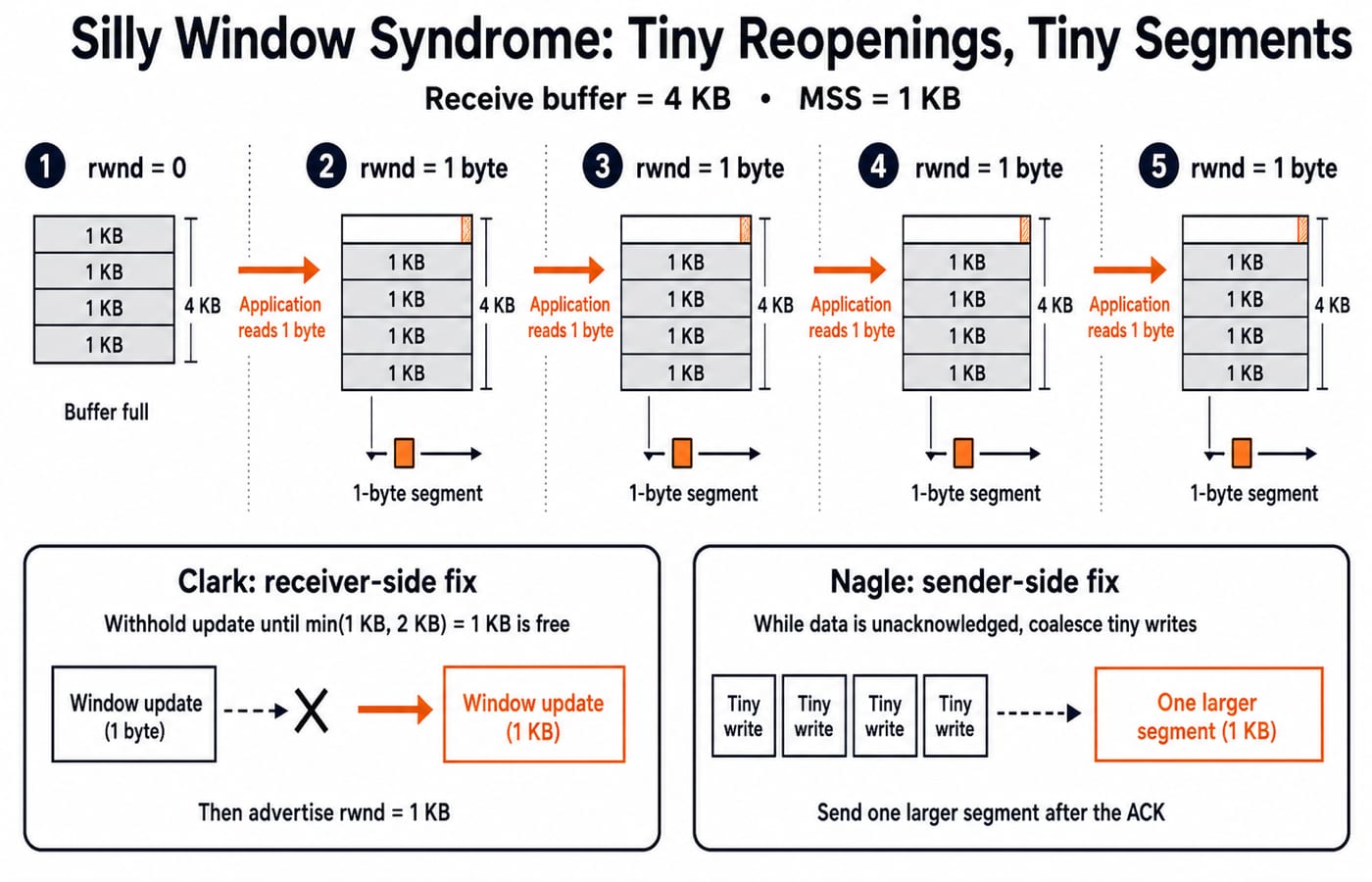
Suppose a receiver has a 4 KB buffer and an MSS of 1 KB. The buffer fills, so it acknowledges the next expected byte with rwnd=0. If the application frees 1 byte and TCP immediately advertises rwnd=1, the sender can send a 1-byte segment. Repeating this four times moves only 4 payload bytes in four tiny segments. Clark's rule keeps the window closed until at least min(MSS, half-buffer)=min(1 KB, 2 KB)=1 KB is free, then advertises 1 KB. At the sender, Nagle combines successive tiny writes while earlier small data remains unacknowledged.
TCP timer MCQ: retransmission, persist, keep-alive and TIME-WAIT
Q4. Match TCP timers
Match the following TCP timers (List 1) with their functionality (List 2).

List 1 | List 2
A. Time Wait Timer | 1. Runs for twice the maximum segment lifetime, ensuring all stray duplicate packets have died out after a connection closes.
B. Keep Alive Timer | 2. Designed to prevent a flow-control deadlock.
C. Persistent Timer | 3. When this timer expires, the system checks whether the peer is still reachable.
D. Time-out (Retransmission) Timer | 4. If the acknowledgment fails to arrive before the timer expires, the corresponding segment is retransmitted.

Choose the option that gives the correct matching.

(a) A-1, B-2, C-3, D-4
(b) A-1, B-3, C-2, D-4
(c) A-4, B-3, C-2, D-1
(d) A-4, B-2, C-3, D-1
Answer: (b) A-1, B-3, C-2, D-4. Persist probes zero-window receivers; retransmission handles unacknowledged data. TIME-WAIT expires duplicates; keep-alive tests idle peers.
RTT EWMA solved questions: one update and the alpha trap
Under the old-estimate-weight convention, new=alpha×old+(1-alpha)×sample. Keep units visible on every line.
Q5. RTT sample, alpha 0.9
Question:
TCP uses ACK timer to calculate Timeout for every transmission if there is no congestion. The RTT Between client and server is 30m Sec. The initial deviation for the network is 5ms and smoothing factor α = 0.9. Calculate estimated RTT is you get ACK at 40 m Sec.

(a) 27 m Sec
(b) 31m Sec
(c) 4m Sec
(d) 30 m Sec
Answer: (b) 31 ms. EstimatedRTT_new=0.9×30 ms+0.1×40 ms=27 ms+4 ms=31 ms. The 5 ms deviation affects RTO, not this estimate.
Q6. Recover alpha
At a given RTT estimation step, estimated RTT =28 and new sampled RTT is =27 and with the current RTT as 30ms. The value of α isAnswer: 0.33. Under the old-estimate-weight convention, 28=alpha×30+(1-alpha)×27=27+3×alpha, so alpha=1/3=0.33. Changing alpha's target changes the result, so state the convention.
RTT sequence MCQs, Jacobson/Karels RTO and Karn's rule
Q7. Three RTT samples
If the TCP round trip time is 30 ms and the following acknowledgement comes in after 26,32, and 24 milliseconds, What is the new RTT estimate?(α=0.9)

(a) 29.625
(b) 29.256
(c) 29
(d) none of the above
Answer: (b) 29.256 ms. Recursively, E1=0.9×30+0.1×26=29.6 ms; E2=0.9×29.6+0.1×32=29.84 ms; E3=0.9×29.84+0.1×24=29.256 ms. Reusing 30 ms is not recursive EWMA.
Q8. Adaptive TCP timeout
GATE 2007. Practise this question.
Consider the following statements about the timeout value used in TCP.
i. The timeout value is set to the RTT (Round Trip Time) measured during TCP connection establishment for the entire duration of the connection.
ii. Appropriate RTT estimation algorithm is used to set the timeout value of a TCP connection.
 iii. Timeout value is set to twice the propagation delay from the sender to the receiver.
 Which of the following choices hold?

(a) (i) is false, but (ii) and (iii) are true
(b) (i) and (iii) are false, but (ii) is true
(c) (i) and (ii) are false, but (iii) is true
(d) (i), (ii) and (iii) are false
Answer: (b) (i) and (iii) are false, but (ii) is true. RTT varies, so TCP smooths samples instead of freezing the initial measurement. Twice one-way propagation omits queuing, processing, transmission and variation.
Compare the protocols in TCP vs UDP: Transport Layer Explained.
Q9. RTT at option precision
If the TCP round-trip time, RTT, is currently 30 msec and the following acknowledgments come in after 26, 32, and 24 msec, respectively, what is the new RTT estimate using the Jacobson algorithm? Use α = 0.9

(a) 29.6
(b) 29.4
(c) 29.2
(d) 29.8
Answer: (c) 29.2. The path 29.6 -> 29.84 -> 29.256 ms matches Q7. The closest choice is 29.2 ms.
Q10. Infer weight and update
Assume that a TCP process A first measures the actual round trip time to another TCP process to be 20ms , and A thus set its estimated round trip time to be 20 ms . The next actual round trip time that A sees is 50ms. In response, A increases its estimation round trip time to 40ms. The next actual round trip time that A sees is 30ms. What is the next estimated round trip time (in ms) computed by A using Jacobson’s algorithm ?(up to 2 decimal point) ________Answer: 33.33 ms. First, 40=alpha×20+(1-alpha)×50 gives the old-estimate weight alpha=1/3. Next, E=(1/3)×40+(2/3)×30=40/3+20=100/3=33.33 ms.
Jacobson/Karels RTO: a complete update
Start with old SRTT=100 ms, old RTTVAR=20 ms, and unambiguous SampleRTT=140 ms. The sample weight is alpha=1/8, variance weight is beta=1/4, K=4, and timer granularity is negligible. Using old SRTT, the error is |140-100|=40 ms. Update variance first: RTTVAR_new=(3/4)×20+(1/4)×40=15+10=25 ms. Then SRTT_new=(7/8)×100+(1/8)×140=87.5+17.5=105 ms. Therefore, RTO=105+4×25=205 ms. If 140 ms came from an ACK after retransmission, Karn's rule rejects it, retains the prior estimators, and applies timeout backoff.
TCP timers, RTT and SWS: the short scoring checklist
Before answering, identify the timer's triggering event and its action. Write the EWMA convention and mark whether alpha weights the old estimate or the new sample, then carry each estimate forward recursively. Keep Nagle as the sender-side tiny-write fix and Clark as the receiver-side tiny-window fix. If a segment was retransmitted, apply Karn's ambiguity rule before doing RTT arithmetic. Use GATE Guidance by Sanchit Sir for structured Computer Networks teaching and the GATE Test Series for timed practice. Keep units on every step, and never treat SRTT alone as the full retransmission timeout when variability is provided.
Keep learning

Computer Networks Basics & Criteria MCQs: 12 Solved Questions with Explanations
Solve 12 Computer Networks questions, then use clear explanations and worked criteria checks to separate similar terms confidently.
3 Oct 20268 min readComputer Networks MCQs
RSA Algorithm MCQs: 12 Solved Questions with Step-by-Step Explanations
Practise RSA key generation, modular inverses, encryption, signatures and defining equations, with concise working for conceptual and numerical answers.
25 Sep 20268 min readComputer Networks MCQs

Firewall, VPN, IDS and IPS MCQs: 11 Network Security Questions Solved
Solve 11 previous-year questions on firewalls, VPNs, IDS and IPS. Learn rule filtering, connection state, DMZ design, IPsec modes, tunnels and signatures.
Updated 24 Sep 20267 min readComputer Networks MCQs

Network Security Goals, Threats and Attacks MCQs: 12 Solved Questions
Solve 12 network-security MCQs covering confidentiality, integrity, attack types, spoofing, DDoS and protection properties. Every answer has a clear explanation and a link to practise the question again.
Updated 22 Sep 20267 min readComputer Networks MCQs