Dependency Preserving Decomposition MCQs: 12 Solved DBMS Questions
Solve 12 DBMS questions and learn to test dependency preservation, lossless joins and BCNF separately, using projected FDs and attribute closures.
KnowledgeGate Team
Exam prep & CS education
24 Aug 20269 min read64 views
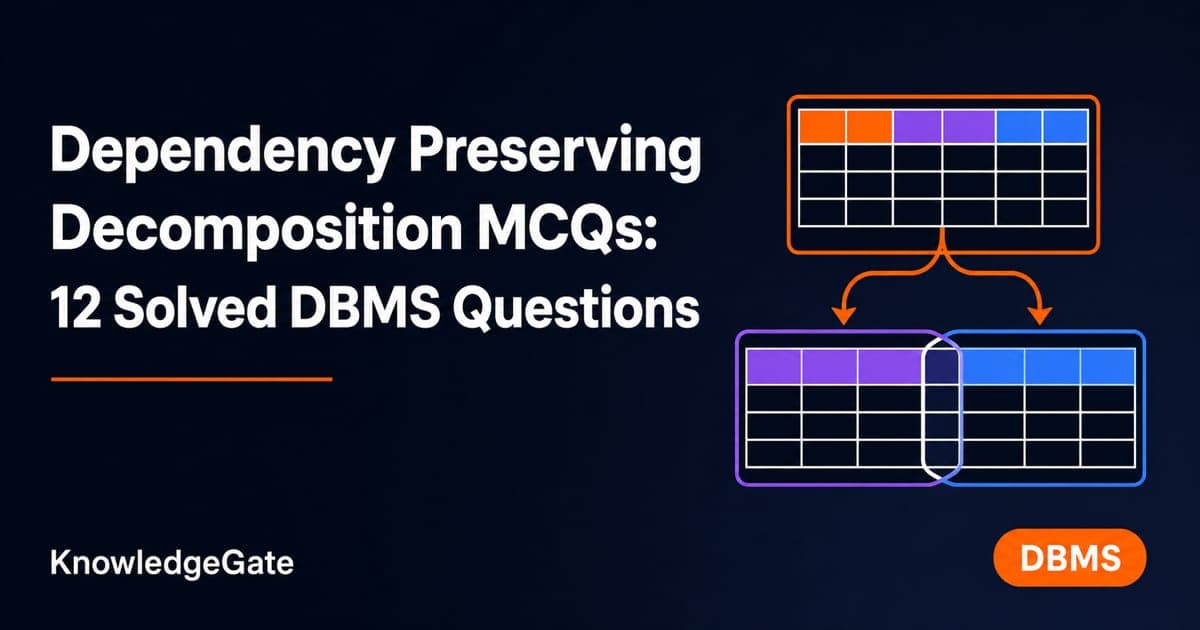
Dependency preservation and lossless join are separate tests, but MCQ distractors often swap their conditions or assume that a BCNF decomposition guarantees both. A decomposition can keep every functional dependency locally enforceable and still lose rows on the natural join, and the standard BCNF decomposition is always lossless yet can leave a dependency that no single component is able to enforce. Choose an option before you read each explanation, then check which closure the explanation actually computes. KnowledgeGate has more than 30 practice questions on dependency preserving decomposition, one of the DBMS topics that repeats across GATE CS Exam Preparation.
Dependency preservation and lossless join: the two tests to keep separate
For a decomposition D = {R1, R2, ..., Rn}, project F onto every component to obtain F1, F2, ..., Fn, then form G = F1 ∪ F2 ∪ ... ∪ Fn. The decomposition is dependency preserving when every FD in F follows from G, or equivalently F ⊆ G+. Compute each original determinant's closure under G. An FD need not appear verbatim in one component if the union of projections can infer it.
For a binary decomposition of R into R1 and R2, use a separate lossless test. The join is lossless when (R1 ∩ R2) → R1 or (R1 ∩ R2) → R2 belongs to F+. Passing either test says nothing by itself about the other.
Consider R(A,B,C,D), F = {A→B, C→D}, R1(A,B) and R2(C,D). The projected union is exactly G = {A→B, C→D}, so every original FD is locally enforceable. Yet R1 ∩ R2 = ∅, so the join is lossy. Take r = {(a1,b1,c1,d1), (a2,b2,c2,d2)}. Each projection contains two rows. Their natural join is a Cartesian product with four rows, adding (a1,b1,c2,d2) and (a2,b2,c1,d1). The decomposition therefore preserves dependencies but does not preserve the relation through a lossless join.
Under G, A+={A,B} and C+={C,D}, so both dependency checks pass. For losslessness, ∅+ = ∅ determines neither component. These calculations produce independent verdicts. Do not substitute one closure for the other.
Dependency preserving decomposition MCQs 1-3: definition, lossless condition and a lossy join
Question 1
The dependency preservation decomposition is a property to decompose database schema D, in which each functional dependency X → Y specified in F
A. appeared directly in one of the relation schemas Rᵢ in the decomposed D.
B. could be inferred from dependencies that appear in some Rᵢ.
C. both (A) and (B)
D. None of these
Answer: C. A covers direct projection and B inference under the projected union. Both preserve an original FD. See the full solution.
Question 2 (UGC NET 2008)
Suppose R is a relation schema and F is a set of functional dependencies on R. Further, suppose R₁ and R₂ form a decomposition of R. Then the decomposition is a lossless join decomposition of R provided that:
A. R₁ ∩ R₂ → R₁ is in F⁺
B. R₁ ∩ R₂ → R₂ is in F⁺
C. both R₁ ∩ R₂ → R₁ and R₁ ∩ R₂ → R₂ functional dependencies are in F⁺
D. at least one from R₁ ∩ R₂ → R₁ and R₁ ∩ R₂ → R₂ is in F⁺
Answer: D. For I = R1 ∩ R2, losslessness requires I→R1 or I→R2 in F+. One direction suffices. See the full solution.
Question 3 (UGC NET 2012)
Consider a schema R(A, B, C, D) and functional dependencies A → B and C → D. Then the decomposition R₁(A, B) and R₂(C, D) is
A. Dependency preserving but not lossless join
B. Dependency preserving and lossless join
C. Lossless Join but not dependency preserving
D. Lossless Join
Answer: A. The projections keep both FDs. Their empty intersection turns two rows per component into four joined rows, two spurious. See the full solution.
Dependency preserving decomposition MCQs 4-6: 3NF, BCNF and projected closures
Question 4 (UGC NET 2015)
Which one of the following statements about normal forms is FALSE ?
A. Lossless, dependency-preserving decomposition into 3NF is always possible
B. Lossless, dependency-preserving decomposition into BCNF is always possible
C. Any relation with two attributes is in BCNF
D. BCNF is stricter than 3NF
Answer: B. 3NF synthesis builds one relation per determinant of a minimal cover and then adds a candidate key, which is why it always reaches both properties. BCNF guarantees losslessness but may lose an FD. With two attributes, a non-trivial FD makes its determinant a key. The wider 1NF to BCNF ladder behind this statement is drilled in DBMS Normalization MCQs. See the full solution.
Question 5 (GATE IT 2008)
Let R (A, B, C, D) be a relational schema with the following functional dependencies: A → B, B → C, C → D and D → B. The decomposition of R into (A, B), (B, C), (B, D)
A. gives a lossless join, and is dependency preserving
B. gives a lossless join, but is not dependency preserving
C. does not give a lossless join, but is dependency preserving
D. does not give a lossless join and is not dependency preserving
Answer: A. B+ = C+ = D+ = {B,C,D}. Join (A,B) to (B,C) using B→C, then add (B,D) using B→D. The projections recover C→D as C→B→D. See the full solution.
Question 6 (GATE 2019)
Let the set of functional dependencies F = {QR → S, R → P, S → Q} hold on a relation schema X = (PQRS). X is not in BCNF. Suppose X is decomposed into two schemas Y and Z, where Y = (PR) and Z = (QRS). Consider the two statements given below. I. Both Y and Z are in BCNF II. Decomposition of X into Y and Z is dependency preserving and lossless Which of the above statements is/are correct?
A. I only
B. Neither I nor II
C. II only
D. Both I and II
Answer: C. R→P makes Y BCNF. In Z, S+={S,Q} misses R, violating BCNF. Intersection {R} determines Y, and every original FD remains projected. See the full solution.
Dependency preserving decomposition MCQs 7-9: two ways a projected dependency disappears
A dependency drops out of the projected union G in one of two ways. Either the determinant and the attribute it determines land in different components, as Q→S does in Question 7 and B→D and E→A do in Question 9, or the determinant is itself split so that no single component ever sees all of it, as with RS→T in Question 7 and NO→P in Question 8. Both cases surface the same way: the determinant's closure under G stops short of the attribute it should reach.
Question 7
Consider the following relational schema (P,Q, R, S, T) with FD set (P→QR, RS→T, Q→S, T→P) if the relation is decomposed into R1(P,Q,R) and R2(P, S, T), which of the following is true for the given decomposition?
A. Lossless join and dependency preserving
B. Lossless but not dependency preserving
C. Lossy and dependency preserving
D. Lossy but not dependency preserving
Answer: B. {P} determines R1 through P→QR, so the join is lossless. Under the projections, Q+={Q} misses S and (RS)+={R,S} misses T. Both corresponding FDs are lost. See the full solution.
Question 8
For relation R = (L, M, N, O, P), the following dependencies hold: { M → O, NO → P, P → L, L → MN }. R is decomposed into R1 = (L, M, N, P) and R2 = (M, O). The decomposition is:
A. Lossless decomposition and dependency preserving
B. Lossless decomposition and not dependency preserving
C. Lossy decomposition and dependency preserving
D. Lossy decomposition and not dependency preserving
Answer: B. Common attribute M determines R2 through M→O, proving losslessness. The projections keep P→L, L→MN and M→O, but (NO)+={N,O} misses P. See the full solution.
Question 9
Consider a relation R(ABCDE) with the FD set F = {A→BC, CD→E, B→D, E→A} decomposed into D={ABC, CDE}. Which of the following is true regarding the decomposition D?
A. It is lossless but not dependency preserving
B. It is lossy but dependency preserving
C. It is neither lossless nor dependency preserving
D. It is both lossless and dependency preserving
Answer: C. The intersection is {C}, and C+={C} determines neither component. The projected union also derives neither B→D nor E→A, so both tests fail. See the full solution.
Dependency preserving decomposition MCQs 10-12: combined closure and BCNF trade-offs
Question 10
Given R(A,B,C,D) with FDs F = {AB→CD, C→A, B→D} is decomposed into R1(A,B,C) and R2(B,C,D) then which of the following statements is true about decomposition of R?
A. Lossless and Not Dependency preserving
B. Lossless and Dependency preserving
C. Lossy and Dependency preserving
D. Lossy and Not dependency preserving
Answer: B. The intersection is {B,C}. Using C→A and B→D, (BC)+={A,B,C,D}, proving losslessness. The projections keep C→A, AB→C and B→D, which together recover AB→CD. See the full solution.
Question 11 (UGC NET 2024)
Which of the following relations can not be decomposed in to BCNF with a lossless join and dependency-preserving decomposition?
A. R(V, W, X, Y, Z) {VW→X, WX→V, VX→W, W→Y, Y→Z}
B. R(V, W, X, Y) {VW→W, X→Y}
C. R(V, W, X, Y) {VW→X, X→VY}
D. R(V, W, X, Y, Z) {VW→X, X→Y, Y→Z, Z→V}
Answer: C. VW is a key, while X+={X,V,Y} misses W, so X→VY violates BCNF. Decomposition into XVY and XW is lossless, but its projections cannot recover VW→X, because any component holding V, W and X also carries X→V with X short of a superkey there. Option D repeats that defect behind a longer cycle, since X+={X,Y,Z,V} also misses W. C is the official key, and D is a second relation with the identical failure. Spotting the violating determinant itself, relation by relation, is drilled in Boyce-Codd Normal Form (BCNF) MCQs. See the full solution.
Question 12
You are given the following set of functional dependencies for a relation R(A,B,C,D,E,F), F = {AB → C, DC → AE, E → F }. i. Is this relation in BCNF? ii. Is the decomposition (A,B,C,D) (B,C,D,E,F) a dependency preserving decomposition?
A. i: Yes, ii: Yes
B. i: Yes, ii: No
C. i: No, ii: No
D. i: No, ii: Yes
Answer: D. AB+={A,B,C}, DC+={A,C,D,E,F} and E+={E,F} miss attributes, so BCNF fails. Projected DC→A and DC→E recover DC→AE; the other FDs also remain local. See the full solution.
A four-line check for decomposition questions
Write each component's projected FDs and union them as G. For every original X→Y, verify Y ⊆ X+ under G. Run the lossless test separately. Check BCNF last.
This order blocks three traps: treating an empty intersection as harmless, requiring an FD to appear verbatim, and assuming BCNF preserves dependencies. Redo Questions 3, 7, 9 and 11 without looking, writing out every closure before you compare the options. Use Normalization in DBMS: 1NF to BCNF for concepts and GATE Guidance by Sanchit Sir for GATE CS study.
In short: preserve dependencies by proving F ⊆ G+, prove losslessness with the join criterion, and never merge the two verdicts.
Keep learning
Tuple Relational Calculus (TRC) MCQs: 12 Solved Questions on Queries, Quantifiers and Safety
Practise 12 TRC questions with worked explanations, concrete tuple traces, implication checks, division, query interpretation and safety conventions.
25 Oct 20268 min readDBMS MCQs

Set Operations and Cartesian Product MCQs: 12 Solved Relational Algebra Questions
Solve 12 relational algebra MCQs on Cartesian products, set difference, identities, referential integrity, aggregation and division. Each answer shows the decisive reasoning step.
24 Oct 20267 min readDBMS MCQs

Safety of Expressions & Power MCQs: 10 Solved Relational Calculus Questions
Practise the active-domain test, De Morgan rewrites and the equivalence of relational algebra, safe TRC and safe DRC through ten fully explained questions.
Updated 20 Oct 20268 min readDBMS MCQs

Introduction to Query Languages MCQs: 8 Solved MCQs and 2 Concept Checks
Attempt eight published query-language MCQs, check each answer with a focused explanation, then use two written prompts to test recall of relational algebra.
Updated 16 Oct 20267 min readDBMS MCQs