C Data Type Fundamentals MCQs: 12 Solved Questions with Explanations
Attempt 12 C data-type MCQs, then check concise explanations, two worked output traces, and an honest note about one ambiguous option.
KnowledgeGate Team
Exam prep & CS education
Updated 28 Jul 20267 min read68 views
C data-type questions often look like simple recall, but they mix specifier grammar, implementation-dependent widths, literal suffixes, character codes, promotions, and format behaviour. Miss any one of those and a one-mark question becomes a guess. Three of the 12 below are past questions, from GATE 2022, UGC NET 2022 and Coal India 2017. Attempt each one before reading its explanation, and treat every option you reached by elimination as a rule you still owe yourself a revision on.
If the ground underneath this set is still shaky, what C is, which identifiers are legal, and which types exist at all, clear the solved intro and data types MCQs first. When you want a structured route through the subject rather than practice alone, browse Coding & Skills courses.
C data type fundamentals: five rules to keep beside the MCQs
Question cue | Rule | Common trap |
|---|---|---|
| It means | Calling it a signed |
Plain | Its type is | Assuming every decimal constant is |
Floating suffix |
| Combining suffixes as |
| It reports bytes and has type | Letting the stored value affect the size |
|
| Reporting the numeric code instead |
C does not make int universally 2 or 4 bytes. If a stem supplies a width, use it. If it does not, do not guess. Question 6 explicitly says that int occupies 4 bytes, while Question 5 asks for the portable, implementation-dependent answer.
For code questions, first write each literal's base or each character's numeric code. Perform the arithmetic or bitwise operation next, then apply the printf conversion. Recognising 015 as octal and 0x71 as hexadecimal is easier after revising number systems and base conversions.
Integer families, shorthand declarations, and signedness traps
Question 1. Integral type
Which of the following is integral data type?

1. void
2. char
3. float
4. double
Answer: option 2, char. C places char, signed and unsigned integer types, and enumerated types in the integer family. float and double are floating types, while void represents no value and is not an integral type.
Question 2. unsigned shorthand
This question appeared in Coal India 2017.
The data type of the variable “var1” declared in the following ‘C’ language statement is:
unsigned var1;

1. int
2. double
3. char
4. float
Answer: option 1, int. Expand the declaration to unsigned int var1;. When unsigned appears without char, short, long, or another integer type specifier, int is implied. The full type remains unsigned int, not plain signed int.
Question 3. Signed versus unsigned range
This question appeared in UGC NET 2022.
Which of the following statements about data types is wrong?

1. The number is always positive when the qualifier 'unsigned' is used.
2. The number can be positive or negative when the qualifier 'signed' is used.
3. The range of values for signed data types is more than that of unsigned data types.
4. The leftmost bit in an unsigned data type is used to represent the value.
Answer key: option 3. In a typical 8-bit comparison, unsigned spans 0 to 255, while signed two's-complement spans -128 to 127. Unsigned uses every bit for the value, so its non-negative maximum is larger.
Read option 1 carefully before you move on. It says the number is always "positive" under unsigned, yet zero is a valid unsigned value and zero is not positive, so "non-negative" would have been the precise word. Option 1 is therefore loosely worded as well, and option 3 is the intended answer rather than the only false sentence on the list. When a paper leaves you two imperfect statements, pick the one that is wrong about the concept under test, which here is range.
Data-type ranges and sizeof questions
Question 4. Minimum of unsigned char
What is the minimum value that an unsigned char data type can hold in C?

1. 0
2. -128
3. -256
4. 1
Answer: option 1, 0. An unsigned integer type has no negative values, and zero is included. Its maximum depends on CHAR_BIT, but its minimum remains zero. This also shows why "positive" was imprecise in Question 3.
Question 5. Minimum value of int
What is the minimum value that an int data type can hold in C?

1. It depends on the compiler and system
2. -32768
3. 0
4. -2147483648
Answer: option 1. A 16-bit two's-complement int has minimum -32768, while a 32-bit two's-complement int has minimum -2147483648. The stem gives no width, so neither numeric option is portable.
Question 6. sizeof with a stated width
What will be the output of the following C code? Assume that an int occupies 4 bytes.
int main()
{
    int a = 45;
    int i = sizeof(a);
    printf("%d", i);
}

1. 1
2. 6
3. 2
4. 4
Answer: option 4, 4. Variable a has type int, and the stem fixes sizeof(int) at 4 bytes. Therefore sizeof(a) yields 4, that value is assigned to i, and %d prints 4. The stored value 45 does not change the type's storage size.
Type-specifier grammar and floating-constant suffixes
Question 7. Valid type-specifier combination
In the context of C data types, which of the followings is correct?

1. “unsigned long long int” is a valid data type.
2. “long long double” is a valid data type
3. “unsigned long double” is a valid data type.
4. Above all are valid data types.
Answer: option 1. long long and unsigned are valid integer specifiers, so unsigned long long int is legal. long long double incorrectly mixes an integer-family specifier with double, and floating types cannot be unsigned.
Question 8. long double constant
Which of the following correctly represents a long double constant?

1. 6.68
2. 6.68L
3. 6.68f
4. 6.68LF
Answer: option 2, 6.68L. Plain 6.68 is double, 6.68f is float, and 6.68L is long double. LF is not a combined floating suffix. Lowercase l is permitted, but uppercase L is easier to distinguish from digit 1.
Question 9. Default real-number type
In C, by default, a real number is treated as a ____

1. float
2. double
3. long double
4. far double
Answer: option 2, double. Without a suffix, the literal 6.68 has type double. Use 6.68f for float and 6.68L for long double. far double is not a standard C type.
Character values, integer operations, and library return types
Question 10. Character arithmetic and bitwise output
This question appeared in GATE 2022.
What is printed by the following ANSI C program?
    #include<stdio.h>
    int main(int argc, char *argv[]){
         char a = 'P';
         char b = 'x';
         char c = (a & b) + '*';
         char d = (a | b) - '-';
         char e = (a ^ b) + '+';
         printf("%c %c %c\n", c, d, e);
        return 0;
    }
ASCII encoding for relevant characters is given below
A B C ... Z
65 66 67 ... 90
a b c ... z
97 98 99 ... 122
* + -
42 43 45

1. z K S
2. 122 75 83
3. * - +
4. P x +
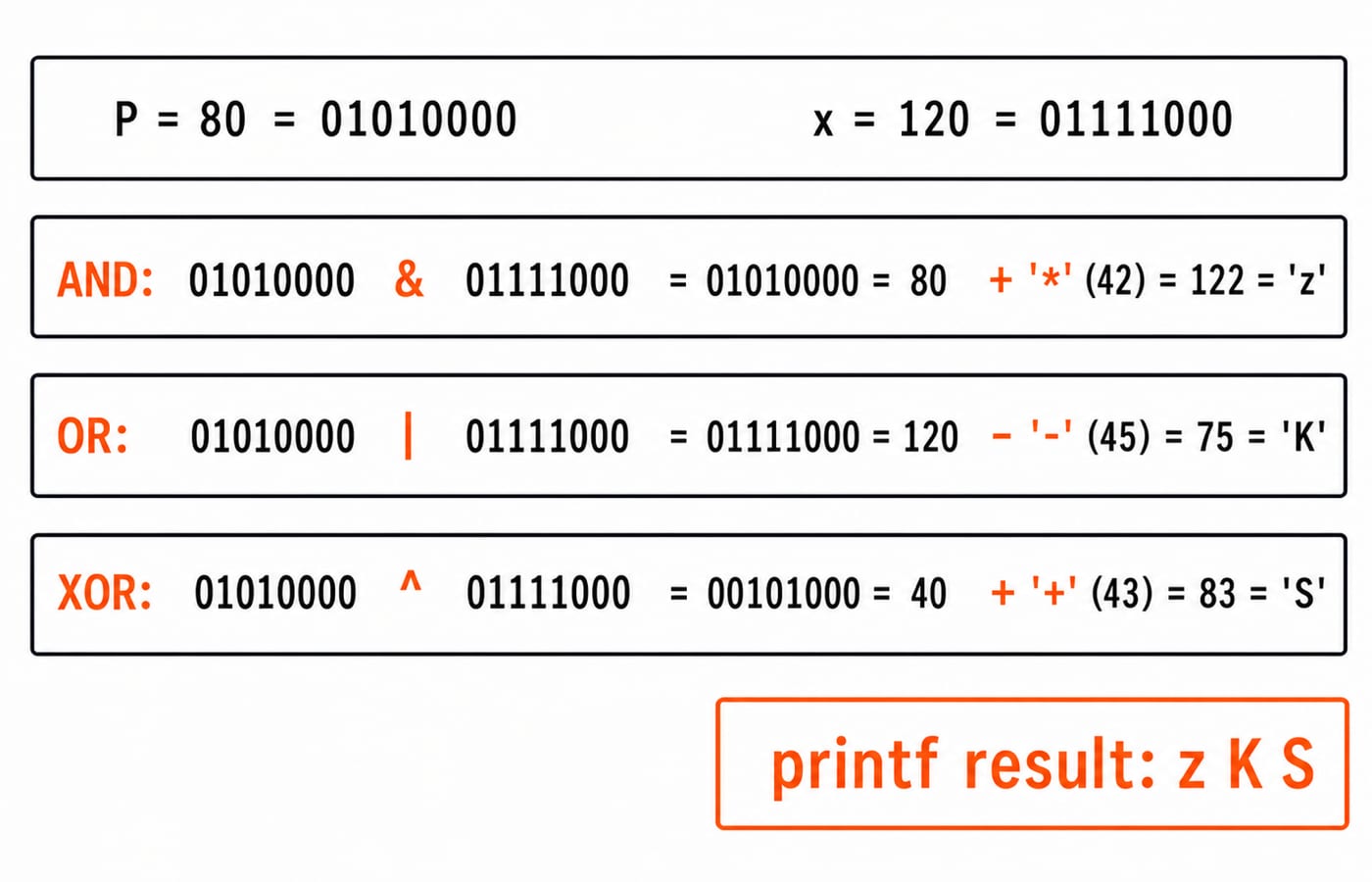
Answer: option 1, z K S. Start with 'P' = 80 = 01010000₂ and 'x' = 120 = 01111000₂.
AND:
80 & 120 = 80; then80 + 42 = 122, the code for'z'.OR:
80 | 120 = 120; then120 - 45 = 75, the code for'K'.XOR:
80 ^ 120 = 40; then40 + 43 = 83, the code for'S'.
The conversion %c prints characters rather than decimal codes, so the output is z K S.
Question 11. Return type of getchar
What is the return type of getchar()?

1. int
2. char
3. unsigned char
4. float
Answer: option 1, int. getchar() must represent every possible unsigned char value and the distinct sentinel EOF. On a common implementation, a byte value such as 255 and EOF such as -1 must remain distinguishable, which a plain char return type cannot guarantee.
Decimal, octal, and hexadecimal integer constants
Question 12. Mixed-base constant addition
What will be output of the following program?
#include<stdio.h>
int main(){
                int a;
                a=015 + 0x71 +5;
                printf("%d",a);
                return 0;
}

1. 127
2. 130
3. 131
4. None of these
Answer: option 3, 131. Convert before adding: octal 015 = 1 x 8 + 5 = 13, hexadecimal 0x71 = 7 x 16 + 1 = 113, and decimal 5 remains 5. Therefore 13 + 113 + 5 = 131. The %d conversion prints that integer in decimal.
What these 12 C data-type MCQs are testing, and what to do next
Questions 1 to 3 test classification and signedness. Questions 4 to 6 test ranges and storage assumptions. Questions 7 to 9 test legal specifiers and literal suffixes. Questions 10 and 11 test character values, integer operations, and library return types. Question 12 tests literal bases.
For every miss, revise the rule rather than memorising the option, then attempt the question again without viewing the choices. Keep this final checklist beside you:
Never assume the width of
int.Treat bare
unsignedasunsigned int.Remember that zero belongs to unsigned ranges.
Read literal suffixes before calculating.
Separate numeric character codes from
%coutput.Convert octal and hexadecimal constants before decimal addition.
If you need the full sequence with concept teaching and MCQ practice, continue with the C Language Course. If you are preparing across C, C++, Java, Python, and coding rounds, Coding for Placements is the broader route.
Keep learning
Stack Basics and Operations MCQs: 12 Solved Questions with Step-by-Step Explanations
Test stack fundamentals through 12 exam MCQs on LIFO, TOP, array bounds, queue transfers and permutations. Complete traces make every state and answer checkable.
Updated 3 Oct 20268 min readData Structures MCQs
Evaluation of Expressions MCQs: 12 Solved Questions with Stack Traces
Solve 12 expression MCQs step by step. Trace postfix and prefix evaluation, nesting depth, precedence and notation conversion without reversing operands.
Updated 27 Sep 20267 min readData Structures MCQs
Priority Queue MCQs: 12 Solved Questions on Heaps, Deques and Variants
Attempt 12 verified priority queue and queue-variant MCQs, then learn from concise heap, array, circular queue and deque traces.
Updated 25 Sep 20267 min readData Structures MCQs
Infix, Postfix and Prefix MCQs: 12 Solved Questions with Step-by-Step Explanations
Solve 12 expression-notation MCQs in increasing difficulty, from basic stack use to conversions, associativity and maximum operand-stack depth.
Updated 24 Sep 20268 min read53 viewsData Structures MCQs