

Computer Network Basics and Criteria: Performance, Reliability, Security and Worked Examples
Build a precise model of how networks deliver data, then calculate delay, throughput and availability without confusing the three quality criteria.
KnowledgeGate Team
Exam prep & CS education
Updated 15 Nov 20266 min read

Knowing that a network connects devices is only the start. Questions become difficult when bandwidth is confused with throughput, availability is treated as a synonym for reliability, or security is mistaken for speed. A packet may reach its destination while the network still performs poorly, fails too often or exposes data. These distinctions matter in statement-based and numerical questions.
Computer network basics: what is connected and why
A computer network connects two or more autonomous devices to exchange data and share resources under agreed rules. An end device, or host, creates or consumes data. An intermediary node, such as a switch or router, moves it.
A link carries signals between interfaces. A packet is a formatted data unit; a path is the sequence it follows. A protocol defines message format, order and expected action.
When a laptop requests a remote file, the laptop and server are hosts, each network attachment is an interface, and packets cross intermediary nodes. The connection is useless unless both ends follow compatible protocols.
Connectivity tells us whether communication is possible. Performance, reliability and security tell us how well the network serves the user. Use Introduction to Computer Networks for layers, topologies, switching and the introductory delay formula. The three criteria add a separate test: how quickly data arrives, how well service survives failure and whether data and access are protected.
From application data to delivery: the smallest useful model
A request passes from the source application through the protocol stack, where headers guide communicating layers. The network interface places it on a link, intermediary devices move it, and the destination interface delivers it to the correct application.
Four jobs should remain separate:
Addressing identifies endpoints and networks.
Forwarding sends a packet through the appropriate next interface.
Routing chooses a path through the network.
Transport provides application-to-application delivery, with service properties determined by the chosen protocol.
Compare transport choices in TCP vs UDP: Transport Layer Explained. IP Addressing and Subnetting Explained connects addresses to networks and hosts. Path choice differs from link speed.
The three network criteria: performance, reliability and security
Performance needs measurable quantities. Bandwidth, or capacity, is a link's maximum rate. Throughput is the achieved rate and cannot exceed the path bottleneck. Response time is the wait for a result. Jitter is delay variation.
Packet delay may include:
transmission delay while placing all data bits onto a link
propagation delay while a signal crosses the link
queueing delay while data waits
processing delay while a device handles data
The core formulas are:
Transmission delay = data size in bits / link rate in bits per second
Propagation delay = distance / propagation speed
Reliability concerns failure frequency, consistent delivery, recovery time and resilience. Availability is one summary:
Availability = uptime / total observed time x 100
Availability is evidence about reliability, not a synonym. Failure impact and resilience also matter.
Security centres on confidentiality, integrity and availability. Eavesdropping threatens confidentiality, alteration threatens integrity, and flooding threatens availability. Authentication checks identity; authorisation decides what that identity may do.
Worked example: calculate performance without mixing the delays
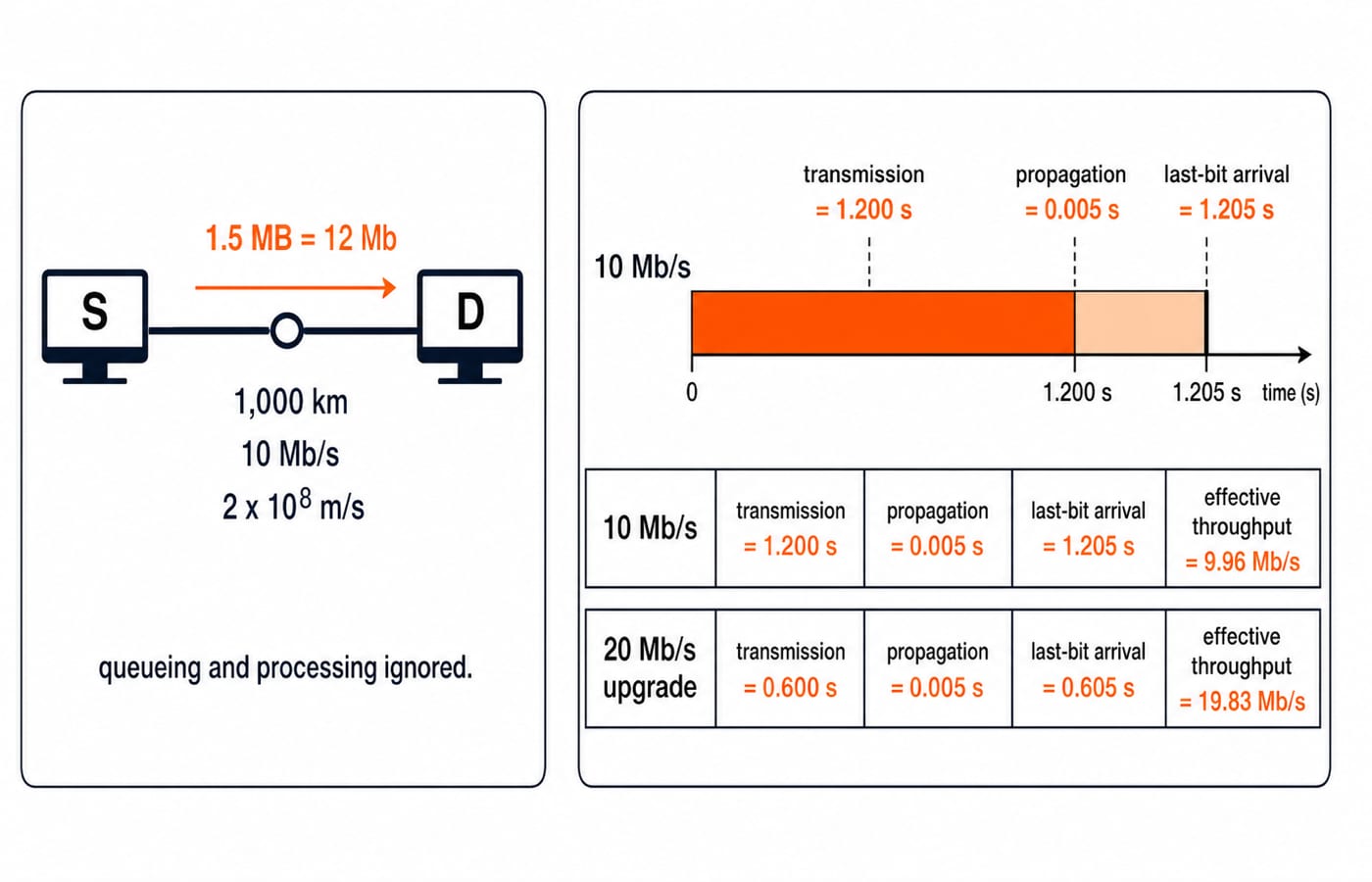
Source S sends a decimal 1.5 MB file to destination D over one 1,000 km point-to-point link. The link rate is 10 Mb/s and the propagation speed is 2 x 10^8 m/s. Ignore queueing and processing.
Convert the units first:
1.5 MB x 8 = 12 Mb1,000 km = 1,000,000 m
Now calculate each delay separately:
Transmission delay =
12 Mb / 10 Mb/s = 1.200 s.Propagation delay =
1,000,000 m / (2 x 10^8 m/s) = 0.005 s = 5 ms.The first bit arrives after 5 ms. The last bit arrives after
1.200 + 0.005 = 1.205 s.Effective file throughput =
12 Mb / 1.205 s = 9.9585 Mb/s, or about 9.96 Mb/s.
Dividing file size by link rate gives transmission delay, not propagation delay. Propagation depends on distance and signal speed, so it affects even the first bit.
If the link is upgraded to 20 Mb/s on the same path:
Transmission delay =
12 / 20 = 0.600 s.Propagation delay remains
0.005 s.Last-bit arrival =
0.600 + 0.005 = 0.605 s.Effective throughput =
12 / 0.605 = 19.8347 Mb/s, or about 19.83 Mb/s.
The upgrade halves the transmission component. It does not change the distance-dependent propagation component.
Reliability calculation and security controls
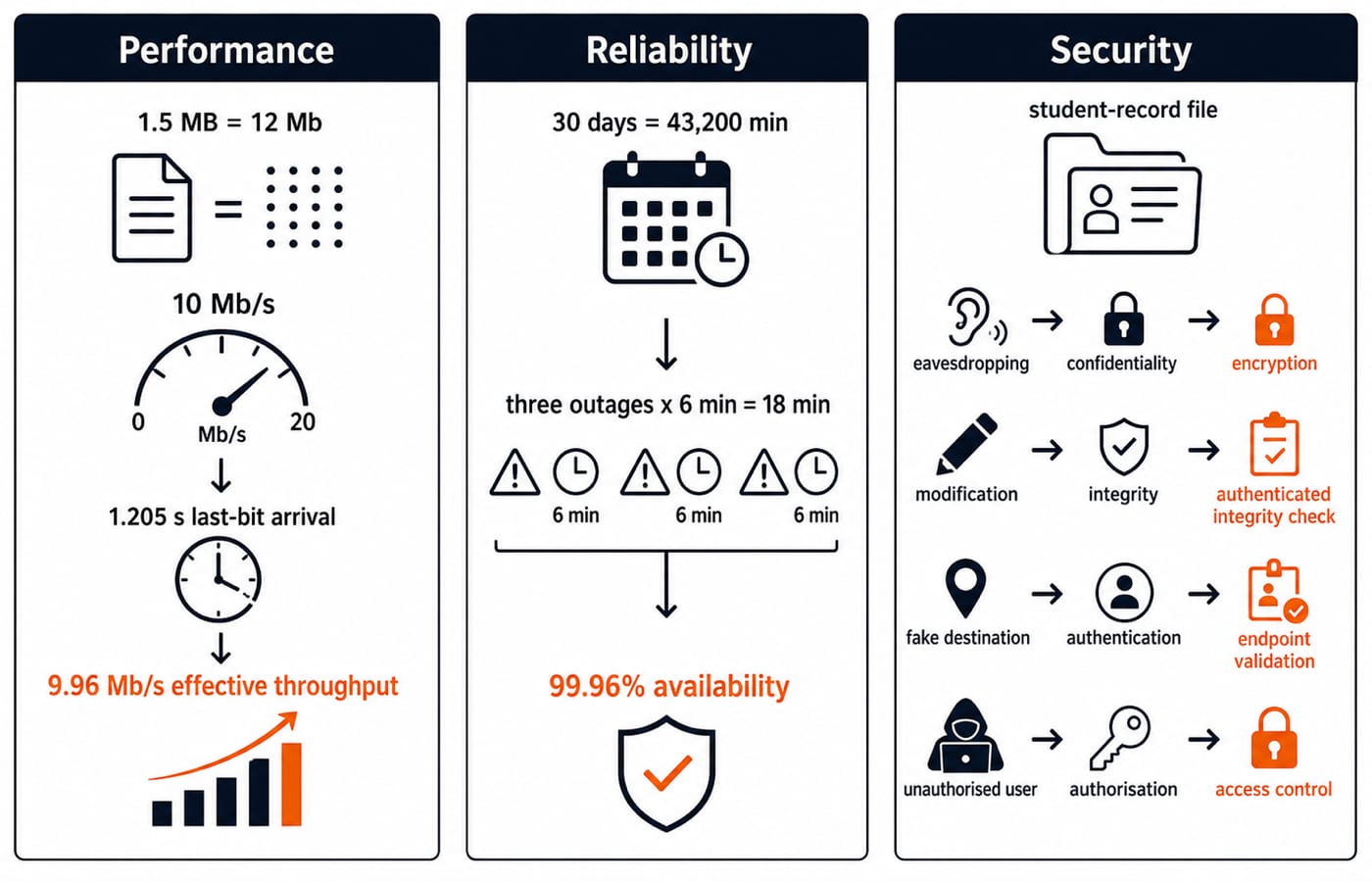
Observe the service for 30 days. That is 30 x 24 = 720 hours, or 720 x 60 = 43,200 minutes. There are three outages of 6 minutes each.
Downtime =
3 x 6 = 18 minutes.Uptime =
43,200 - 18 = 43,182 minutes.Availability =
43,182 / 43,200 x 100 = 99.9583%, rounded to 99.96%.Mean repair time for these equal incidents =
18 / 3 = 6 minutes.
That percentage alone says nothing about failure impact, alternate paths or service continuity during an incident.
Now treat the file as a student-record export. Encryption in transit protects confidentiality from eavesdropping. Authenticated encryption and integrity verification reveal modification. Certificate or endpoint validation addresses a fake destination. Access control stops an authenticated but unauthorised user.
Higher capacity does not repair weak access control, and encryption does not create an alternate path after router failure. A sound design needs all three criteria.
Traps that turn easy questions into wrong answers
Confused terms | Correct distinction |
|---|---|
Bandwidth vs throughput | Bandwidth is supported capacity; throughput is the achieved rate. |
Transmission vs propagation delay | Transmission depends on data size and rate; propagation depends on distance and signal speed. |
Reliability vs availability | Reliability is the wider behaviour around failure and recovery; availability is one measurable summary. |
Security availability vs network reliability | Security availability protects authorised access to service; reliability covers dependable operation and recovery more broadly. |
Authentication vs authorisation | Authentication checks who an entity is; authorisation checks what it may do. |
Communication characteristics vs network criteria | Delivery, accuracy, timeliness and jitter describe effective data communication; performance, reliability and security evaluate the network. |
Correct these false statements:
Doubling bandwidth always halves total delay. False, because other delays may remain.
High bandwidth guarantees high throughput. False, because bottlenecks or congestion can limit it.
Encryption alone makes a system secure. False, because other controls still matter.
Availability of 99.96% describes all reliability. False, because it is one measurement over one observation period.
Convert bytes to bits and kilometres to metres before substitution. Keep bit units consistent; convert seconds to milliseconds after calculating. Here, MB and Mb are decimal units, so do not reinterpret 1.5 MB as 1.5 MiB.
Exam patterns and key points
Recurring forms include definitions, match-the-column items, statement elimination, delay or availability calculations, and scenarios asking which security property failed. Before touching the options, name the tested criterion and write the units or formula.
Keep five lines in mind:
A network needs devices, links and protocols.
Performance measures service rate and delay.
Reliability covers failures, recovery and resilience.
Security protects data, identity, permissions and service.
Formulas become dependable only after unit conversion.
Redo the 10 Mb/s calculation, then change the file to 3 MB and predict which terms double. For adjacent notes, use the CS Fundamentals category. For structured interview revision, continue with Computer Science Fundamentals for Placements.
Keep learning

Network Security and Cryptography in Computer Networks: How Ciphers, Key Exchange, and TLS Actually Work
Cipher internals for computer networks: ECB vs CBC block modes, HMAC construction, square-and-multiply RSA, a Diffie-Hellman man-in-the-middle, and TLS.
Updated 2 Sep 202611 min read72 viewsComputer Networks

Firewall, VPN, IDS and IPS MCQs: 11 Network Security Questions Solved
Solve 11 previous-year questions on firewalls, VPNs, IDS and IPS. Learn rule filtering, connection state, DMZ design, IPsec modes, tunnels and signatures.
Updated 24 Sep 20267 min read96 viewsComputer Networks MCQs

Network Security Goals, Threats and Attacks MCQs: 12 Solved Questions
Solve 12 network-security MCQs covering confidentiality, integrity, attack types, spoofing, DDoS and protection properties. Every answer has a clear explanation and a link to practise the question again.
Updated 29 Oct 20267 min read109 viewsComputer Networks MCQs

Computer Networks Basics & Criteria MCQs: 12 Solved Questions with Explanations
Solve 12 Computer Networks questions, then use clear explanations and worked criteria checks to separate similar terms confidently.
Updated 29 Oct 20268 min read53 viewsComputer Networks MCQs