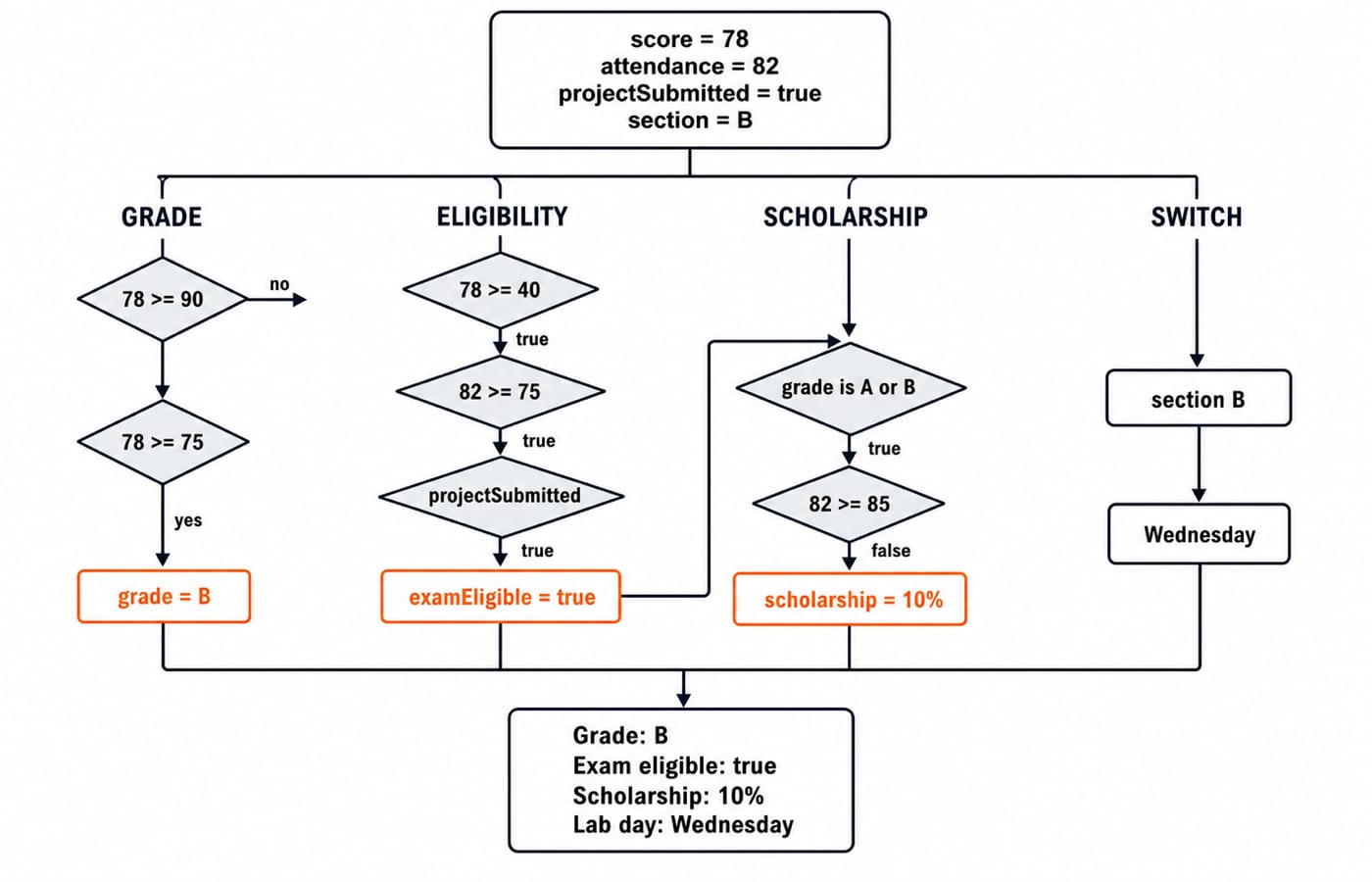
Java programs run sequentially until a decision sends execution down one branch. With score 78, attendance 82, a submitted project and section B, Boolean checks resolve to grade B, exam eligibility, a 10% scholarship and a Wednesday lab.
1. What conditionals do in a Java program
A conditional selects a path. Use if for a one-way action, if-else for two paths, an ordered else-if ladder for ranges, and nested if for a dependent decision. Use switch for discrete alternatives and condition ? value1 : value2 for a short expression.
The example inputs are:
int score = 78;
int attendance = 82;
boolean projectSubmitted = true;
char section = 'B';
First predict grade B, eligibility true, scholarship 10%, and lab day Wednesday. For guided beginner courses across subjects, browse Free Courses for GATE, Placements & CS.
2. Build conditions from comparisons and Boolean operators
Comparisons produce Booleans. Here, score > 40 and score >= 40 are true, attendance < 75 is false, and attendance <= 82 is true. Use == for equality (section == 'B') and != for inequality (score != 0).
Eligibility score >= 40 && attendance >= 75 && projectSubmitted becomes true && true && true. After grading, grade.equals("A") || grade.equals("B") becomes false || true, while !projectSubmitted is false.
Java short-circuits && and ||. Here the first operand is false, so 100 / 0 is never evaluated:
int denominator = 0;
if (denominator != 0 && 100 / denominator > 2) {
    System.out.println("Valid ratio");
}
Propositional and Predicate Logic: Truth Tables to Proofs provides the Boolean foundation for Java's &&, || and ! expressions.
3. Start with if and if-else
int score = 78;

if (score >= 40) {
    System.out.println("Pass");
} else {
    System.out.println("Fail");
}
The output is Pass because 78 >= 40 -> true; the else block is skipped. At the boundary, 40 prints Pass and 39 prints Fail.
A one-way if (score == 100) { System.out.println("Perfect score"); } prints nothing for 78. Use if-else for two actions. An if condition must be boolean or Boolean; an integer such as 78 is not truthy. Java Language Specification, Chapter 14 defines both if and switch, while switch uses its own supported selector types. Keep braces around single statements.
4. Choose one range with an ordered else-if ladder
String grade;

if (score >= 90) {
    grade = "A";
} else if (score >= 75) {
    grade = "B";
} else if (score >= 60) {
    grade = "C";
} else if (score >= 40) {
    grade = "D";
} else {
    grade = "F";
}

System.out.println("Grade: " + grade);
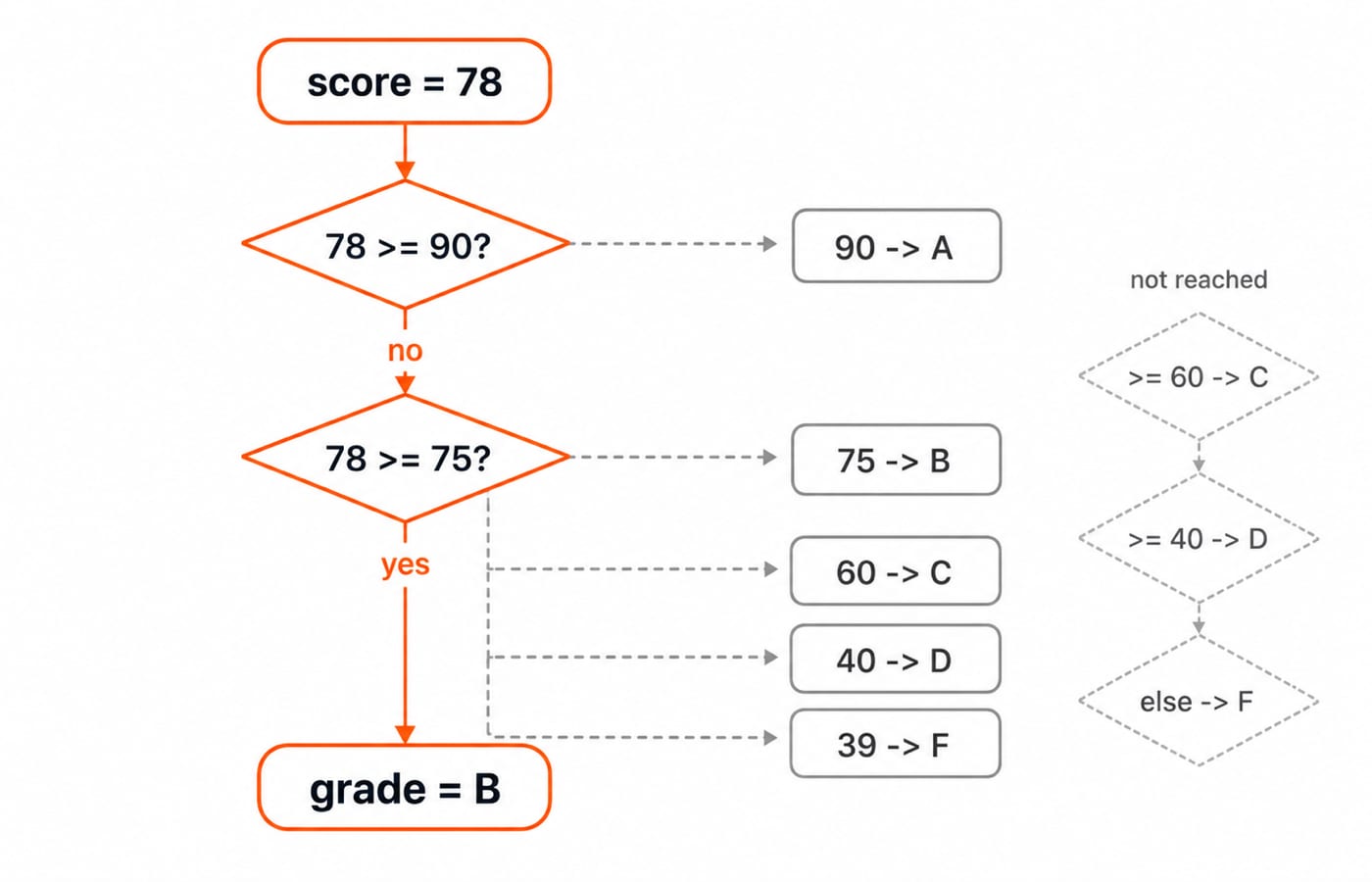
The output is Grade: B: Java rejects 78 >= 90, accepts 78 >= 75, and stops. Testing score >= 40 first would classify 78 as D. Boundaries are 90 -> A, 89 -> B, 75 -> B, 74 -> C, 40 -> D, and 39 -> F. One branch runs.
For a simple choice, String result = score >= 40 ? "Pass" : "Fail"; assigns Pass. Do not hide a five-grade decision inside nested ternaries; its order is harder to inspect.
5. Combine conditions and nest only when the second decision depends on the first
boolean examEligible = score >= 40 && attendance >= 75 && projectSubmitted; reduces to true && true && true. If attendance becomes 74, the middle comparison makes the result false.
After calculating the grade, add the dependent scholarship decision:
int scholarshipPercent = 0;

if (examEligible && (grade.equals("A") || grade.equals("B"))) {
    if (attendance >= 85) {
        scholarshipPercent = 20;
    } else {
        scholarshipPercent = 10;
    }
}

System.out.println("Exam eligible: " + examEligible);
System.out.println("Scholarship: " + scholarshipPercent + "%");
The outputs are Exam eligible: true and Scholarship: 10%. The outer condition succeeds; 82 >= 85 fails, selecting 10. False eligibility would preserve the initial 0.
Combine independent checks with Boolean operators. Nest only when the inner question depends on the outer result. In larger programs, guard clauses or extracted methods reduce deep nesting.
6. Use switch for discrete alternatives and run the complete example
char section = 'B';

String labDay = switch (section) {
    case 'A' -> "Monday";
    case 'B' -> "Wednesday";
    case 'C' -> "Friday";
    default -> "Unassigned";
};

System.out.println("Lab day: " + labDay);
Selector 'B' matches the Wednesday rule, so the output is Lab day: Wednesday. Switch expressions use case ... -> rules without classic fall-through; colon-style switch statements need break to stop fall-through.
The program combines grading, eligibility, scholarship, and lab-day selection:
public class ConditionalsDemo {
    public static void main(String[] args) {
        int score = 78;
        int attendance = 82;
        boolean projectSubmitted = true;
        char section = 'B';

        String grade;
        if (score >= 90) {
            grade = "A";
        } else if (score >= 75) {
            grade = "B";
        } else if (score >= 60) {
            grade = "C";
        } else if (score >= 40) {
            grade = "D";
        } else {
            grade = "F";
        }

        boolean examEligible = score >= 40
                && attendance >= 75 && projectSubmitted;
        int scholarshipPercent = 0;
        if (examEligible && (grade.equals("A") || grade.equals("B"))) {
            if (attendance >= 85) {
                scholarshipPercent = 20;
            } else {
                scholarshipPercent = 10;
            }
        }

        String labDay = switch (section) {
            case 'A' -> "Monday";
            case 'B' -> "Wednesday";
            case 'C' -> "Friday";
            default -> "Unassigned";
        };

        System.out.println("Grade: " + grade);
        System.out.println("Exam eligible: " + examEligible);
        System.out.println("Scholarship: " + scholarshipPercent + "%");
        System.out.println("Lab day: " + labDay);
    }
}
It prints, in order:
Grade: B
Exam eligible: true
Scholarship: 10%
Lab day: Wednesday
A colon-style switch needs break after each action. With int code = 2, cases printing B, C, then D, omitted breaks produce BCD; breaks produce B. Use switch for a discrete selector and if-else for ranges or compound rules.
7. Common errors and how exams or interviews test conditionals
Frequent mistakes include:
if (score = 78)assigns anintand does not compile; usescore == 78.if (score >= 40);ends with an empty statement, so the next block runs unconditionally; remove the semicolon.An ascending ladder starting at
score >= 40gives 78 the wrong gradeD; test higher thresholds first.new String("A") == "A"is false because==compares references; use.equals("A").Omitting braces makes later edits risky; keep braces.
A classic
switchwithoutbreakfalls through, so case 2 can printBCD; add the required breaks.
Practise predicting output. The ladder gives C for 74. Changing attendance to 74 makes eligibility false and leaves scholarship at 0%. In int x = 8, y = 4; if (x > 5) if (y > 5) System.out.print("A"); else System.out.print("B");, the output is B because else associates with the nearest unmatched if.
Assessments ask you to trace branches or repair compilation, boundary and fall-through bugs. Sorting Algorithms: Complexity, Stability, n log n Bound shows the same branch logic inside comparison-based algorithms. A useful drill is to change one boundary value, predict the selected path, and then run the code.
8. Exercises, the short version and the next step
Try these exercises:
Set
cartTotal = 1200andmember = true. Delivery is free only when the cart conditioncartTotal >= 1000and membership are both true; otherwisedeliveryFeeis 99.Use conditionals to find the largest of 18, 27 and 12.
Map
dayNumber = 6withswitch: 1 to 5 meansWeekday, 6 and 7 meanWeekend, and anything else meansInvalid.Rerun the complete example with
score = 91,attendance = 88,projectSubmitted = false, andsection = 'C'.
The first three results are delivery fee 0, largest value 27, and Weekend. With score 91, attendance 88, projectSubmitted set to false, and section C, the modified program prints:
Grade: A
Exam eligible: false
Scholarship: 0%
Lab day: Friday
Use if for one-way action, if-else for two paths, else-if for ranges, nesting for a dependent follow-up, switch for a discrete selector, and ?: for a short assignment. Continue through Java syntax and object-oriented fundamentals with the Complete Java Course. Change one input, predict all outputs, then run the program.