CLR(1) Parser and Canonical LR(1) Items: Worked Closure, GOTO and Parse Table
Build a CLR(1) parser from one small grammar. Follow every closure, GOTO, table entry, and stack action until ccdd is accepted.
KnowledgeGate Team
Exam prep & CS education
Updated 29 Aug 20265 min read
An LR(1) item adds one lookahead to an LR(0) item, changing closure, state identity, and permitted reductions. A bottom-up parsing construction runs from augmentation through ACTION/GOTO to acceptance of ccdd. For the broader parser family, see Parsing in Compiler Design: Top-Down and Bottom-Up Explained.
What a CLR(1) item actually records
In [A -> alpha . beta, a], the dot records recognised input. Lookahead a controls a completed item's reduction. It need not follow the dot, and GOTO neither moves nor consumes it.
A -> alpha . beta is the LR(0) core; closure supplies lookaheads; a CLR state contains all resulting items. [C -> d ., c] reduces only on c.
Augment with S' -> S and start at [S' -> . S, $]. Only [S' -> S ., $] accepts under $.
Closure and GOTO with explicit lookaheads
For [A -> alpha . B beta, a], each B -> gamma, and b in FIRST(beta a), add [B -> . gamma, b] to a fixed point. Review First and Follow in Compiler Design: Solved Examples if needed.
GOTO moves each applicable dot across X, retains lookaheads, then closes. Terminal moves enter ACTION; non-terminal moves enter GOTO.
[S -> . C C, $] gives FIRST(C$) = {c, d}. [S -> C . C, $] has empty beta, so FIRST($) = {$}.
Build the complete canonical collection
Use (0) S' -> S, (1) S -> C C, (2) C -> c C, (3) C -> d, with FIRST(C) = {c, d}.
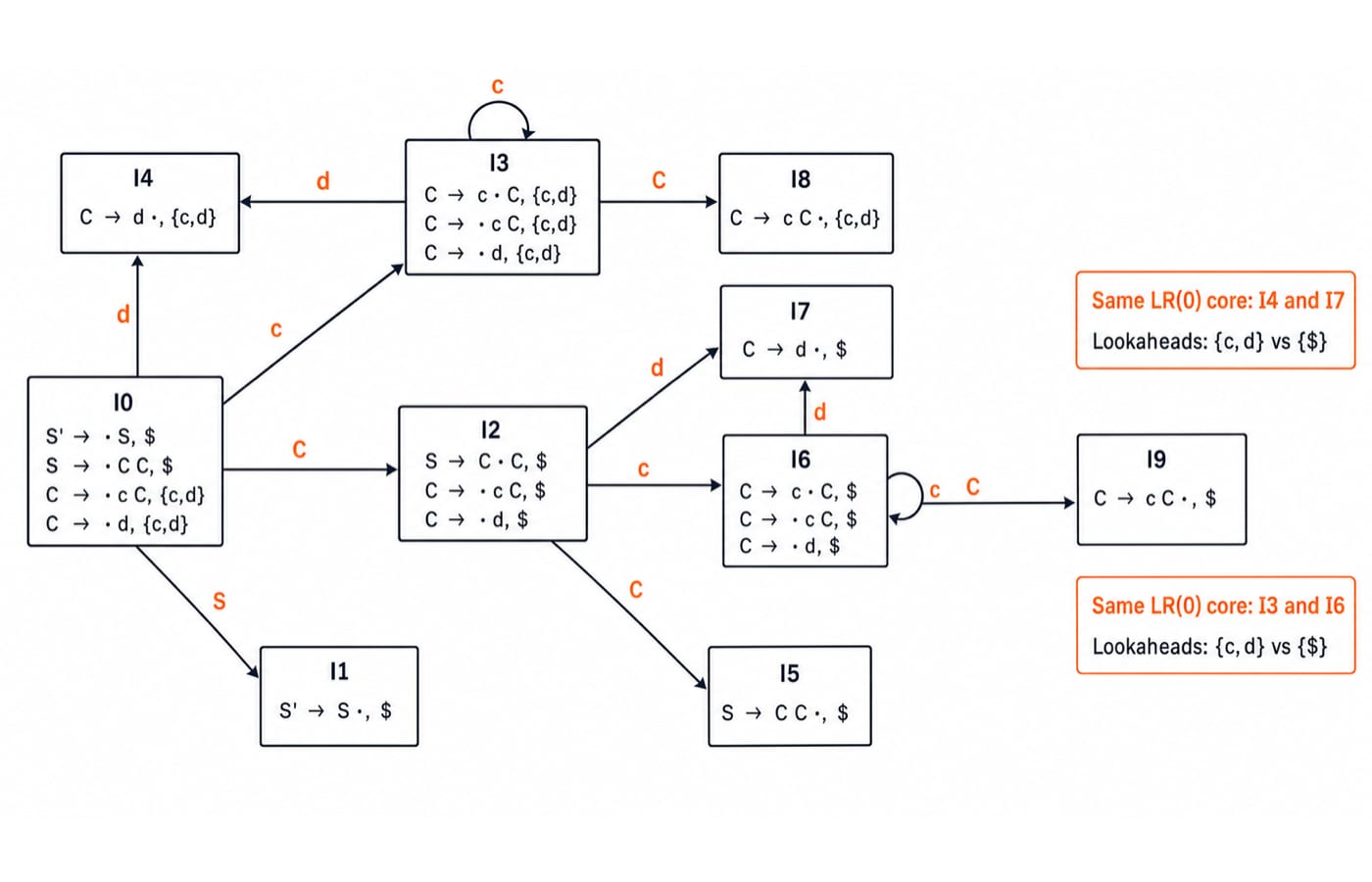
Closure adds [S -> . C C, $], then two lookaheads per C production. [C -> . c C, c] and [C -> . c C, d] remain distinct items.
I0 = {[S' -> . S, $], [S -> . C C, $], [C -> . c C, c], [C -> . d, c], [C -> . c C, d], [C -> . d, d]}I1 = {[S' -> S ., $]}I2 = {[S -> C . C, $], [C -> . c C, $], [C -> . d, $]}I3 = {[C -> c . C, c], [C -> c . C, d], [C -> . c C, c], [C -> . d, c], [C -> . c C, d], [C -> . d, d]}I4 = {[C -> d ., c], [C -> d ., d]}I5 = {[S -> C C ., $]}I6 = {[C -> c . C, $], [C -> . c C, $], [C -> . d, $]}I7 = {[C -> d ., $]}I8 = {[C -> c C ., c], [C -> c C ., d]}I9 = {[C -> c C ., $]}
The non-empty transitions are:
I0 --S--> I1,I0 --C--> I2,I0 --c--> I3,I0 --d--> I4I2 --C--> I5,I2 --c--> I6,I2 --d--> I7I3 --C--> I8,I3 --c--> I3,I3 --d--> I4I6 --C--> I9,I6 --c--> I6,I6 --d--> I7
There are 10 states and 26 individual items: 6+1+3+6+2+1+3+1+2+1 = 26.
Convert item sets into ACTION and GOTO
A terminal transition gives shift j; [A -> alpha ., a] reduces only under a; [S' -> S ., $] accepts; a non-terminal transition fills GOTO. Let r1: S -> C C, r2: C -> c C, r3: C -> d.
State | ACTION | ACTION | ACTION | GOTO | GOTO |
|---|---|---|---|---|---|
0 | s3 | s4 | error | 1 | 2 |
1 | error | error | accept | error | error |
2 | s6 | s7 | error | error | 5 |
3 | s3 | s4 | error | error | 8 |
4 | r3 | r3 | error | error | error |
5 | error | error | r1 | error | error |
6 | s6 | s7 | error | error | 9 |
7 | error | error | r3 | error | error |
8 | r2 | r2 | error | error | error |
9 | error | error | r2 | error | error |
No cell has both a shift and reduction or two reductions, so the table is conflict-free. I4 and I7 share core C -> d ., but reduce on {c,d} and $ respectively.
Trace ccdd$ from shift to accept
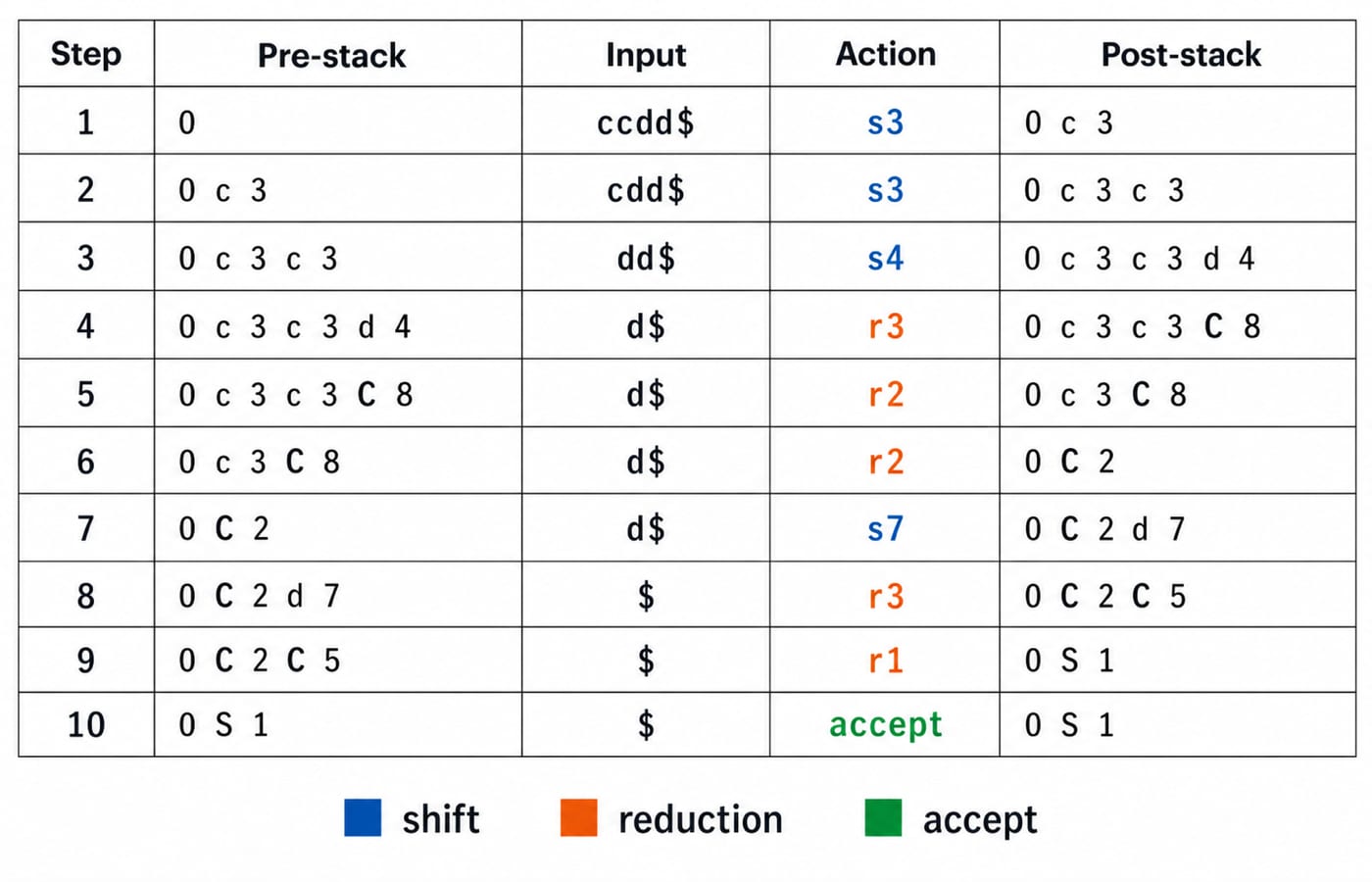
Derive S => C C => c C C => c c C C => c c d C => c c d d. The first C uses C -> c C twice then C -> d; the second uses C -> d.
Step | Pre-action stack | Unread input | Action | Post-action stack |
|---|---|---|---|---|
1 |
|
| s3 |
|
2 |
|
| s3 |
|
3 |
|
| s4 |
|
4 |
|
| r3 |
|
5 |
|
| r2 |
|
6 |
|
| r2 |
|
7 |
|
| s7 |
|
8 |
|
| r3 |
|
9 |
|
| r1 |
|
10 |
|
| accept |
|
At step 4, r3 pops d,4, exposing state 3. GOTO(3,C)=8 produces 0 c 3 c 3 C 8, including the required state transition.
How questions test CLR(1) and where errors start
Problems ask for closure, state count, table entries, conflicts, a trace, or merging. See SLR vs CLR vs LALR Parsers for GATE: States & Conflicts for comparison.
Mistake | Why it fails | Correction |
|---|---|---|
Copy | New lookaheads depend on the suffix | Compute |
Reduce in every terminal column | CLR reductions are lookahead-specific | Use only the completed item's lookahead |
Merge equal LR(0) cores | The result is no longer canonical LR | Keep CLR states separate |
Stop closure early | Required items may still be missing | Continue to a fixed point |
Count a compact set as one item | Each core-lookahead pair is an item | Expand lookahead sets before counting |
Treat |
| Keep |
Keep I4/I7 and I3/I6 separate. Merging equal cores creates LALR states; check conflicts after lookahead union.
CLR(1) in the short version
Augment; start at [S' -> . S, $]; close with FIRST(beta a); generate GOTO states without merging; enter shifts, specific reductions, GOTOs, and accept. Now reproduce all 10 states and justify each non-error cell.
Use CS Fundamentals for the broader subject map, or revisit the opening parsing guide. For a sequenced core-CS path, continue with ZERO TO HERO.
Keep learning
Grammar and CFG Mistakes for GATE: 7 Traps and How to Fix Them
Seven small grammars expose the errors that make CFG answers go wrong, with reproducible checks for classification, ambiguity, FIRST sets and CNF.
Updated 24 Oct 20265 min readCompiler Design
Code Optimization Mistakes in Compiler Design: How to Avoid Losing GATE Marks
A rewrite that looks familiar is not necessarily safe. Trace six common optimization errors, learn why each one changes program meaning, and use a five-step check before accepting an answer.
Updated 22 Oct 20265 min readCompiler Design
Compiler Design Semester Guide: Trace One Program from Tokens to Target Code
Follow one assignment through lexical analysis, parsing, semantic checks, TAC, optimization and abstract target instructions, with every hand-off made visible.
Updated 18 Oct 20267 min readCompiler Design
Bottom-Up Parsing in Compiler Design: Shift-Reduce Trace, LR Items and Conflicts
Follow a nested-parentheses LR(0) parse from input to acceptance, derive every item set, and see why lookahead changes parser-family conflicts.
Updated 14 Oct 20265 min readCompiler Design