

How to Choose an Online Course That Fits Your Goal
Choose an online course by matching its level, practice, schedule, support, and full cost to a clear learning goal.
KnowledgeGate Team
Exam prep & CS education
12 Nov 20265 min read

With so many courses promising new skills, certificates, and career progress, it is easy to choose by popularity or price and discover later that the course does not fit what you need. Start with your goal, then check whether the course’s content, practice, pace, support, and cost make sense for you.
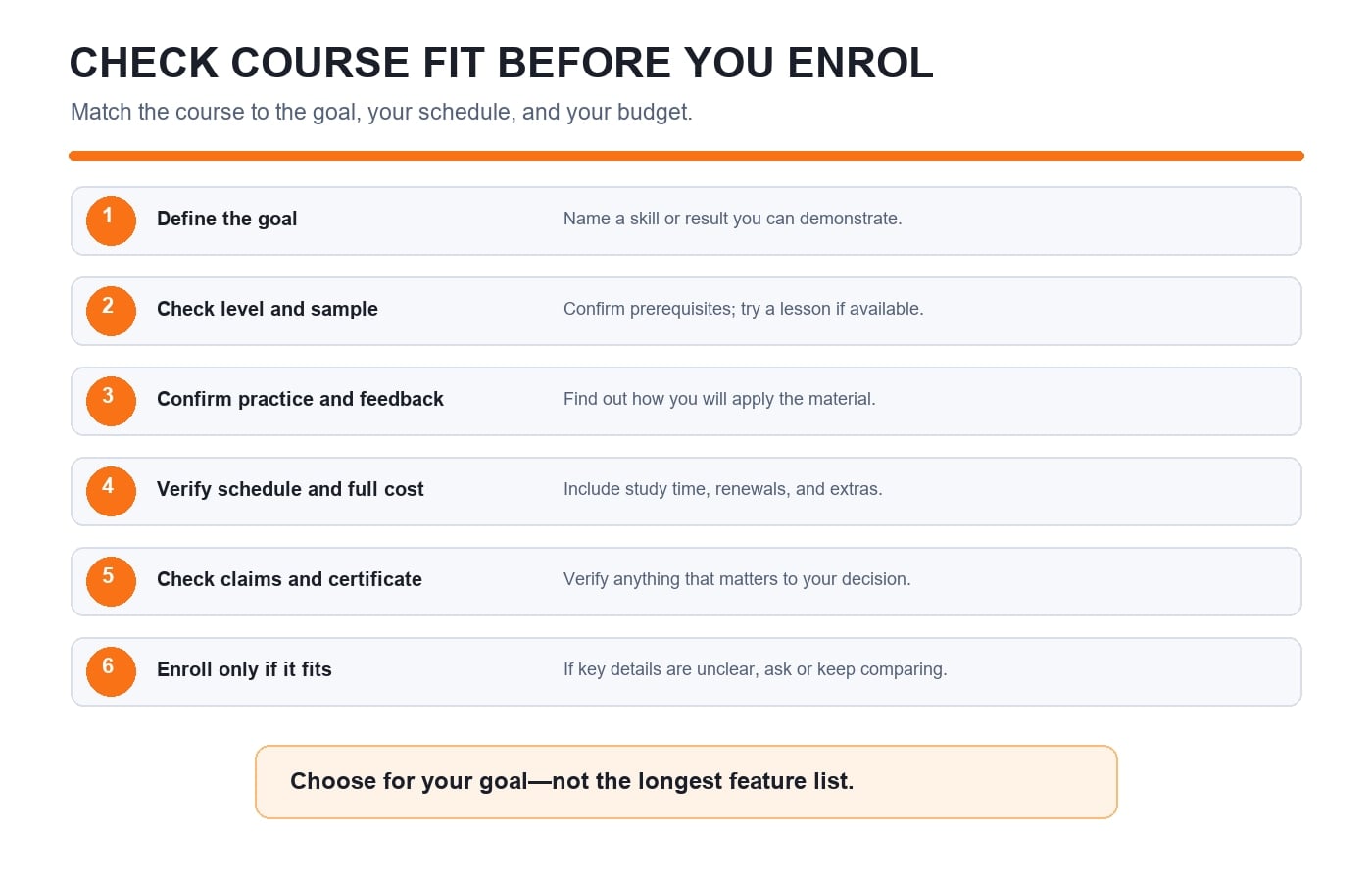
Define what you want to be able to do
Write your goal as an action you could demonstrate, not a broad subject you want to “learn.” For example, “understand data science” is hard to measure. “Clean a small dataset, explain the steps, and build a basic chart” gives you something to check at the end.
Ask yourself:
What task, exam, project, or decision should this course help me with?
What can I already do, and what is the next skill I need?
By when do I need the skill, and how much time can I realistically give it each week?
How will I know I made progress: a working project, solved questions, a completed syllabus, or a clear explanation?
If you cannot answer these, pause before buying. You may need to explore the topic first or compare a few free introductory lessons.
Match the course to your starting point
A good course for one learner may be too basic or too advanced for another. Check prerequisites, sample lessons, and the assumed knowledge. If the page is unclear, ask the provider what you should know before enrolling.
Compare the course outline with your goal. Look for the concepts and tasks you actually need, not just a long list of modules. A course can be comprehensive and still be the wrong fit if it spends most of its time on material you do not need yet.
Try a sample lesson if one is available. Notice whether the explanation is understandable, the pace works for you, and the examples resemble the way you need to use the skill. A polished trailer tells you about presentation; it does not show the full learning experience.
Check how you will practise
Watching lessons can introduce a topic, but your goal may require solving problems, writing code, building a project, or answering questions. Look for practice that resembles the work you want to do, along with solutions or feedback that help you understand mistakes.
Before enrolling, find out:
Are there exercises, quizzes, past questions, labs, or projects?
Can you attempt a task before seeing its solution?
Are explanations provided, or only an answer key?
Is there a way to ask questions or get feedback?
Does the course show a final project or skill you can demonstrate?
For an exam goal, compare the syllabus and question practice with the current official exam material. For a job skill, check whether you will build or complete something you can explain in an interview. Do not assume a course alone guarantees a score, job, or promotion.
Choose a format you can sustain
Check whether the course is self-paced, live, or a mix. Note the lesson length, access period, deadlines, required software, language, and any attendance expectations. A live course may help you keep a routine, while a self-paced course may be easier to fit around college or work. The better choice is the one you can realistically continue.
Estimate the weekly time needed for lessons and practice, not just the video length. If your schedule is already full, a demanding course can become another unfinished tab. Choose one course that matches your current priority instead of enrolling in several courses that compete for the same study time.
Compare the full cost and what it includes
Check the total amount payable, any renewal or expiry conditions, and what access includes. Confirm whether projects, tests, doubt support, downloadable material, or mentor sessions are part of the plan or offered separately. Read the refund and cancellation terms before paying.
Treat a certificate as one part of the decision. Ask who issues it, what it represents, and whether a college, employer, or exam process you care about recognizes it. If the main value is learning a skill, inspect the lessons and practice rather than paying extra for a badge you may not need.
Be cautious with guaranteed outcomes, vague placement claims, or pressure to pay immediately. Look for specific course details and written terms. If a claim matters to your decision, verify it with the institution or employer that would need to accept it.
Compare options with a simple checklist
Use the same questions for each course so that you compare like with like:
What to compare | Questions to ask |
|---|---|
Goal fit | Does it teach the skill or material I need next? |
Starting level | Do I meet the prerequisites? Is the sample lesson clear? |
Practice | Will I solve, build, write, or explain something relevant? |
Feedback | Can I learn why an answer or approach is wrong? |
Schedule | Can I make time for lessons and practice each week? |
Total cost | What is included, and what terms or extras should I know? |
Evidence | What can I demonstrate after completing the course? |
Mark each item “yes,” “no,” or “unclear.” Ask the provider about important unclear items. Then decide which two or three factors matter most for your goal. You do not need the course with the most features; you need the one that fits the work you plan to do.
A quick example: one subject, different goals
Suppose two students are interested in artificial intelligence. One wants a structured introduction to AI and machine learning concepts; another is preparing for a specific competitive exam and needs to match a syllabus and practise exam questions. They may need different courses even though they use the same subject keyword.
KnowledgeGate’s Artificial Intelligence & Machine Learning course is one catalog option for learners exploring AI/ML. A learner preparing for GATE may instead check what guidance GATE Guidance by Sanchit Sir provides and decide whether they also need dedicated syllabus teaching and exam-question practice. These are examples to evaluate against your goal, not a claim that one course is right for everyone.
If your goal is placement preparation, check what practice and project work, if any, the Computer Science Fundamentals for Placements course includes. For more on matching learning decisions to career plans, read How to Use AI in Your Job Search Without Losing Your Own Voice.
Before you enrol
Use this short check before you pay:
I can describe the skill or outcome I want.
I have checked the course level and a sample lesson.
The outline covers my next learning need.
I know how I will practise and get feedback.
The schedule and total cost fit my situation.
I have checked any certificate or outcome claim that matters to me.
If several important answers are “no” or “unclear,” keep comparing. Choosing carefully can save time and help you stay focused on the goal that made you look for a course in the first place.
Keep learning
KVS vs NVS vs EMRS: Choose the Right School System for Your Teaching Career
Compare KVS, NVS and EMRS through current post rules, lifestyle limits and a weighted personal-fit matrix. See why changing priorities can change the answer.
Updated 30 Oct 20267 min read102 viewsKVS & NVS
EMRS vs State PSC Teaching Jobs: Choose by Work Setting, Mobility and Fit
Compare an EMRS post with a named State PSC route using official clauses, personal mobility limits, syllabus overlap and a worked 100-point fit score.
Updated 29 Oct 20266 min readEMRS
UP LT Grade vs KVS/NVS: Choose Your CS Teaching Route
Choose a Computer Science teaching route by checking the current notice first, then comparing mobility, school setting, preparation overlap and mock evidence.
Updated 29 Oct 20266 min readUP LT Grade
Which Tech Role Fits You: Developer, Tester, Analyst, or Support Engineer?
Compare developer, tester, analyst, and support engineer work, try small role-based tasks, and choose a tech path to explore as a fresher.
Updated 12 Nov 20265 min readPlacement Preparation