

Cache Memory Organization Mistakes: 7 Mark-Losing Traps and Fixes
Learn a reliable repair sequence for units, address fields, mapping, valid and tag checks, LRU, AMAT and cache write policies through one consistent example.
KnowledgeGate Team
Exam prep & CS education
Updated 24 Nov 20265 min read

Cache questions are often lost despite remembered formulas. One unstated unit, wrong set count or confused timing definition shifts the answer. A unit ledger, an address split, an LRU trace, a conditional AMAT path and separate write-policy cases expose the error before it reaches the final answer. CS Fundamentals is the wider route, with over 290 Cache Memory Organization practice questions.
1. Cache mistake 1: mixing bytes, words, blocks and addressable units
Why it happens: 16 words per block looks like the offset in byte-addressable memory. What goes wrong: log2(16) = 4 shifts every later field by two bits. What to do instead: write a unit ledger before taking a logarithm.
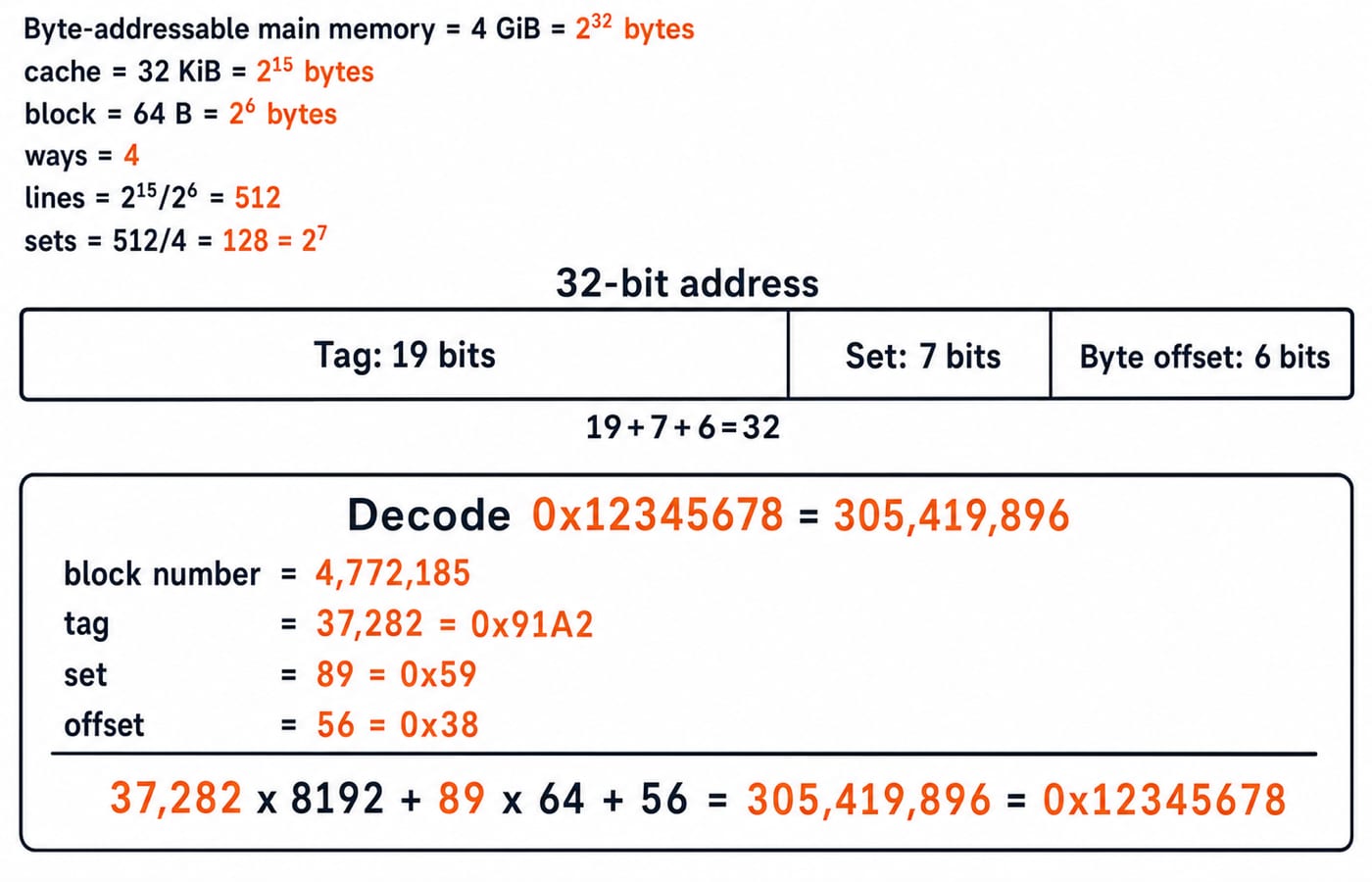
Here, 4 GiB = 2^32 bytes gives 32-bit addresses. Cache is 32 KiB = 32 x 1024 = 32768 = 2^15 bytes. A 64 B = 2^6 bytes block holds 16 words because 1 word = 4 B, so byte offset is 6 bits, not 4. Check lines: (2^15 bytes)/(2^6 bytes per line) = 2^9 = 512 lines. Word-addressable memory changes the calculation.
2. Cache mistake 2: splitting the address before counting sets
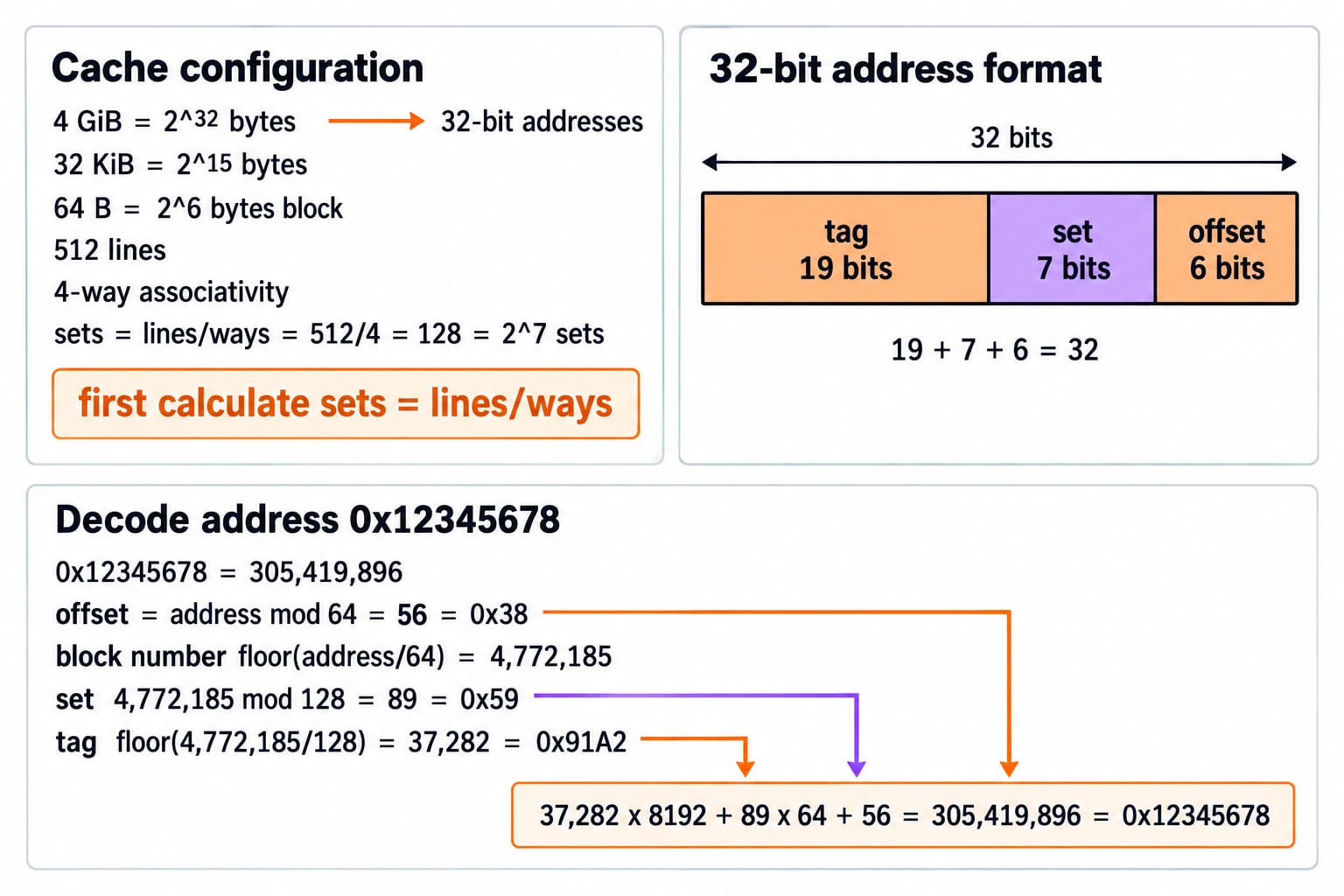
Why it happens: line count is reused as the index. What goes wrong: 512 lines become 512 sets, giving 9 index and 17 tag bits. What to do instead: first calculate sets = lines/ways.
For 4-way associativity, 512/4 = 128 = 2^7 sets. The 32-bit split is tag 32 - 7 - 6 = 19 bits, set 7 bits, offset 6 bits. Check: 19 + 7 + 6 = 32.
For 0x12345678, offset is address mod 64 = 56 = 0x38; block number floor(address/64) = 4,772,185; set 4,772,185 mod 128 = 89 = 0x59; tag floor(4,772,185/128) = 37,282 = 0x91A2. Check: 37,282 x 8192 + 89 x 64 + 56 = 305,419,896 = 0x12345678.
3. Cache mistake 3: applying one mapping formula to every organisation
Why it happens: modulo is remembered without its divisor. What goes wrong: an associative cache gets one line, or 128 sets get modulo 512. What to do instead: list eligible locations. Cache Memory Mapping and Hit Ratio: Solved Examples develops this comparison.
For memory block 357 and 512 physical lines:
Organisation | Number of sets | Mapping result | Eligible locations |
|---|---|---|---|
Direct mapped | 512 |
| Line 357 only |
4-way set associative | 128 |
| Any of set 101's four ways |
Fully associative | 1 | No index calculation | All 512 lines |
4. Cache mistake 4: calling a set match a hit without checking valid and tag
Why it happens: reaching the set feels complete. What goes wrong: a collision or stale invalid tag looks like a hit. What to do instead: require valid = 1 and matching tag.
Set 101's ordered ways are (V=1, tag=2), (V=0, tag=5), (V=1, tag=7), (V=1, tag=9). Block 357 gives set 101, tag floor(357/128) = 2, so way one hits. Block 485 reaches set 101 with tag floor(485/128) = 3, so it misses. Use the invalid second way before eviction. Try Associative Mapping MCQs for GATE: 11 Solved Questions for tag practice.
5. Cache mistake 5: reconstructing LRU from memory
Why it happens: only misses update order. What goes wrong: LRU becomes FIFO, changing eviction and hits. What to do instead: record LRU -> MRU after every access.
For an empty 2-way set and A, B, A, C, B:
Step | Requested tag | Hit/miss | Eviction | LRU -> MRU after access |
|---|---|---|---|---|
1 | A | Miss | None |
|
2 | B | Miss | None |
|
3 | A | Hit | None |
|
4 | C | Miss | B |
|
5 | B | Miss | A |
|
Result: 1 hit, 4 misses. FIFO differs because step 3 preserves insertion order. Never mix policies.
6. Cache mistake 6: mixing local miss rates and AMAT penalties
Why it happens: rates lack denominators and times lack definitions. What goes wrong: memory is charged on every L1 miss or counted twice. What to do instead: draw the conditional path and mark additional or total time.
L1 hit 1 ns, local miss 0.05; its miss adds an 8 ns L2 lookup. L2 local miss is 0.25; its miss adds 80 ns memory. Thus AMAT = 1 + 0.05 x (8 + 0.25 x 80) = 1 + 0.05 x 28 = 2.4 ns. Memory is reached on 0.05 x 0.25 = 0.0125 = 1.25% of CPU references. The tempting 1 + 0.05 x (8 + 80) = 5.4 ns charges memory on every L1 miss. Cache Write Policies & AMAT Numericals for GATE has more conditional paths.
7. Cache mistake 7: treating write-back and write-allocate as one choice
Why it happens: memorised pairings look fixed. What goes wrong: hit propagation and miss placement blur. What to do instead: ask when the lower level is written and whether a miss fills cache.
Write hit: propagation | Write miss: placement |
|---|---|
Write-back: with cache | Write-allocate: on a miss with lower-level |
Write-through: the same hit sets cache and memory to | No-write-allocate: the same miss sends |
Do not assume a pairing unless supplied.
8. Cache memory organisation: the short version and next repair drill
Normalise units.
Count lines, then sets.
Split offset, index and tag.
Map only to eligible locations.
Require valid plus matching tag.
Update the stated replacement policy after every access.
Define every AMAT rate and write-policy axis before calculating.
Use a 12-minute drill: 4 minutes to rebuild 32/19/7/6 and decode 0x12345678; 4 to retrace A, B, A, C, B to 1 hit, 4 misses; 4 to recover AMAT = 2.4 ns and explain 1.25% memory reach. For a named exam, confirm current rules in the conducting body's official material.
Continue with Computer Architecture and Organisation for focused study, or ZERO TO HERO for the broader core-CS route that also includes Cache Memory Organization.
Keep learning
Control Flow in C: 7 Mark-Losing Mistakes and Precise Fixes
Trace seven common C control-flow mistakes step by step, see exactly where execution changes course, and learn a short routine for checking every branch and loop.
Updated 14 Nov 20265 min readC Programming & Data Structures
Intermediate Code Generation Mistakes: 7 Mark-Losing Errors and Exact Fixes
Seven tempting shortcuts can corrupt an otherwise neat intermediate-code answer. Trace each wrong result, then apply the exact repair for TAC, arrays, records, jumps, loops and expression reuse.
Updated 8 Nov 20265 min readCompiler Design

Run-Time Environment Mistakes: 7 Mark-Losing Errors and Exact Fixes
Definitions are not enough when a trace depends on storage duration, calling order, lexical nesting and frame-address rules. Repair seven common errors through small, checkable examples.
Updated 3 Nov 20265 min readCompiler Design

Lexical Analysis Mistakes for GATE: 7 Mark-Losing Errors and Exact Fixes
These seven repairs show exactly where lexical analysis answers go wrong. Trace one shared source, separate token counts from lexemes and categories, and keep each compiler phase in its lane.
Updated 30 Oct 20265 min readCompiler Design