C Language Concepts Explained: A Worked Program from Variables to Pointers
Follow a small C program from its declarations to its final output. The trace connects expressions, loops, functions, arrays and pointer behaviour step by step.
KnowledgeGate Team
Exam prep & CS education
Updated 21 Sep 20266 min read
Recognising separate pieces of C syntax is not the same as predicting what a complete program will do. The difficult part is seeing how types, expressions, control flow, functions, arrays and pointers cooperate while the program runs. One small program joins those ideas, and its execution reveals every state change. These skills support exam questions and beginner coding.
C language concepts begin with declarations, expressions and statements
A declaration introduces a typed name, an expression computes a value, and a statement performs an action. A function groups statements behind a call. In int total = 0;, int is the type, total is the name, and 0 is the initial value. The complete line is an initialised declaration.
The program uses one helper and one call. #include <stdio.h> makes the declaration of printf available. main is the entry function, while sum_even is a helper function. A return statement hands a value back to the caller. Before execution, the preprocessor handles the include directive, the compiler translates the C source, and the linker connects required compiled pieces. The important execution begins when main runs.
These building blocks also support the wider programming path in Coding & DSA, where the same ideas grow into algorithms and data structures.
C data types and operators determine what each expression means
C has scalar values such as int count = 5, char grade = 'A', and double average = 7.5. A pointer is also a scalar value, but its purpose is to refer to an object or function. Aggregates combine values: arrays hold a sequence of elements, and structures group named members. void represents the absence of a value in contexts such as a function that returns nothing. Exact byte sizes depend on the implementation, so type meaning matters more here than assumed sizes.
Operators use those types when computing results. With integer operands, 7 / 2 = 3. With one floating-point operand, 7.0 / 2 = 3.5. Remainder reveals parity: 8 % 2 = 0, while 5 % 2 = 1. The expression is evaluated using its operand types before any later assignment.
Assignment = stores a value, while comparison == asks whether two values are equal. In a[i] % 2 == 0, C reads a[i], computes its remainder after division by 2, compares that remainder with 0, and produces integer 1 for true or 0 for false. The if uses that result as its condition.
C control flow turns expressions into decisions and repetition
Control flow decides which statement runs next. Selection with if, else, or switch chooses among paths. Iteration with for, while, or do while repeats work. Transfers such as break, continue, and return leave a loop, move to its next iteration, or leave a function.
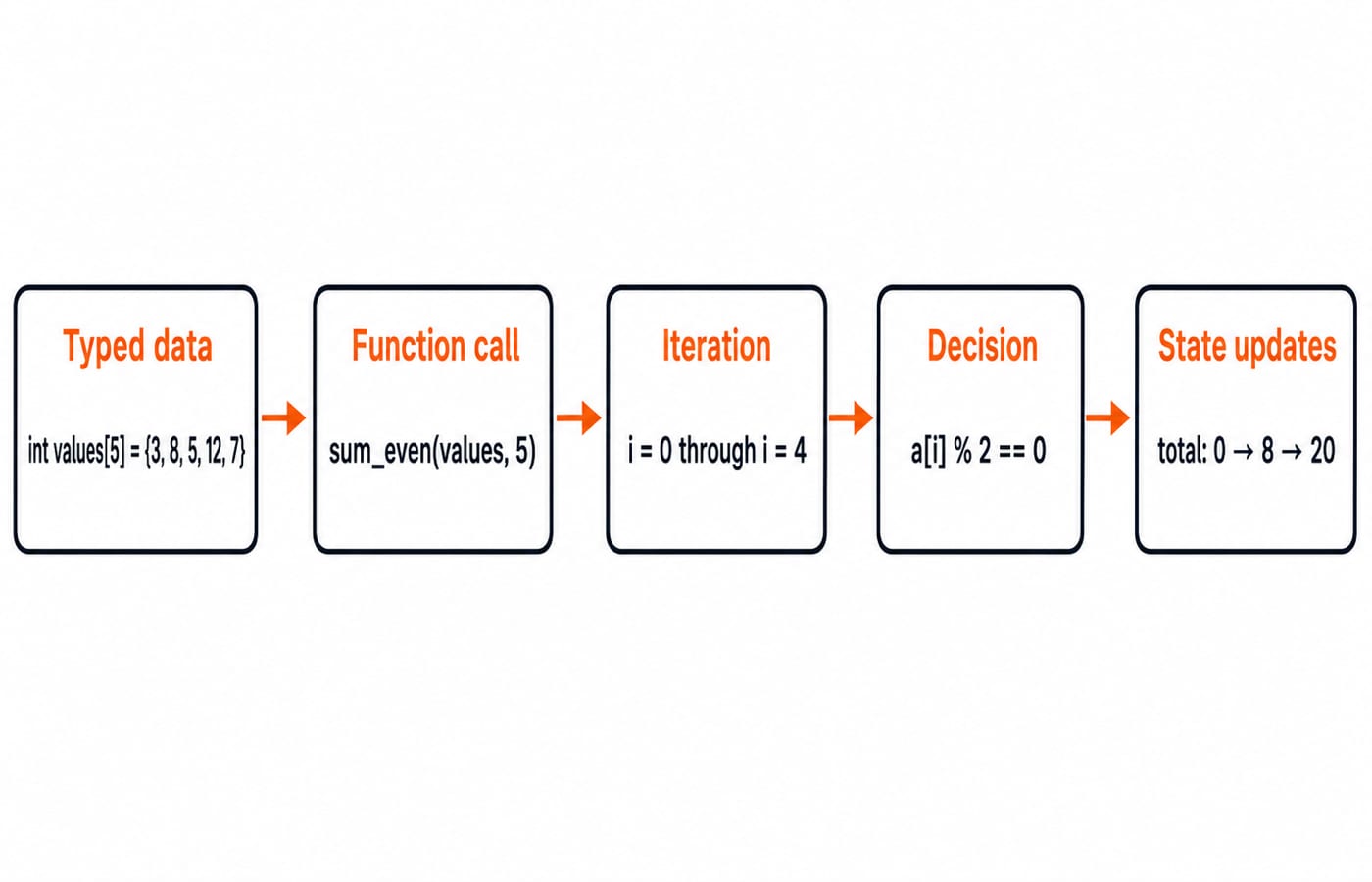
The worked loop is for (int i = 0; i < n; i++). With n = 5, it starts at i = 0, permits i values 0, 1, 2, 3, and 4, then stops when i becomes 5. The nested if changes total only when the current element is even.
That gives us a strict tracing rule. For every iteration, record the current i, a[i], a[i] % 2, whether the branch runs, and the new value of total. This prevents a mental shortcut from hiding a state change.
C functions, arrays and pointers share data across calls
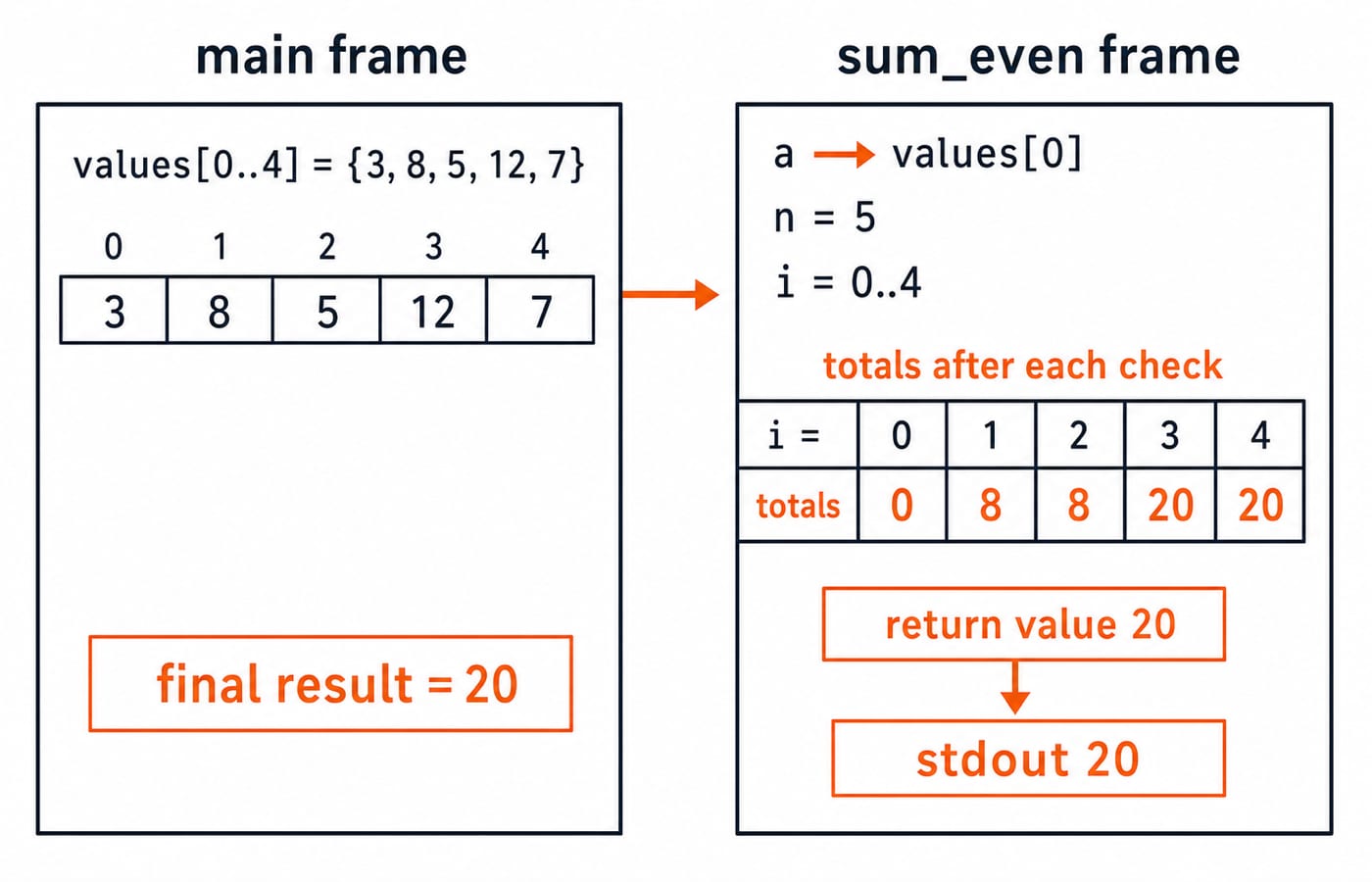
The definition int sum_even(const int a[], int n) says that sum_even receives two arguments and returns an int. The const qualifier prevents the function from modifying array elements through a. C passes every argument by value. In this call, values is converted to a pointer to its first element, and that pointer value is passed to the function.
The array still contains five contiguous int elements at indexes 0 through 4. Within a function parameter list, however, a[] is adjusted to pointer form. The pointer does not carry the array's element count, which is why the separate argument n = 5 is required. We do not need invented addresses or an assumed byte size to understand that boundary.
C Programming Mixed-Concept Questions Explained: Arrays, Pointers, Functions and Output Tracing follows aliasing, static state and mutations across two calls. This program isolates a const array parameter, one loop and one return value, so every state change comes from a foundational C rule.
C worked example: trace the sum of even array elements
The program stores five integers, calls the helper and prints the helper's result.
#include <stdio.h>

int sum_even(const int a[], int n) {
    int total = 0;
    for (int i = 0; i < n; i++) {
        if (a[i] % 2 == 0) {
            total += a[i];
        }
    }
    return total;
}

int main(void) {
    int values[5] = {3, 8, 5, 12, 7};
    int result = sum_even(values, 5);
    printf("%d\n", result);
    return 0;
}
Start with total = 0, then execute one row for each permitted value of i.
State | Current |
|
| Does branch run? | New |
|---|---|---|---|---|---|
Initial | Not started | Not read | Not computed | No | 0 |
Iteration 1 | 0 | 3 | 1 | No | 0 |
Iteration 2 | 1 | 8 | 0 | Yes, | 8 |
Iteration 3 | 2 | 5 | 1 | No | 8 |
Iteration 4 | 3 | 12 | 0 | Yes, | 20 |
Iteration 5 | 4 | 7 | 1 | No | 20 |
After the fifth iteration, i becomes 5. The test i < n is then false because 5 < 5 is false. The loop stops, sum_even returns 20, and result becomes 20. The exact output is 20 followed by a newline.
An independent check reaches the same answer without following the loop: the even elements are 8 and 12, and 8 + 12 = 20.
C language traps: wrong results, invalid access and misleading syntax
Small-looking syntax mistakes can change the result or make the program invalid. These are worth checking systematically.
Trap | What goes wrong | Fix |
|---|---|---|
| Both operands are integers, so the result is 3 | Use a floating operand, such as |
| It assigns 0 to | Compare with |
An uninitialised | Reading its indeterminate value cannot provide a valid starting sum | Initialise it with |
Accessing | Only | Keep the loop condition |
Using | There, | Pass |
Undefined behaviour has no dependable output, so guessing what values[5] might produce is not a valid trace. Respecting the bound is the only correct repair.
C exam patterns: trace, classify, repair and predict
Output questions ask you to predict the final line, while state-trace questions ask for variable values after each iteration. Classification questions test the governing type or operator rule. Repair questions target bounds, assignment, initialisation or pointer semantics.
Try one fresh check with the same function. Replace the array with {2, 4, 9, 10, 11} and derive the answer before reading on. The accepted values are 2, 4, and 10, so the returned total is 2 + 4 + 10 = 16.
C Programming by Yash Sir: Complete Guide with Worked Examples supplies the broader curriculum map from fundamentals through dynamic memory, macros and files. The single-program discipline uses a narrower lens: preserve types, aliases and loop state until the printed output is inevitable.
C language concepts: key execution rules and applications
Keep the execution sequence clear: types give values meaning, expressions compute, control flow chooses and repeats, functions organise work, and arrays plus pointers move data into a call. In the checked program, only 8 and 12 enter the sum, so the output is 20.
For a structured concepts, MCQ, and coding route, continue with C Language, which includes C Programming by Yash Sir. If you want a focused practical alternative, use C Programming.
Keep learning
Functions in C: Syntax, Parameters and Worked Examples
Learn how C declarations, calls, and definitions fit together. Compile two complete programs, follow their values, and trace composition and recursion.
Updated 6 Oct 20266 min readC Programming & Data Structures
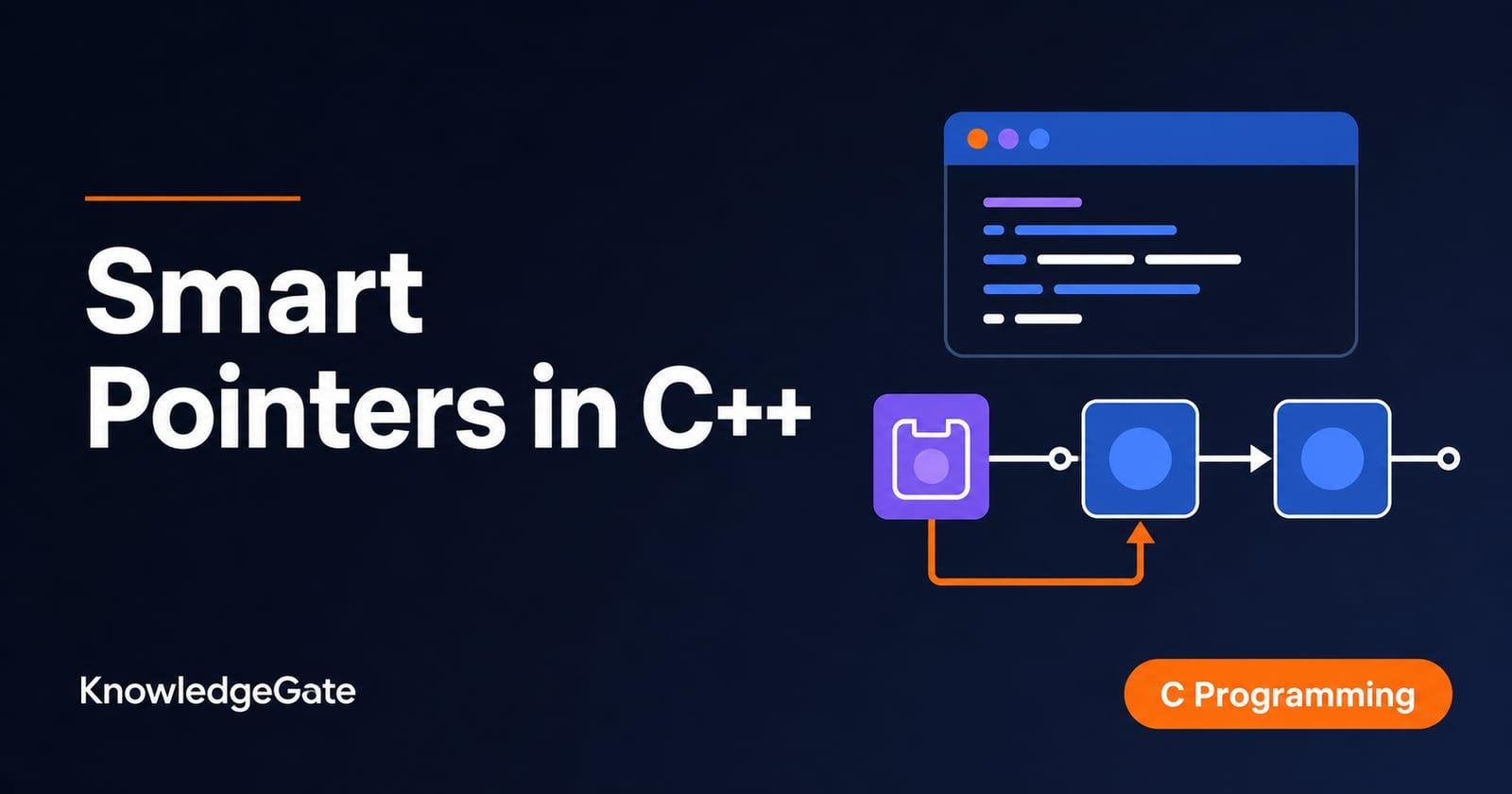
Smart Pointers in C++: unique_ptr, shared_ptr and weak_ptr with Worked Examples
Learn who owns a C++ object, when it is destroyed, and how to choose among unique_ptr, shared_ptr, weak_ptr and a borrowed raw pointer.
Updated 1 Oct 20265 min readC Programming & Data Structures
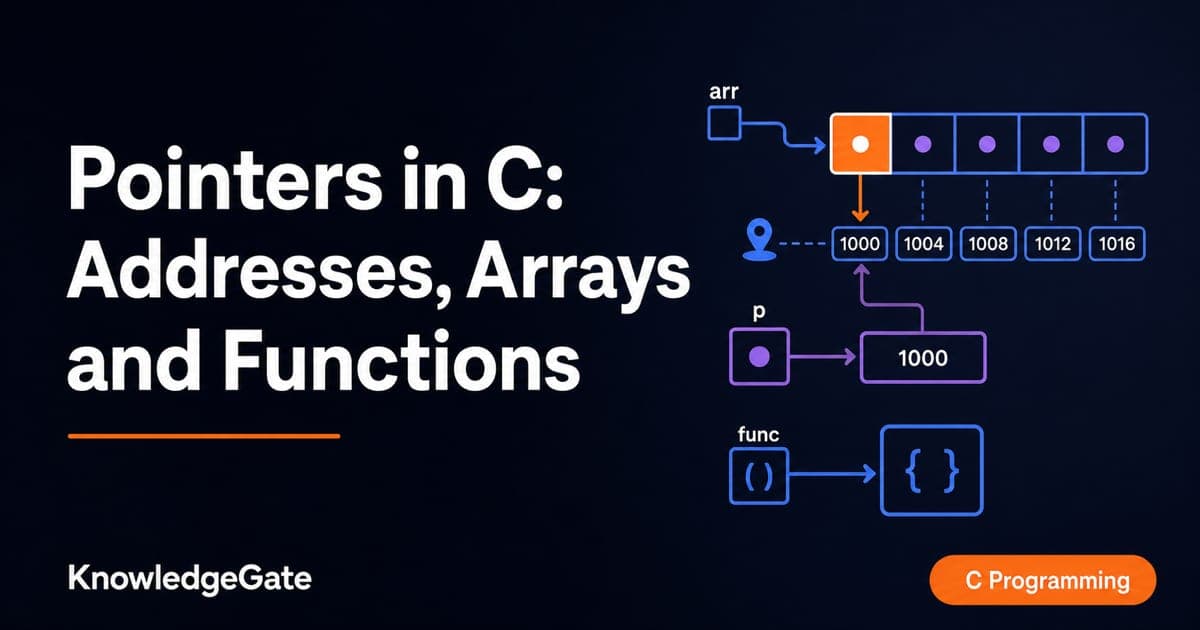
Pointers in C: Addresses, Arrays and Functions with Worked Examples
Build a practical pointer model with runnable C programs for dereferencing, arrays, swapping, dynamic memory and common tracing questions.
Updated 26 Sep 20265 min readC Programming & Data Structures
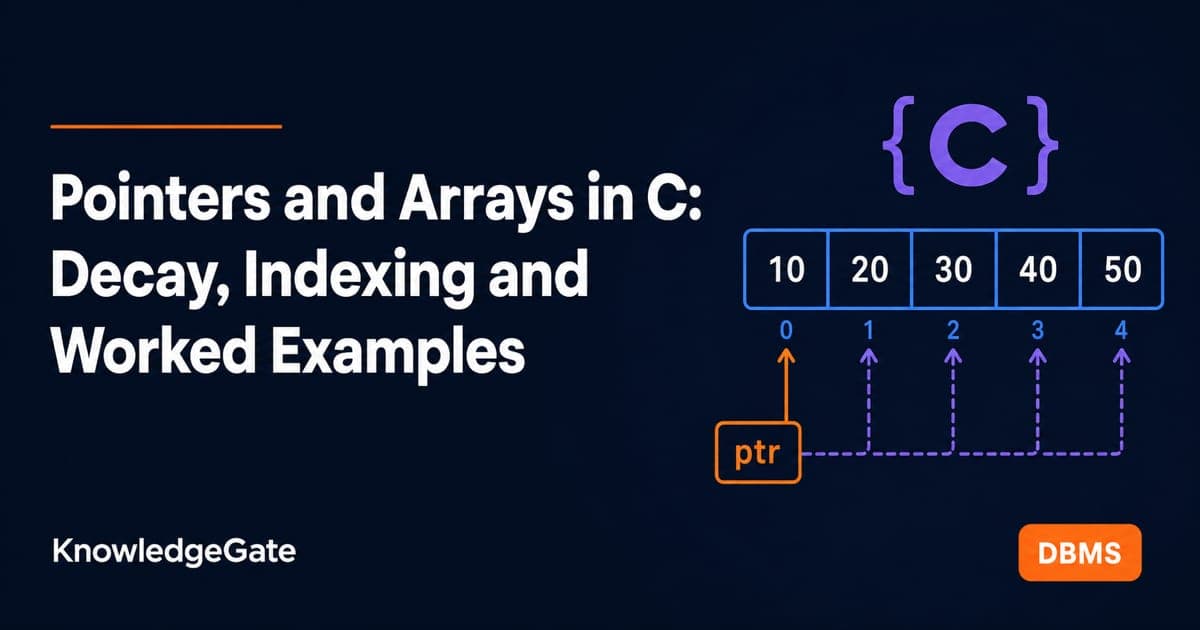
Pointers and Arrays in C: Decay, Indexing and Worked Examples
Separate arrays from pointers with runnable traces covering indexing, one-past boundaries, function parameters, two-dimensional arrays and declaration traps.
Updated 24 Sep 20265 min readC Programming & Data Structures