Data Link Layer Delay Analysis: Formulas, Worked Examples and Exam Question Patterns
Learn to separate transmission and propagation delay, calculate a complete stop-and-wait cycle, and choose the minimum sliding-window size without unit traps.
KnowledgeGate Team
Exam prep & CS education
Updated 22 Sep 20265 min read

Delay questions look like formula substitution, yet most errors come from confusing transmission with propagation or mishandling the ACK trip. The same link parameters determine stop-and-wait efficiency and the sliding-window size required to keep the sender busy. Computer Networks connects the layer models and switching foundations; data-link timing adds ACK serialization and sender-window occupancy.
Data link layer delay analysis starts with a timing model
Define the objects before calculating. Let a data frame contain L bits, an ACK contain A bits, the forward and reverse link rate be R bits/s, the link distance be d metres, and the propagation speed be v metres/s.
Our model is full duplex and error-free, with the same rate in both directions. The receiver sends an ACK only after the complete frame arrives. Processing and queuing delays are zero.
Transmission delay, or serialization delay, is the time needed to push every frame bit onto the link. Propagation delay is one bit's travel time across the medium. The first bit can arrive while the sender is still serializing later bits.
Transmission, propagation, processing and queuing delay formulas
Quantity | Formula | Meaning | Unit |
|---|---|---|---|
Data transmission delay |
| Time to place the complete data frame on the link | seconds |
ACK transmission delay |
| Time to place the complete ACK on the reverse link | seconds |
One-way propagation delay |
| Time for one bit to cross the link | seconds |
One-packet total |
| Delay for one packet at one node and link | seconds |
Processing and queuing delays need values the question gives you. Drop them only when stated or declared negligible.
In stop-and-wait, the sender transmits one frame and waits for the complete ACK. Thus:
T_cycle = T_t + T_p + T_ack + T_p = T_t + T_ack + 2T_p
Utilization is U = T_t/T_cycle. Counting all L frame bits as useful data, throughput is:
L/T_cycle = U x R
Before substitution, run a unit check:
bytes times
8gives bits;kilometres times
1,000gives metres;Mb/s means
10^6bits/s unless the question says otherwise;seconds times
1,000gives milliseconds.
Stop-and-wait delay analysis: a complete worked example
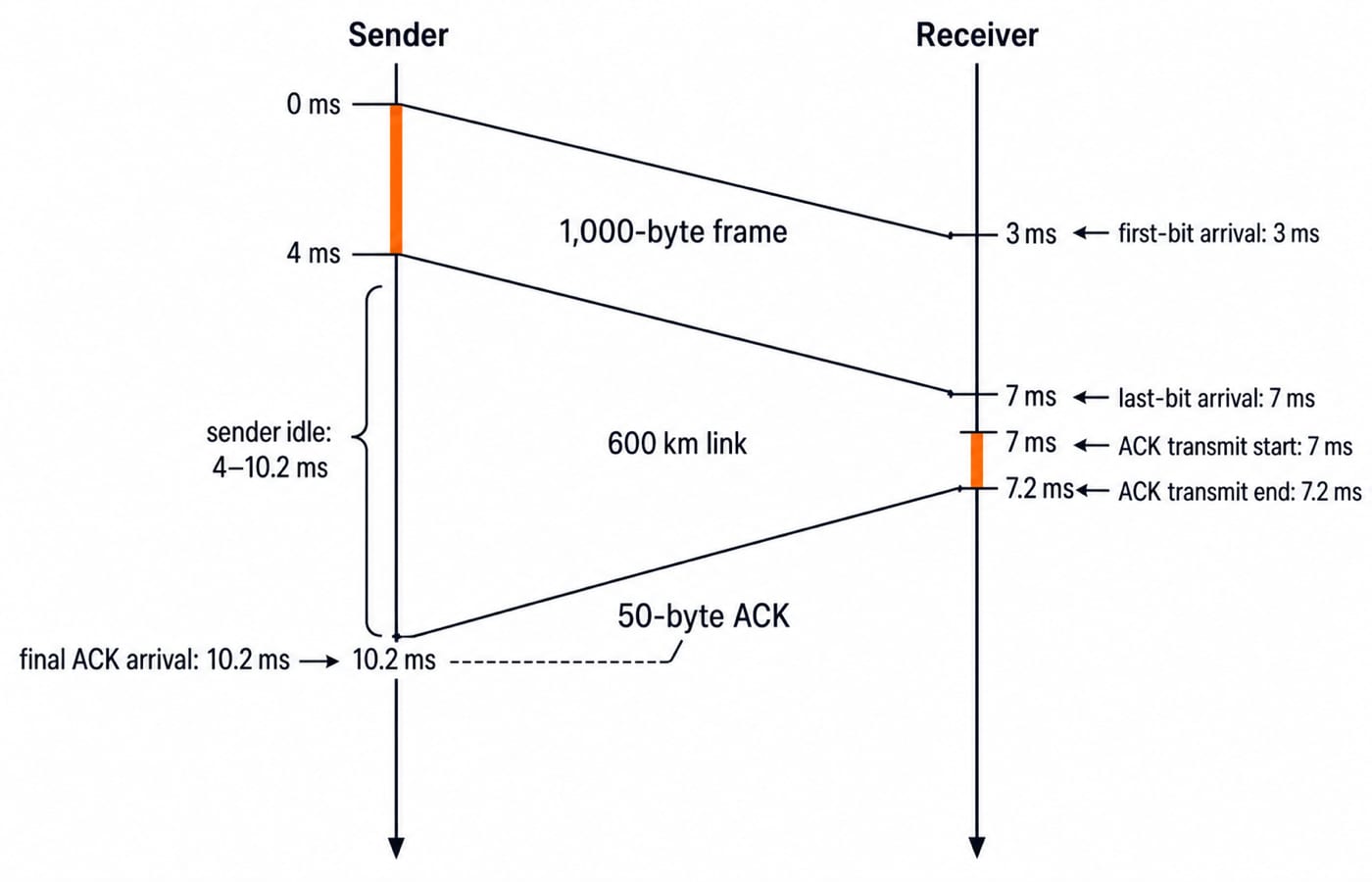
Use a 1,000-byte frame, a 50-byte ACK, a 2 Mb/s link in both directions, distance 600 km, and propagation speed 2 x 10^8 m/s. Processing and queuing delays are zero.
First convert all values:
L = 1,000 x 8 = 8,000 bitsA = 50 x 8 = 400 bitsR = 2 x 10^6 = 2,000,000 bits/sd = 600 x 1,000 = 600,000 m
Now calculate each primitive delay:
T_t = 8,000/2,000,000 = 0.004 s = 4 msT_p = 600,000/(2 x 10^8) = 0.003 s = 3 msT_ack = 400/2,000,000 = 0.0002 s = 0.2 ms
The sender serializes the frame from t = 0 to 4 ms. Its first bit reaches the receiver at 3 ms; its last arrives at 4 + 3 = 7 ms. The receiver serializes the ACK from 7 to 7.2 ms. Another 3 ms of propagation puts the ACK's last bit at the sender at 10.2 ms.
Therefore:
T_cycle = 4 + 3 + 0.2 + 3 = 10.2 msU = 4/10.2 = 0.392157 = 39.22%useful throughput
= 8,000/0.0102 = 784,314 bits/s, approximately0.784 Mb/s
Cross-check: U x R = 0.392157 x 2 Mb/s = 0.784 Mb/s after rounding.
The propagation ratio a and the common shortcut
The propagation ratio is a = T_p/T_t. Here, a = 3/4 = 0.75, so one-way propagation takes three-quarters of one frame-transmission time.
If, and only if, ACK transmission is explicitly negligible, divide the stop-and-wait cycle by T_t:
U = T_t/(T_t + 2T_p) = 1/(1 + 2a)
Here, U = 1/(1 + 2 x 0.75) = 1/2.5 = 40%. This is the negligible-ACK approximation; 39.22% includes the stated 50-byte ACK. The distinction can separate two answer options.
Sliding-window flow control on the same link
A sliding window puts multiple frames in flight. In this error-free model:
U_W = min(1, W T_t/T_cycle)
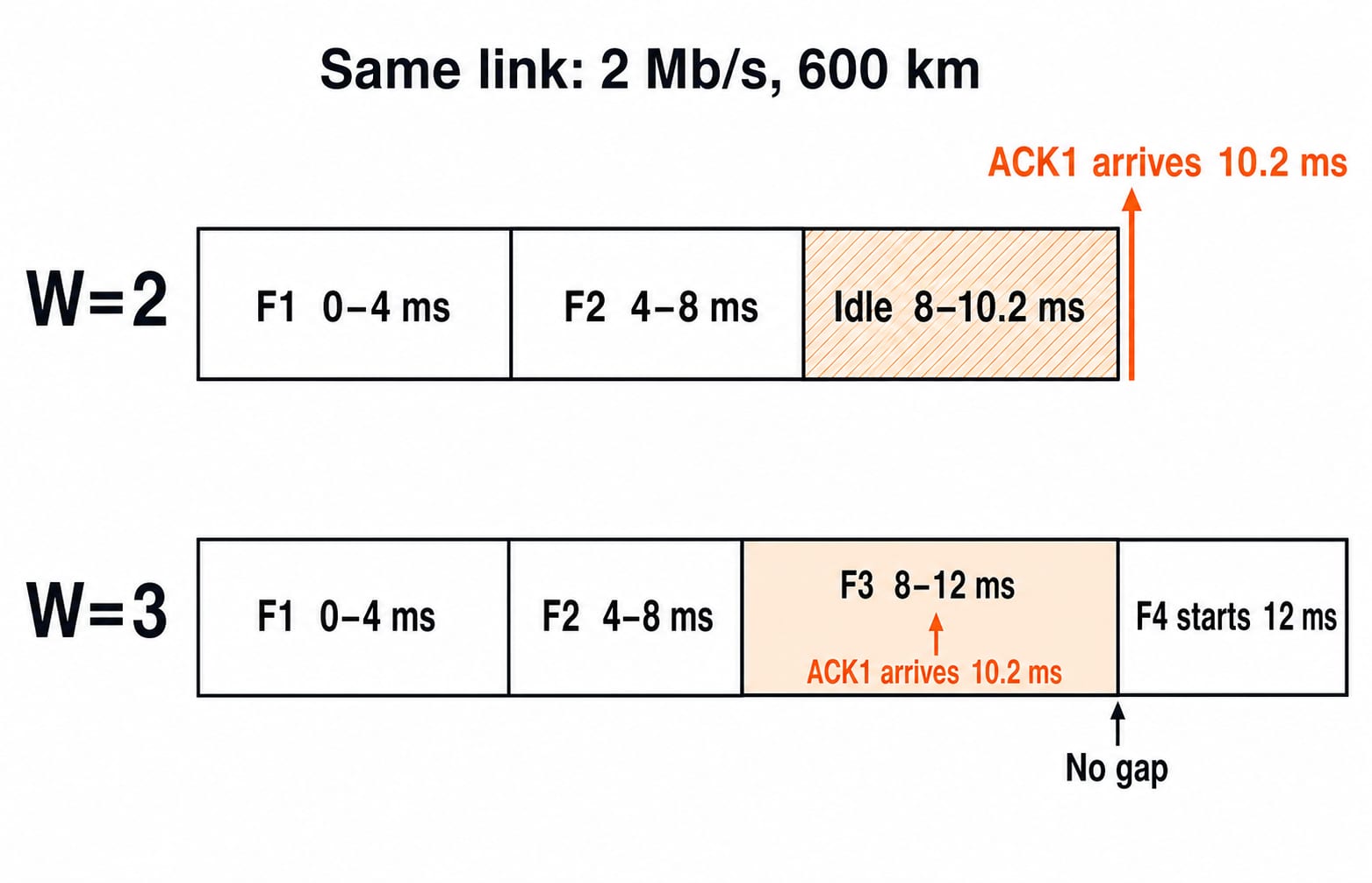
With W = 2, U_2 = 2 x 4/10.2 = 0.784314, or 78.43%. Throughput is 0.784314 x 2 Mb/s = 1.568628 Mb/s, rounded to 1.569 Mb/s.
To prevent sender idle time, the smallest integer window is:
W_min = ceil(T_cycle/T_t) = ceil(10.2/4) = ceil(2.55) = 3 frames
Frames F1, F2 and F3 occupy 0-4, 4-8 and 8-12 ms. ACK1 arrives at 10.2 ms during F3, freeing a slot before F4 starts at 12 ms. With no gap, ideal utilization reaches 100% and throughput reaches the raw 2 Mb/s link rate.
Delay-analysis mistakes that change the answer
Mistake | Why it fails | Correction |
|---|---|---|
Using bytes directly with bits/s | Numerator and denominator use different units | Multiply bytes by |
Using | Rate serializes bits; it does not describe signal travel | Use |
Doubling an RTT the question already gives | RTT already covers both directions | Use the given RTT once |
Ignoring ACK transmission when ACK length is given | It removes a real part of the sender cycle | Add |
Adding propagation only once | Data and ACK each cross the link | Add |
Reporting utilization above | A link cannot transmit useful bits for more than all available time | Apply |
Inventing processing or queuing values | Those delays depend on information the question does not give | Include them only when stated |
Calling | It confuses protocol throughput with link rate | Raw capacity is |
How exams turn delay analysis into questions
Recurring constructions include direct T_t or T_p calculation, stop-and-wait utilization or throughput, reverse problems for distance, rate, frame size or target utilization, and the smallest integer W that keeps a sliding-window link busy.
Two quick checks can distinguish the answer options. Including the ACK gives 39.22%, while neglecting its transmission gives 40%. Window size must be an integer, so ceil(2.55) = 3, not 2.55 or 2. Broader practice across protocol timing, flow control and layered networking is available through Computer Networks MCQs.
Under time pressure, write assumptions, convert units, compute each primitive delay, draw one round, form the denominator once, and round only the final result.
Data link delay analysis: the short version and next step
Transmission delay is
T_t = L/R.Propagation delay is
T_p = d/v.Stop-and-wait waits for a full data-plus-ACK round.
A sufficiently large sliding window hides that wait.
For the worked link, the results are a 10.2 ms cycle, 39.22% stop-and-wait utilization, approximately 0.784 Mb/s useful throughput, and W_min = 3.
For structured preparation across the complete subject, continue with GATE Guidance by Sanchit Sir. To browse the wider syllabus and related resources, use the GATE CS Exam Preparation category.
Keep learning

Computer Networks Hardware Basics: Devices, Domains and Worked Examples
Learn what hubs, switches, routers, gateways and access points actually do, then count network domains and trace frames through a two-LAN topology.
Updated 6 Oct 20266 min readComputer Networks

Data Link Layer Framing Explained: Byte Stuffing, Bit Stuffing and a Cross-Concept Numerical
Frame one four-byte payload in two ways, decode it, and then reuse the verified frame sizes in link-load and Stop-and-Wait calculations.
Updated 1 Oct 20266 min readComputer Networks
Byte Stuffing in Computer Networks: Worked Framing Example and Exam Traps
Learn a precise byte-stuffing convention, trace a payload containing both FLAG and ESC, reverse it safely, and calculate frame overhead and transmission time.
Updated 26 Sep 20266 min readComputer Networks

Go-Back-N Protocol Explained: Sliding Windows, Worked Numericals and Exam Traps
Trace Go-Back-N through a lost frame, calculate its legal window and link utilisation, and avoid the ACK and wrap-around traps that spoil numericals.
Updated 24 Sep 20266 min readComputer Networks