RBI Grade B Preparation Strategy: A 16-Week Phase-by-Phase Plan
A working aspirant must build early-stage speed without leaving economics, finance, management and writing cold. This plan turns 15 hours a week into foundations, timed practice, mock repair and a post-Phase-I bridge.
KnowledgeGate Team
Exam prep & CS education
Updated 27 Aug 20265 min read
RBI Grade B preparation demands first-stage speed and breadth, but deeper economics, finance, management and writing cannot wait. Without one weekly allocation, separate resources create shallow coverage or a cold start.
This 16-week plan is for a working aspirant who can protect 15 hours a week, plus a post-Phase-I bridge. If your calendar differs, preserve the sequence and exit gates under the latest RBI notification.
1. Turn the current RBI notification into a preparation map
Open the latest RBI Grade B notification on the official Reserve Bank of India website. It controls stage and paper labels, syllabus, format, timings, marks, penalties, cutoffs, dates, eligibility, fees, vacancies and selection rules.
Make a one-page map connecting each syllabus line to a source, practice format, diagnostic result, weekly hours and retest date. Group the work into ESI; Finance and Management; aptitude and reasoning; English; and tests, review and official checks.
Treat the notification as the authority for exam requirements, including timing and marking. Everything else here, including hours, diagnostics, mock cadence, accuracy gates, practice sizes and examples, is coaching guidance. The linked SBI and IBPS resources contribute transferable study methods; they do not define the RBI syllabus or rules.
2. Protect a 15-hour week and allocate it from evidence
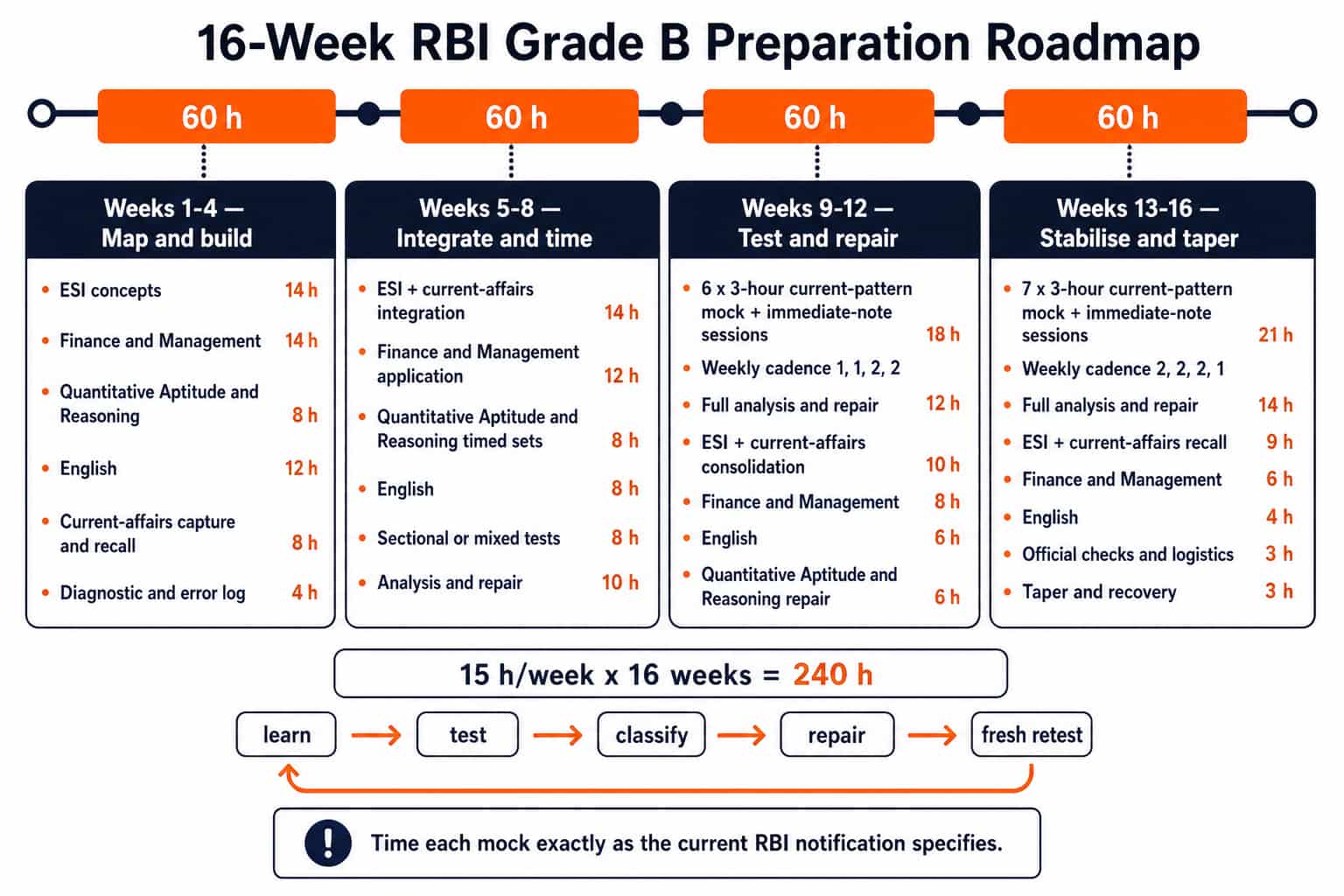
Study 2 hours Monday to Thursday, rest Friday, then 4 hours Saturday and 3 Sunday. 4 x 2 + 4 + 3 = 15 hours; 15 x 16 = 240 hours. Reserve 2 hours for current-affairs capture and recall and 1 for error-log review. Allocate the other 12 using a four-bucket diagnostic:
Bucket | Result | Need | Share of 12 hours | Rounded |
|---|---|---|---|---|
ESI concepts |
| 45 |
| 3.5 h |
Finance and Management |
| 50 |
| 3.5 h |
Quantitative Aptitude and Reasoning |
| 30 |
| 2 h |
English writing |
| 40 |
| 3 h |
Needs total 165; rounded allocation 12; anchors bring the week to 15. Recalculate every four weeks.
3. Weeks 1-4: build foundations without postponing Phase II work
Use 60 hours: ESI 14, Finance and Management 14, aptitude and reasoning 8, English 12, current affairs 8, and diagnostic/error-log work 4. Week 1 completes the map and baseline; Weeks 2 and 3 build the two weakest buckets; Week 4 retests all four and reallocates hours.
Give each current event a dated note, syllabus tag, 20-word explanation and self-question. End ESI or Finance and Management with a closed-book five-line explanation. For English, write a 150-word summary or 250-word timed response. End aptitude or reasoning with five fresh questions without notes.
Use the IBPS PO Prelims preparation course for overlapping aptitude, reasoning and English, alongside RBI-specific ESI, Finance and Management, current-affairs and descriptive resources.
4. Weeks 5-8: integrate current events with concepts and introduce timing
Use exactly 60 hours: ESI and current-affairs integration 14, Finance and Management application 12, aptitude and reasoning timed sets 8, English 8, sectional or mixed tests 8, and analysis plus repair 10.
Study a current event by linking it to a syllabus concept and answering a self-made question from memory. Revise in three layers: compress it to 20 words that day; answer the question closed-book after 7 days; mix it into recall after 21 days. The banking-awareness static-plus-current plan demonstrates this note structure for adaptation to RBI topics.
Exit after two fresh sets in each weak bucket reach at least 80% accuracy, with a repair action and retest date for every repeated error.
5. Weeks 9-12: let mock analysis decide the next study block
Use a 1, 1, 2, 2 mock cadence. Each 3-hour block combines a notification-timed mock with immediate notes; another 12 hours cover classification and repair. Take no new mock while errors remain unexplained.
In a 100-question mixed set, suppose 84 are attempted, with 68 correct, 16 wrong and 16 left. Accuracy is 68 / 84 x 100 = 80.95%, rounded to 81.0%.
Classify errors: 6 recall gaps, 4 concept gaps, 3 poor-selection errors and 3 careless-reading errors. Repair with 2 hours recall, 90 minutes concepts, 60 minutes selection drills, 45 minutes controlled reading and 45 minutes on a fresh retest. Check: 2 + 1.5 + 1 + 0.75 + 0.75 = 6 hours.
After 48 hours, use a fresh 25-question set. With 23 attempts and 20 correct, accuracy is 20 / 23 x 100 = 86.96%, rounded to 87.0%. Keep the topic open if the error returns.
6. Weeks 13-16: stabilise, taper and stop chasing a lucky peak
Follow 2, 2, 2, 1, leaving analysis and repair after each mock. Add no large source after Week 14. Week 16 has one early mock, repair of the top two recurring errors, instruction and logistics checks, light recall, and 3 protected hours for taper or recovery.
Use a stability rule. For accuracies 78, 80, 82, 84 and 88, the median is 82 and the five-point band is 77 to 87. Four results (78, 80, 82 and 84) fit; 88 is an outlier. If fewer than four of five fit, reduce new material and repair the most frequent error class.
Protect sleep and full analysis. A third unanalysed mock is worth less than repairing a repeated concept or selection failure.
7. Bridge to Phase II and compress disruption without creating study debt
If the latest notification retains the recent Phase II papers, use this three-week bridge after Phase I:
Week | ESI | Finance and Management | English | Current affairs | Tests and analysis | Total |
|---|---|---|---|---|---|---|
A | 6 h | 6 h | 3 h | 2 h | 1 h diagnostic | 18 h |
B | 5 h | 5 h | 4 h | 2 h | 2 h paper practice plus review | 18 h |
C | 3 h | 3 h | 3 h | 2 h | 7 h current-pattern paper practice plus analysis | 18 h |
Total | 14 h | 14 h | 10 h | 6 h | 10 h | 54 h |
Miss 2 hours? Recover at most 1 hour Friday and 30 minutes each weekend day. Lose over 4? Keep the test, review, current-affairs recall and top weakness; drop breadth, never sleep.
With no fixed date, or more than 16 weeks, use the calendar-agnostic banking preparation plan for maintenance between peak-mock blocks.
8. Short version and next step
Use the current RBI notification as the authority. Protect 15 hours weekly. Allocate 12 flexible hours from diagnostics. Integrate current affairs with ESI and Finance and Management from Week 1. Analyse each mock before another.
Use the Banking and Insurance exam preparation category for the live catalogue, combining transferable aptitude, reasoning and English work with RBI-specific study.
Complete the one-page map and reserve your first 90-minute diagnostic session in the calendar.
Keep learning

RBI Grade B Previous Year Analysis: Recurring Topics and Study Priorities
Use recurring topic families to choose what to revise, then let your errors decide the time allocation. Work through DI, reasoning and reading examples before building a practical weekly plan.
22 Oct 20264 min readBanking Exams
RBI Grade B Exam Pattern and Marking Scheme: Phases, Scores and Penalties
Clearing Phase I and earning final-merit marks are different jobs. Understand the General-cadre stages, section timers and score calculations before planning your next mock.
18 Oct 20265 min readBanking Exams
GST Explained for Competitive Exams: Rates, CGST vs SGST vs IGST
Separate GST rates from tax components, then work through a 1,000 rupees supply and a simple input tax credit chain. Keep dated reforms apart from the concepts you use in calculations.
Updated 14 Oct 20265 min readBanking Exams
RBI Grade B Eligibility and Selection Process: Age, Qualifications and Stages
Check your RBI Grade B General Cadre eligibility in the right order: stream, age, qualification and previous appearances. Worked examples explain the boundaries before you plan for each selection stage.
9 Oct 20265 min readBanking Exams