Starting from a point 'M', Hari walked 18 metres towards south. He turned to…
2023
Starting from a point 'M', Hari walked 18 metres towards south. He turned to his left and walked 25 metres. He then turned to his left and walked 18 metres. He again turned to his left and walked 35 metres and reached a point 'P'. How far Hari is from the point 'M' and in which direction?
Answer: B. 10 m west — Concept: In direction-sense problems, every walk is resolved onto two perpendicular axes: North-South and East-West. A left turn rotates the walker's facing…
- A.
10 m east
- B.
10 m west
- C.
35 m west
- D.
10 m south
Attempted by 3 students.
Show answer & explanation
Correct answer: B
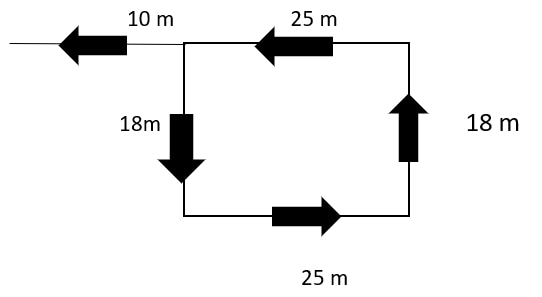
Concept: In direction-sense problems, every walk is resolved onto two perpendicular axes: North-South and East-West. A left turn rotates the walker's facing by 90° in a fixed way (South → East → North → West → South, and so on), and the final displacement from the start is obtained by summing the movements along each axis separately — two equal-and-opposite movements on the same axis cancel completely, leaving only the net remainder to fix the true distance and direction.
Applying it to this walk:
Hari starts at M and walks 18 m South.
Facing South, a left turn points him East; he walks 25 m East.
Facing East, a left turn points him North; he walks 18 m North.
Facing North, a left turn points him West; he walks 35 m West and reaches P.
Resolving the two axes:
North-South axis: 18 m South and 18 m North are equal and opposite, so they cancel completely — net vertical displacement is zero.
East-West axis: 25 m East and 35 m West are opposite; the final westward leg is 10 m longer, so the net horizontal displacement is 10 m in its direction.
Cross-check: Taking M as the origin with East as +x and North as +y: after the four walks the position moves from (0, 0) to (0, −18) to (25, −18) to (25, 0) to (−10, 0) — confirming a single net displacement of 10 m along the horizontal axis, matching the diagram.
Hari (point P) is 10 m west of the starting point M.