A tourist drives 10 km toward the east and turns to his right, driving 3 km.…
20252024
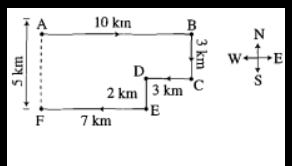
A tourist drives 10 km toward the east and turns to his right, driving 3 km. He then drives 3 km toward the west. Next, he turns to his left and drives 2 km. Finally, he turns to his right and travels 7 km. How far is he from his starting point, and in which direction?
Answer: D. 5 km South — CONCEPT: In a direction-and-distance problem, track the tourist's position along two independent axes — East-West (horizontal) and North-South (vertical). A…
- A.
10 km East
- B.
9 km North
- C.
8 km West
- D.
5 km South
Attempted by 3 students.
Show answer & explanation
Correct answer: D
CONCEPT: In a direction-and-distance problem, track the tourist's position along two independent axes — East-West (horizontal) and North-South (vertical). A move along a stated compass direction (e.g., "drives towards west") changes that axis directly; a "turn right" or "turn left" instead rotates the tourist's CURRENT facing direction by 90° (right = clockwise, left = counter-clockwise) before the next move. The question asks for the net (straight-line) displacement from start to end, not the total distance walked.
Start at A = (0, 0). Facing East, drive 10 km East to B = (10, 0).
At B, turn right — facing East, a right turn means the new heading is South. Drive 3 km South to C = (10, -3).
At C, the tourist drives 3 km West (a stated compass direction, not a turn). Move to D = (10 - 3, -3) = (7, -3).
At D, turn left — facing West, a left turn means the new heading is South. Drive 2 km South to E = (7, -5).
At E, turn right — facing South, a right turn means the new heading is West. Drive 7 km West to F = (0, -5).
CROSS-CHECK: Group the legs by axis. East-West: +10 km (leg 1) and −3 km, −7 km (legs 3 and 5) sum to 10 − 3 − 7 = 0, so the horizontal displacement is zero. North-South: −3 km and −2 km (legs 2 and 4, both South) sum to −5 km, so the vertical displacement is 5 km South. Both the step-by-step trace and this independent axis-sum check agree.
RESULT: The tourist ends up 5 km South of the starting point A.