The sheet of paper shown in the figure (X) given on the left hand side, in…
2025
The sheet of paper shown in the figure (X) given on the left hand side, in each problem, is folded to form a box. Choose from the alternatives (1), (2), (3) and (4), the boxes that are similar to the box that will be formed.
Choose the box that is similar to the box formed from the given sheet of paper (X).
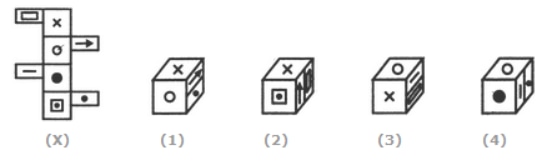
Answer: B. 1 and 3 only — Concept: When a flat net is folded into a cube, each face becomes adjacent to the faces that touch it in the net (in some rotated orientation), while the face…
- A.
1 and 2 only
- B.
1 and 3 only
- C.
3 and 4 only
- D.
1, 2, 3 and 4
Attempted by 5 students.
Show answer & explanation
Correct answer: B
Concept:
When a flat net is folded into a cube, each face becomes adjacent to the faces that touch it in the net (in some rotated orientation), while the face separated from it by exactly one square along a straight run of the net becomes its opposite face. Two faces that are opposite each other in the cube can never appear together in the same view of the box, since any view of a cube shows three mutually adjacent faces meeting at one corner. So, to check whether a shown box is a possible folding of the net, first find the pairs of faces that must lie opposite each other from the net, then reject any option that puts an opposite pair together or that breaks the adjacency fixed by the net.
Application:
Tracing the fold of the given net (X) shows that the face bearing the 'x' sign lies opposite the face bearing the black circle, and the face bearing the white circle lies opposite the face bearing the square (with a dot inside). Checking each candidate box against these opposite pairs and the adjacency fixed by the net:
The box in figure (1) matches the fold of sheet (X), so it can be formed.
The box in figure (2) places faces together in an arrangement the net does not produce, so it cannot be formed.
The box in figure (3) also matches the fold of sheet (X), so it can be formed.
The box in figure (4) places faces together in an arrangement the net does not produce, so it cannot be formed.
Cross-check:
Only figures (1) and (3) are consistent with both opposite-face pairs derived from the net ('x' opposite the black circle; white circle opposite the square with a dot); figures (2) and (4) each break at least one of these pairings. Hence the box formed from sheet (X) matches figures (1) and (3) only.