The sheet of paper shown in figure (X) is folded to form a box. From the…
2023
The sheet of paper shown in figure (X) is folded to form a box. From the alternatives (1), (2), (3) and (4), choose the box(es) that can be formed by folding the sheet shown in figure (X).
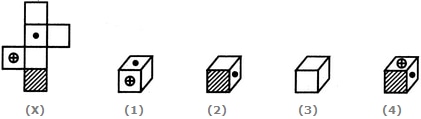
Answer: A. 1 only — Concept: When a net is folded into a cube, faces that share an edge in the flattened net become adjacent on the cube. In a strip of four squares within the…
- A.
1 only
- B.
1 and 3 only
- C.
1, 3 and 4 only
- D.
1, 2, 3 and 4
Attempted by 5 students.
Show answer & explanation
Correct answer: A
Concept: When a net is folded into a cube, faces that share an edge in the flattened net become adjacent on the cube. In a strip of four squares within the net, the 1st and 3rd squares end up opposite each other, and the 2nd and 4th end up opposite each other; two flaps attached on opposite sides of adjacent squares in that strip fold around to become the remaining opposite pair. On any 3-D view showing three faces meeting at one corner, no two of those three faces can be an opposite pair -- a genuine cube view only ever shows faces that are mutually adjacent.
Application: Trace the net in figure (X):
The vertical strip of the net has four faces in order: a blank face, the dot face, another blank face, and the shaded face. By the strip rule, the 1st and 3rd are opposite, so the two blank faces in the strip are opposite each other; the 2nd and 4th are opposite, so the dot face is opposite the shaded face.
Two more faces are attached as side flaps: the circle-plus face is attached beside the third face in the strip (the blank face just below the dot face), and one more blank face is attached beside the dot face itself, on the opposite side. These flaps sit on opposite sides of two adjacent squares in the strip, so they fold around to occupy opposite ends of the cube -- the circle-plus face is opposite this remaining blank face.
So the three opposite-face pairs fixed by the net are: dot opposite shaded; circle-plus opposite blank; blank opposite blank.
Cross-check: A genuine view of the folded cube can only show three faces that are pairwise adjacent, so it must show at most one face from each opposite pair above. Checking each candidate: the dot face together with the circle-plus face is fine, since they belong to two different pairs. The dot face together with the shaded face is impossible, since that is exactly an opposite pair. Three blank faces together are impossible too, since two of the three blank faces are themselves an opposite pair.
Only the box in figure (1) shows dot and circle-plus together and nothing else, so figure (1) alone can be formed from the sheet. The correct choice is '1 only'.