The sheet of paper shown in the figure (X) given on the left hand side, in…
2023
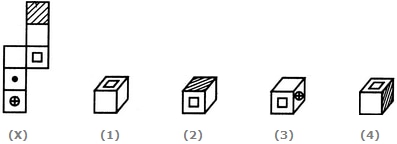
The sheet of paper shown in the figure (X) given on the left hand side, in each problem, is folded to form a box. Choose from amongst the alternatives (1), (2), (3) and (4), the boxes that are similar to the box that will be formed.
Choose the box that is similar to the box formed from the given sheet of paper (X).
Answer: C. 1 and 3 only — Concept When a two-dimensional net is folded into a cube, each edge-to-edge join in the net becomes a pair of touching (adjacent) faces on the cube. Two facts…
- A.
1 only
- B.
2 and 3 only
- C.
1 and 3 only
- D.
1, 2 and 4 only
Attempted by 4 students.
Show answer & explanation
Correct answer: C
Concept
When a two-dimensional net is folded into a cube, each edge-to-edge join in the net becomes a pair of touching (adjacent) faces on the cube. Two facts about such nets are useful here. First, in any straight run of three squares joined in a row with no bend, the outer two squares of that run -- the 1st and 3rd -- always end up opposite each other on the cube. Second, a cube has exactly three pairs of opposite faces and every face belongs to exactly one such pair, so once two of the three opposite pairs are fixed, whatever two faces are left over must themselves be the third opposite pair, even if they never sit in the same straight run of the net. Once all three opposite-face pairs of a net are known this way, a pictured cube is a genuine folding of that net only if none of its two visibly touching faces form one of those opposite pairs -- true opposite faces of a cube never appear side by side in a picture.
Applying it to this sheet
Label the six faces in the order they are joined along the sheet: the shaded face, the first blank face, the square-symbol face, the second blank face, the dot face, and the circle-with-plus face.
Reading down the sheet, the shaded face, the first blank face and the square-symbol face form one straight run of three faces, so the outer two of this run -- the shaded face and the square-symbol face -- are opposite each other.
The second blank face, the dot face and the circle-with-plus face form the sheet's other straight run of three faces, so the outer two of this run -- the second blank face and the circle-with-plus face -- are opposite each other.
That leaves exactly two faces still unpaired: the first blank face and the dot face. Since a cube has only three opposite pairs and two are already fixed, these two remaining faces must be the third pair -- the first blank face is opposite the dot face.
So the sheet fixes exactly three opposite-face pairs: shaded face <-> square-symbol face; second blank face <-> circle-with-plus face; first blank face <-> dot face.
Cross-check against each option figure
Figure | Faces shown touching | Can it be folded from sheet (X)? |
|---|---|---|
(1) | The square-symbol face touches two blank faces only. | Yes -- no touching pair matches an opposite pair. |
(2) | The shaded face touches the square-symbol face directly. | No -- this is exactly the shaded/square-symbol opposite pair; they can never touch. |
(3) | The square-symbol face touches a blank face and the circle-with-plus face. | Yes -- neither touching pair matches an opposite pair. |
(4) | The square-symbol face again touches the shaded face directly. | No -- same opposite pair as figure (2), shown from a different side. |
Result
Only the cubes pictured in figure (1) and figure (3) can actually be formed by folding sheet (X). Figures (2) and (4) each force the shaded face and the square-symbol face -- an opposite pair -- to sit side by side, which is geometrically impossible.