Read the following table carefully and answer the question that follows. The…
2020
Read the following table carefully and answer the question that follows.
The following table embodies the details about the students of the different departments A, B and C in a University for participating in the blood donation camp.
Participation in Blood Donation Camp - Data
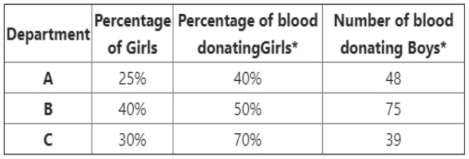
* Out of total blood donors.
Ques: The number of girls in the department 'A' who donated blood is
Answer: A. 32 — Concept: When a table gives one sub-group's count directly (here, the boys who donated blood) together with that sub-group's percentage share of a total, the…
- A.
32
- B.
130
- C.
55
- D.
48
Attempted by 2 students.
Show answer & explanation
Correct answer: A
Concept: When a table gives one sub-group's count directly (here, the boys who donated blood) together with that sub-group's percentage share of a total, the standard technique is to use the complementary percentage of the group you actually want to back-calculate the total, then apply that group's own percentage to the total. A percentage column is only valid for what its footnote scopes it to — ‘out of total blood donors’ is not the same as ‘out of total students’ — and mixing the two up is the most common trap in this kind of question.
The footnote (*) marks ‘Percentage of blood donating Girls’ and ‘Number of blood donating Boys’ as figures out of the department's total blood donors; the unmarked ‘Percentage of Girls’ column instead describes the department's overall student mix and is not needed for this question.
For Department A, girls make up 40% of that department's blood donors, so boys make up the complementary 100% − 40% = 60% of the same donor total.
The boys' count is given as 48, and this equals 60% of Department A's total blood donors, so the total = 48 ÷ 60% = 48 × 100/60 = 80.
Girls who donated blood = 40% of the total donors = 40% × 80 = 32.
Cross-check: 32 girls + 48 boys = 80 total donors, and 32 is exactly 40% of 80 — consistent with the department's given donor split.