Directions : A word and number arrangement machine when given an input line of…
2023
Directions : A word and number arrangement machine when given an input line of numbers and words rearranges them following a particular rule in each step. The following is an illustration of input and rearrangement:
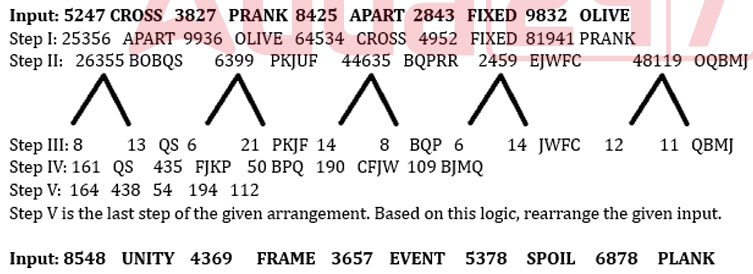
Which among the following element is third to the left of the element which is fourth from the right end in step III?
Answer: A. QBLF — ConceptIn a word-and-number arrangement machine puzzle, every step applies one fixed, consistent transformation to ALL elements. To find any specific…
- A.
QBLF
- B.
14
- C.
VMJSX
- D.
12
- E.
MS
Attempted by 6 students.
Show answer & explanation
Correct answer: A
Concept
In a word-and-number arrangement machine puzzle, every step applies one fixed, consistent transformation to ALL elements. To find any specific position's element, first recover the three sub-rules from the worked illustration (how elements are grouped/ordered, how each element's letters are re-coded step to step, and how the sequence shrinks), then apply the SAME three rules to the new input, and finally count positions in the resulting step.
Application
From the illustration, three consistent rules can be verified across all five groups:
Grouping rule (Input -> Step I): words beginning with a vowel (A/E/I/O/U) come first, sorted alphabetically among themselves, followed by the consonant-starting words, also sorted alphabetically. For the new input UNITY, FRAME, EVENT, SPOIL, PLANK: the vowel-starting words are EVENT and UNITY (alphabetically EVENT before UNITY); the consonant-starting words are FRAME, PLANK, SPOIL (alphabetically FRAME, PLANK, SPOIL). So the Step I group order is EVENT, UNITY, FRAME, PLANK, SPOIL.
Letter-shift rule (Step I -> Step II): every vowel in a word moves one letter forward in the alphabet, and every consonant moves one letter back. Applying this to the third group's word, FRAME: F(consonant)->E, R(consonant)->Q, A(vowel)->B, M(consonant)->L, E(vowel)->F, giving EQBLF.
Reduction rule (Step II -> Step III): drop every vowel, then drop any letter that repeats, keeping only the remaining unique consonants. EQBLF has one vowel (E); removing it leaves Q, B, L, F, none of which repeat, so the Step III element for this group is QBLF.
Position count: Step III lists each of the 5 groups as [number, number, word] - 15 tokens in all - so the word tokens sit at overall positions 3, 6, 9, 12 and 15 (one per group). Counting from the right end, the 4th-from-right token is at position 12, the fourth group's word. Three positions to its LEFT is position 9, the third group's word - which is exactly the FRAME group derived above.
Cross-check
Applying this same three-rule pipeline to the illustration's own worked example reproduces every one of its Step II and Step III words exactly - APART->BOBQS->QS, OLIVE->PKJUF->PKJF, CROSS->BQPRR->BQP, FIXED->EJWFC->JWFC, PRANK->OQBMJ->QBMJ - confirming both the transformation rules and the same 'fourth group, then three left to the third group' position pattern generalise correctly to the new input.
Therefore, the required element is QBLF.