Directions : Study the given information and answer the questions: When a…
2018
Directions : Study the given information and answer the questions:
When a number arrangement machine is given an input line of numbers, it arranges them following a particular rule. The following is an illustration of an input and its rearrangement.
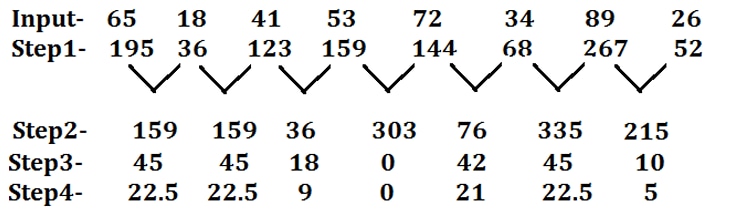
Step IV, is the last step of the above arrangement as the intended arrangement is obtained. As per the rules followed in the given steps find out the appropriate steps for the given input:
Input: 25 22 93 56 17 74 39
What is the sum of the numbers at both the ends in step III of the given arrangement?
Answer: B. 63 — ConceptA number-arrangement machine applies the SAME fixed chain of operations to every input line, one operation per step. To solve any item you must first…
- A.
36
- B.
63
- C.
60
- D.
123
- E.
None of the above
Attempted by 3 students.
Show answer & explanation
Correct answer: B
Concept
A number-arrangement machine applies the SAME fixed chain of operations to every input line, one operation per step. To solve any item you must first decode each step's rule from the worked illustration, then replay that exact chain on the new input. The rule here is a four-stage chain: a parity-based multiplier, a pairwise combine that alternates difference and sum, the product of digits, and finally a halving.
Decoding the rule (from the illustration)
Step 1 — parity multiplier: an ODD number is multiplied by 3, an EVEN number by 2. Check: 65 (odd) -> 195, 18 (even) -> 36, 41 -> 123, 53 -> 159, 72 -> 144, 34 -> 68, 89 -> 267, 26 -> 52.
Step 2 — pairwise combine of adjacent Step-1 values, alternating |difference| then sum, starting with difference: 195-36=159, 36+123=159, |123-159|=36, 159+144=303, |144-68|=76, 68+267=335, |267-52|=215.
Step 3 — product of the digits of each Step-2 value: 1×5×9=45, 1×5×9=45, 3×6=18, 3×0×3=0, 7×6=42, 3×3×5=45, 2×1×5=10.
Step 4 — halve each Step-3 value: 45/2=22.5, 18/2=9, 0, 42/2=21, 45/2=22.5, 10/2=5.
Application to this input
Input: 25 22 93 56 17 74 39
Step 1 (odd×3, even×2): 25->75, 22->44, 93->279, 56->112, 17->51, 74->148, 39->117.
Step 2 (|diff|, sum, |diff|, sum, |diff|, sum across adjacent pairs): |75-44|=31, 44+279=323, |279-112|=167, 112+51=163, |51-148|=97, 148+117=265. Gives: 31, 323, 167, 163, 97, 265.
Step 3 (product of digits): 31->3×1=3, 323->3×2×3=18, 167->1×6×7=42, 163->1×6×3=18, 97->9×7=63, 265->2×6×5=60. Gives: 3, 18, 42, 18, 63, 60.
Result
The two ends of Step III are the first value 3 and the last value 60. Their sum is 3 + 60 = 63.
Cross-check
Re-running the illustration's own ends confirms the method: in the worked example Step 3 was 45, 45, 18, 0, 42, 45, 10, whose ends 45 and 10 sum to 55 under the same first-plus-last reading. Applying the identical chain to the new line yields ends 3 and 60, i.e. 63.