Directions : A word and number arrangement machine when given an input line of…
2023
Directions : A word and number arrangement machine when given an input line of numbers and words rearranges them following a particular rule in each step. The following is an illustration of input and rearrangement:
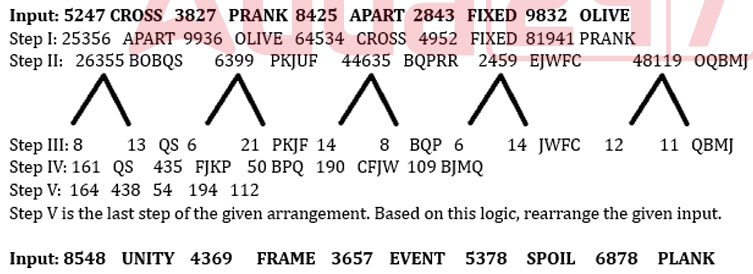
Which among the following statement(s) is/are correct?
I. Three words start with the letter which comes after “M” in alphabetical series in step III
II. More than two odd numbers are found in step V
III. More than two even numbers are found in Step IV
Answer: C. Both I and III — ConceptIn a word-and-number arrangement machine, every step applies one fixed rule to each word and each number. The job is to decode those per-step rules…
- A.
Both I and II
- B.
Both II and III
- C.
Both I and III
- D.
Only I
- E.
All I, II and III
Attempted by 7 students.
Show answer & explanation
Correct answer: C
Concept
In a word-and-number arrangement machine, every step applies one fixed rule to each word and each number. The job is to decode those per-step rules from the worked illustration and then replay exactly the same rules on the new input line. Words and numbers follow separate rules, and a number keeps its own position while the words are re-sorted.
Rules decoded from the illustration
Words:
Order: vowel-initial words first in alphabetical order, then consonant-initial words in alphabetical order.
Step I → II (cipher): every vowel shifts to the next letter, every consonant to the previous letter.
Step II → III: delete all vowels, then delete every letter that appears more than once.
Numbers:
Input → Step I: replace the first digit by its square, add 1 to each middle digit, subtract 1 from the last digit.
Step I → II: rearrange the digits — even digits in ascending order, then odd digits in ascending order.
Step II → III: split the digit string at the first fall (the first digit smaller than the one before it; if it only rises, split at the middle); each Step III number is the digit-sum of one part.
Step III → IV: taking the left value a and the right value b, the Step IV number = b² − a.
Step IV → V: add 3 when a+b is odd, add 4 when a+b is even.
Applying the rules to the new input
Input: 8548 UNITY 4369 FRAME 3657 EVENT 5378 SPOIL 6878 PLANK.
Words become:
Step I order: EVENT, UNITY, FRAME, PLANK, SPOIL
Step II: FUFMS, VMJSX, EQBLF, OKBMJ, ROPJK
Step III: MS, VMJSX, QBLF, KBMJ, RPJK
Number columns (each number keeps its place):
Step I | Step II | Step III (a, b) | Step IV (b²−a) | Step V |
|---|---|---|---|---|
64657 | 46657 | 16, 12 | 128 | 132 |
16478 | 46817 | 18, 8 | 46 | 50 |
9766 | 6679 | 12, 16 | 244 | 248 |
25487 | 24857 | 14, 12 | 130 | 134 |
36987 | 68379 | 14, 19 | 347 | 350 |
Evaluating the statements
Statement I: In Step III the words are MS, VMJSX, QBLF, KBMJ, RPJK. Three of them — VMJSX, QBLF, RPJK — begin with a letter that comes after M (V, Q, R). Exactly three words qualify, so Statement I is TRUE.
Statement II: The Step V numbers are 132, 50, 248, 134, 350 — every one is even, so there are zero odd numbers. “More than two odd numbers” is not met, so Statement II is FALSE.
Statement III: The Step IV numbers are 128, 46, 244, 130, 347 — four of them (128, 46, 244, 130) are even, which is more than two, so Statement III is TRUE.
Cross-check
A number’s Step IV value is b² − a, whose parity equals the parity of a + b, and a + b is simply the digit-sum of that Step I number. Four of the five Step I numbers have an even digit-sum, matching the four even Step IV values. Each Step V number adds 3 to an odd Step IV value or 4 to an even one — an odd+odd or an even+even sum in either case — so every Step V value is even, confirming there are no odd numbers in Step V.
So Statements I and III are correct and II is not; the answer is “Both I and III.”