Directions: Read the table carefully and answer the following question. The…
2023
Directions: Read the table carefully and answer the following question.
The table shows the data about distance (km) covered from one point to another point by the vehicle used between each point and speed of each vehicle (km/hr). i.e., If one person wants to travel from P to S, then he/she can only use vehicle available at the point P
Note: ** means there is no direct connection between given points
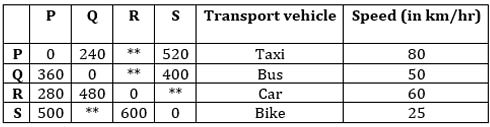
If Ram travels from P to S and Rahul travels from Q to P, then find the difference between the maximum distance travelled by both of them.
Answer: B. 160 — ConceptIn this distance table, the value in the cell (Row X, Column Y) is the direct distance from point X to point Y; a cell marked ** means there is no…
- A.
145
- B.
160
- C.
150
- D.
140
- E.
None of these
Attempted by 13 students.
Show answer & explanation
Correct answer: B
Concept
In this distance table, the value in the cell (Row X, Column Y) is the direct distance from point X to point Y; a cell marked ** means there is no direct connection between those two points. The journey starts at the origin point, so the traveller boards the vehicle available at that origin. The distance a person covers from one point directly to another is read straight off the matching cell — read the row of the starting point and the column of the destination.
Applying it to this question
Read the two journeys off the table, one cell each:
Ram travels from P to S. Look at row P, column S: the distance is 520 km (he uses the Taxi available at P).
Rahul travels from Q to P. Look at row Q, column P: the distance is 360 km (he uses the Bus available at Q).
Required difference = 520 − 360 = 160 km.
Cross-check
Be careful with direction: the table is not symmetric, so distance P→S (520) is taken from row P, while distance Q→P (360) is taken from row Q — not the reverse cells S→P (500) or P→Q (240). Using the correct origin-to-destination cells, 520 − 360 = 160 km, which matches the keyed value.