Consider the following statements: S1: Delayed control transfer involve…
Consider the following statements:
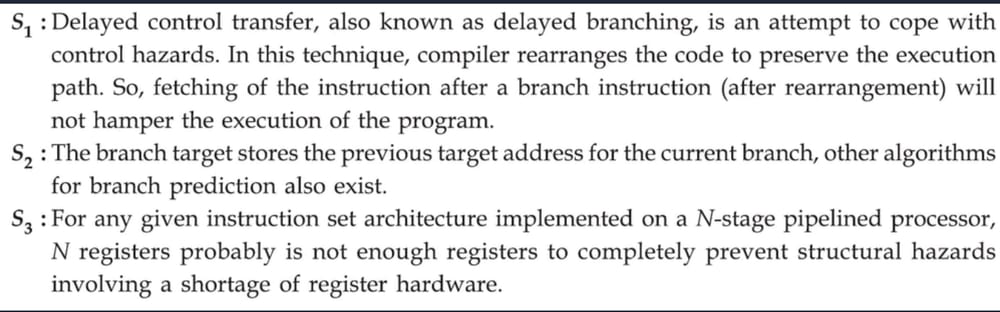
S1: Delayed control transfer involve starting the execution of the instruction after a branch or control instruction regardless of whether the branch is taken.
S2: A way to implement branch prediction is to store the result of a branch condition in a branch target buffer.
S3: If, a multi-cycle, pipelined processor has 'N' pipeline stages, then structural hazards can be avoided completely if at least 'N' registers are available.
Which of the above statements are true?
Answer: B. S1 and S2 only — Answer: S1 and S2 are true; S3 is false. Explanation: S1: True. Delayed control transfer (delayed branching) arranges for an instruction following a branch to…
- A.
S1 only
- B.
S1 and S2 only
- C.
S1 and S3 only
- D.
All of these
Attempted by 5 students.
Show answer & explanation
Correct answer: B
Answer: S1 and S2 are true; S3 is false.
Explanation:
S1: True. Delayed control transfer (delayed branching) arranges for an instruction following a branch to be executed regardless of whether the branch is taken. Compilers or assemblers fill the delay slot to preserve correct execution while reducing control-hazard penalties.
S2: True (with nuance). A branch target buffer stores branch target addresses and commonly includes small prediction bits or indices used to predict whether a branch will be taken. While the raw condition evaluation is not stored, prediction information (taken/not-taken bits or history) is often kept in or alongside the BTB, so using a BTB is a valid approach to implement branch prediction.
S3: False. Structural hazards occur when multiple pipeline stages or instructions contend for the same hardware resource (for example, a single memory port or ALU). Simply having N registers for an N-stage pipeline does not eliminate such resource conflicts. Avoiding structural hazards requires providing sufficient hardware resources or scheduling access, not merely increasing the count of architectural registers.
Therefore the correct selection is the combination that includes the first and second statements only.