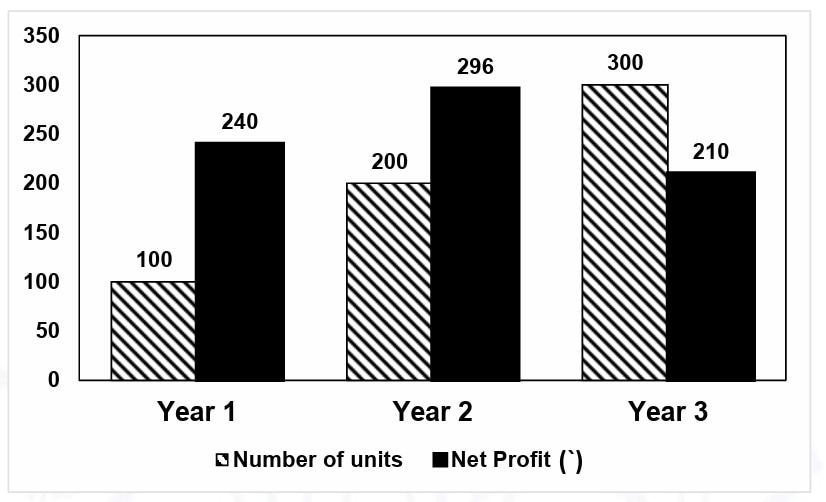
The number of units of a product sold in three different years and the…

2021

The number of units of a product sold in three different years and the respective net profits are presented in the figure above. The cost/unit in Year 3 was ` 1, which was half the cost/unit in Year 2. The cost/unit in Year 3 was one-third of the cost/unit in Year 1. Taxes were paid on the selling price at 10%, 13% and 15% respectively for the three years. Net profit is calculated as the difference between the selling price and the sum of cost and taxes paid in that year.

The ratio of the selling price in Year 2 to the selling price in Year 3 is ________.

  1. A.

    4:3

  2. B.

    1:1

  3. C.

    3:4

  4. D.

    1:2

Attempted by 2 students.

Show answer & explanation

Correct answer: A

Key idea: find the selling price per unit for Year 2 and Year 3. Use net profit per unit = total net profit ÷ number of units, and selling price satisfies selling price × (1 − tax rate) − cost = net profit per unit.

Step 1: Compute net profit per unit.

  • Year 1: 240 ÷ 100 = 2.4 per unit (for completeness).

  • Year 2: 296 ÷ 200 = 1.48 per unit.

  • Year 3: 210 ÷ 300 = 0.7 per unit.

Step 2: Use the formula selling price = (net profit per unit + cost) / (1 − tax rate). Given costs: Year 1 = 3, Year 2 = 2, Year 3 = 1; tax rates: Year 1 = 10%, Year 2 = 13%, Year 3 = 15%.

  • Year 2 selling price = (1.48 + 2) / (1 − 0.13) = 3.48 / 0.87 = 4.

  • Year 3 selling price = (0.7 + 1) / (1 − 0.15) = 1.7 / 0.85 = 2.

Therefore the ratio of selling price in Year 2 to Year 3 = 4 : 2 = 2 : 1.

Note: None of the given answer choices match this correct ratio (2 : 1). The provided answer key entry appears to be incorrect.

Explore the full course: Gate Guidance By Sanchit Sir