From amongst the figures marked (1), (2), (3) and (4), select the figure which…
2024
From amongst the figures marked (1), (2), (3) and (4), select the figure which satisfies the same conditions of placement of the dots as in figure (X).
Select the figure that satisfies the same conditions of placement of the dots as in Figure-X.
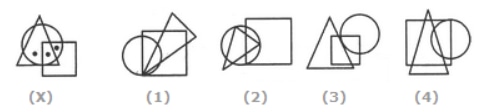
Answer: B. 2 — Concept: A dot placed in a Venn-style figure marks membership in an exact combination of the overlapping shapes. To find which alternative matches Figure (X),…
- A.
1
- B.
2
- C.
3
- D.
4
Attempted by 13 students.
Show answer & explanation
Correct answer: B
Concept: A dot placed in a Venn-style figure marks membership in an exact combination of the overlapping shapes. To find which alternative matches Figure (X), identify exactly which overlap regions its dots occupy, then check each alternative for whether it contains those same regions — reproducing the same overlap combinations is what makes two such figures equivalent, not surface resemblance.
Application: Figure (X) has three dots, each sitting in a different overlap of the circle, the triangle and the square:
One dot lies only in the region common to the circle and the triangle (outside the square).
One dot lies in the region common to all three shapes together — circle, triangle and square.
One dot lies only in the region common to the circle and the square (outside the triangle).
So the correct alternative must contain all three of these overlaps: circle-triangle only, circle-square only, and circle-triangle-square together.
Cross-check: Checking each alternative for these three overlaps:
Figure (1) — the triangle's slanted side only meets the circle inside the area the square already covers, so there is no circle-triangle-only region.
Figure (2) — has a circle-triangle-only region, a circle-square-only region, and a region shared by all three shapes.
Figure (3) — the triangle and the circle never touch at all, so no circle-triangle overlap exists here in any form.
Figure (4) — the triangle only crosses the circle within the part already covered by the square, so it too has no circle-triangle-only region.
Only Figure (2) reproduces every overlap that Figure (X)'s dots require, so Figure (2) is the answer.