From amongst the figures named (1), (2), (3) and (4), select the figure which…
2024
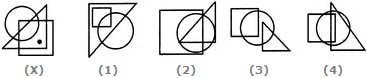
From amongst the figures named (1), (2), (3) and (4), select the figure which satisfies the same conditions of placement of the dots as in figure (X).
Select the figure which satisfies the same conditions of placement of the dots as in Figure-X.
Answer: A. 1 — Concept: In a "dot situation" figure, the marked dot occupies one specific region formed by the overlap of the three shapes (circle, square, triangle) — a…
- A.
1
- B.
2
- C.
3
- D.
4
Attempted by 17 students.
Show answer & explanation
Correct answer: A
Concept: In a "dot situation" figure, the marked dot occupies one specific region formed by the overlap of the three shapes (circle, square, triangle) — a region defined by exactly which shapes contain the dot and which do not. To find the matching alternative, first pin down that exact shape-membership pattern for the dot in Figure (X), then find the one alternative whose circle-square-triangle arrangement actually contains a region with that same membership pattern.
Application:
Check the dot's position against each shape in Figure (X): it lies inside the square's border and inside the triangle's border, but outside the circle's border.
So the dot sits in the region common to the square and the triangle only — a patch that belongs to both the square and the triangle but is not covered by the circle.
Scan each alternative figure for a similarly-shaped patch: an area that is inside both the square and the triangle, yet clear of the circle.
In Figure (1), the square sits entirely inside the triangle's right-angled corner, and the circle covers only part of that square. The uncovered part of the square is therefore inside the square, inside the triangle, and outside the circle — exactly the pattern needed.
Cross-check: none of the remaining figures offer that same patch:
Figure (2): the triangle lies almost entirely outside the square, touching it only at a small corner that is also inside the circle, so no square-and-triangle-only area exists.
Figure (3): the square and the triangle do not overlap at all — the triangle only overlaps the circle — so there is no region shared by the square and the triangle.
Figure (4): the square's overlap with the triangle falls inside the circle's boundary too, leaving no square-and-triangle patch that is free of the circle.
Figure (1) is therefore the figure that reproduces the same placement condition as Figure (X).