Select the figure which satisfies the same conditions of placement of the dots…
2024
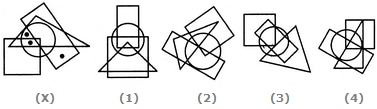
Select the figure which satisfies the same conditions of placement of the dots as in figure (X) from amongst the figures marked (1), (2), (3), (4).
Answer: B. 2 — In a "dot situation" figure-matching question, each dot's position is defined only by which subset of the shapes overlap at that exact spot (for example,…
- A.
1
- B.
2
- C.
3
- D.
4
Attempted by 13 students.
Show answer & explanation
Correct answer: B
In a "dot situation" figure-matching question, each dot's position is defined only by which subset of the shapes overlap at that exact spot (for example, "circle and triangle only", "circle, square and triangle together", or "inside one shape alone, touching no other"). The correct answer figure is whichever redrawn set of shapes reproduces every one of those overlap-subsets seen in Figure (X) -- the size, rotation or exact outline of the shapes does not matter, only which regions of overlap exist.
Reading Figure (X): the first dot sits where the circle and the triangle overlap but the square and the rectangle do not reach that spot; the second dot sits where the circle, the square and the triangle all three overlap together; the third dot sits fully inside the rectangle alone, away from the other three shapes. Checking each option for all three overlap-types:
Figure (1): the triangle's apex only enters the circle at a point that is still inside the square, so there is no "circle-and-triangle-only" region -- it cannot host the first dot.
Figure (2): this arrangement produces a circle-and-triangle-only region, a circle-square-triangle triple-overlap region, AND a patch of the rectangle that touches none of the other shapes -- all three dot positions from Figure (X) can be reproduced here.
Figure (3): the rotated rectangle is threaded entirely through the circle and the triangle, so no part of it stays isolated -- it cannot host the third dot.
Figure (4): the triangle meets the circle only where the square or the rectangle is also present, so there is no "circle-and-triangle-only" region here either -- it cannot host the first dot.
Only Figure (2) offers all three overlap-types at once, so it is the one figure that can reproduce Figure (X)'s dot placement.