Two positions of a parallelepiped are shown below. When the number 3 is on the…
Two positions of a parallelepiped are shown below. When the number 3 is on the top, which number will be at the bottom?
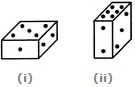
Answer: C. 5 — When the same die or cuboid is shown in two different orientations, and one face value is common to both views, that common face can be held fixed while…
- A.
1
- B.
4
- C.
5
- D.
6
Attempted by 23 students.
Show answer & explanation
Correct answer: C
When the same die or cuboid is shown in two different orientations, and one face value is common to both views, that common face can be held fixed while mentally rotating the solid from the first orientation to the second; tracking the fixed cyclic (rotational) order in which the other visible faces move — as seen in the actual image — pairs up the remaining faces as opposite. Separately, since the six faces are distributed between the common face's own opposite and the four faces arranged cyclically around its axis, a value that appears in NEITHER view is opposite the common face only when the two views together expose all four of those side faces, leaving exactly one value unseen.
Position (i) shows the faces 1, 5 and 2 meeting at one corner; position (ii) shows the faces 6, 2 and 3 meeting at another corner.
The face 2 is common to both positions, so it can be held fixed while mentally rotating the solid from position (i) to position (ii).
Across the two positions, the values 1, 2, 3, 5 and 6 are all visible (2 is common to both), and only 4 is never visible in either view — so 4 must be the face directly opposite the common face 2.
Reading the actual spatial arrangement of the faces around the shared corner in each position of the image: tracking the rotation about the 2-4 axis carries face 1 (from position i) onto the face opposite 6 (in position ii), and carries face 5 onto the face opposite 3. So 1 is opposite 6, and 5 is opposite 3.
Since 3 is opposite 5, placing 3 on the top forces 5 to be directly on the bottom.
As an independent check: the three opposite pairs must partition all six faces exactly once. Face 2 is already paired with 4 (the only value unseen in either view), and the rotation tracked above pairs 1 with 6. That leaves only 3 and 5 unassigned, so they must be opposite each other — confirming 5 is opposite 3 without needing to track that pair directly.
Hence, the number at the bottom is 5.