Three different positions of the same dice are shown below. Find the number of…
Three different positions of the same dice are shown below. Find the number of dots on the face opposite to the face carrying one dot.
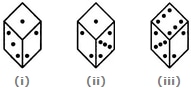
Answer: D. 6 — Concept: When two faces of a die appear together in the same view, they necessarily share an edge and can never be opposite each other. If a particular face…
- A.
2
- B.
3
- C.
4
- D.
6
Attempted by 10 students.
Show answer & explanation
Correct answer: D
Concept: When two faces of a die appear together in the same view, they necessarily share an edge and can never be opposite each other. If a particular face recurs as the common reference across two different views (for example, always showing on top), then every other face paired with it in either view is confirmed to be adjacent to it, never its opposite. A face has exactly four neighbours and exactly one opposite, so once four distinct neighbours of a face are confirmed, its opposite is fixed as whichever value remains.
In positions (i) and (ii), the face carrying one dot appears on top in both. In (i) the other two visible faces carry three dots and two dots; in (ii) they carry two dots and five dots. So the one-dot face is confirmed adjacent to the three-dot, two-dot, and five-dot faces -- none of these three can be its opposite.
Only the four-dot and six-dot faces remain untested against the one-dot face.
In position (iii), the six-dot face appears together with the two-dot face and the five-dot face, so the six-dot face is confirmed adjacent to both of them.
The two-dot face is now confirmed adjacent to four faces across the three positions: the one-dot, three-dot, five-dot, and six-dot faces. Since a face has only four neighbours, the four-dot face -- the only value not yet linked to the two-dot face -- must be the two-dot face's opposite, which also makes the four-dot face adjacent to the one-dot face (through the two-dot face's remaining neighbours).
With the three-dot, two-dot, five-dot, and now four-dot faces all confirmed adjacent to the one-dot face, only the six-dot face is left unassigned. It must therefore be the face opposite the one-dot face.
Cross-check: opposite faces always share the identical set of four neighbours. If the six-dot face is indeed opposite the one-dot face, it should be adjacent to exactly the two-dot, three-dot, four-dot, and five-dot faces -- and position (iii) directly confirms the six-dot face sitting beside both the two-dot and five-dot faces, matching the prediction.
So the face opposite the face carrying one dot has six dots.