A dice is rolled twice and the two positions are shown in the figure below.…
A dice is rolled twice and the two positions are shown in the figure below. What is the number of dots at the bottom face when the dice is in position (i)?
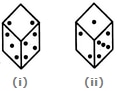
Answer: C. 6 — Concept: When the same die is rolled to two different positions, every face keeps one fixed opposite face across both views. In any single view, the three…
- A.
1
- B.
5
- C.
6
- D.
Cannot be determined
Attempted by 14 students.
Show answer & explanation
Correct answer: C
Concept: When the same die is rolled to two different positions, every face keeps one fixed opposite face across both views. In any single view, the three faces not shown are exactly the three values other than the ones visible, and one of these three hidden faces is the true opposite of each visible face - so if a face value appears as visible in both views, its opposite value must lie in the hidden-face set of BOTH views at once.
Applying this to the two positions:
In position (i), the faces showing dots are 2 (top), 3 (left) and 4 (right); the three faces not shown are therefore the remaining values 1, 5 and 6, in some order, as the bottom, back-left and back-right faces.
In position (ii), the faces showing dots are 1 (top), 2 (left) and 5 (right); the three faces not shown are therefore 3, 4 and 6, in some order.
The value 2 is visible in both positions (on top in (i), on the left in (ii)), so it is the same physical face in both views, and its opposite face is one fixed number for this die.
That fixed opposite of 2 must belong to the hidden set of position (i), {1, 5, 6}, AND to the hidden set of position (ii), {3, 4, 6} - both conditions must hold together.
Comparing the two hidden sets, the only number common to {1, 5, 6} and {3, 4, 6} is 6, so the face opposite 2 is 6.
In position (i), 2 is on top, so its opposite face - the bottom face - carries 6.
Cross-check: removing 6 from each hidden set leaves {1, 5} in position (i) pairing with faces 3 and 4, and {3, 4} in position (ii) pairing with faces 1 and 5 - the same 3-4 / 1-5 opposite grouping in both views, with no contradiction.