Study the information given below carefully, and answer the question that…
2023
Study the information given below carefully, and answer the question that follow:
On a stage, D, N, A, K and P are standing as described below facing North.
1) N is 2.5 m to the west of A.
2) K is 4 m to the right of A.
3) D is 6 m to the south of K.
4) P is 9 m to the north of D.
Who is to the south-west of P?
Answer: A. A — Concept: Direction-and-distance problems are solved by placing every point on one coordinate grid with North as +y and East as +x, then adding each stated…
- A.
A
- B.
D
- C.
K
- D.
Neither N nor A
Attempted by 1 students.
Show answer & explanation
Correct answer: A
Concept: Direction-and-distance problems are solved by placing every point on one coordinate grid with North as +y and East as +x, then adding each stated displacement as a vector step by step. Once two points have coordinates, the direction from one point to another is read directly off the sign of the net (Δx, Δy): a negative Δx together with a negative Δy means the second point lies to the south-west of the first.
Fix A at the origin: A = (0, 0).
N is 2.5 m to the west of A, so N = (-2.5, 0).
K is 4 m to the right (east) of A, so K = (4, 0).
D is 6 m to the south of K, so D = (4, -6).
P is 9 m to the north of D, so P = (4, -6 + 9) = (4, 3).
The displacement from P to A is (0 - 4, 0 - 3) = (-4, -3): 4 m west and 3 m south of P. Both components are negative, so A lies to the south-west of P.
Cross-check: Working the same chain the other way from P confirms this independently: P is 3 m north of K (P is 9 m north of D and D is 6 m south of K, so the net displacement from K to P is 9 - 6 = 3 m north), and K is 4 m east of A, so P is 3 m north and 4 m east of A — equivalently, A is 3 m south and 4 m west of P, the same south-west result.
D and K both lie on the same north-south line as P (their east-west offset from P is zero), so both are due south of P, not south-west. Among the named candidates, A is 4 m west and 3 m south of P, so A does lie to the south-west of P — that alone is enough to make the compound claim 'neither N nor A' false, since A demonstrably qualifies.
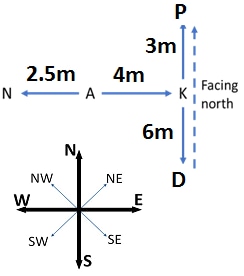
ANSWER: A is to the south-west of P.