Ravindra Jadeja left home and ran 20 km towards South. He then turned right…
2025
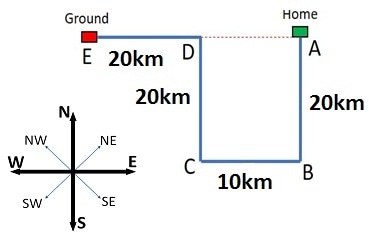
Ravindra Jadeja left home and ran 20 km towards South. He then turned right and ran 10 km. He took rest for ten minutes at the same spot, and then again turned right and ran 20 km. After this, he turned left and ran 20 km to reach the cricket ground.
How many kilometers will he have to run to get back home?
Answer: D. 30 km — Concept: In direction-sense problems, when a person moves along one axis and later moves the same distance in exactly the opposite direction on that same axis…
- A.
15 km
- B.
67 km
- C.
35 km
- D.
30 km
Attempted by 1 students.
Show answer & explanation
Correct answer: D
Concept: In direction-sense problems, when a person moves along one axis and later moves the same distance in exactly the opposite direction on that same axis (for example South then North, or East then West), those two legs cancel each other out and add nothing to the final displacement. The distance needed to return to the starting point is the straight-line net displacement between the finishing point and the start -- not the total distance walked -- so only the un-cancelled segments along each axis need to be combined. A right turn changes the facing direction by 90 degrees clockwise, and a left turn by 90 degrees counter-clockwise, from whichever direction is currently faced.
Start at Home (A) and run 20 km South to reach point B.
At B, turn right -- a right turn from South faces West -- and run 10 km West to reach point C.
At C, turn right again -- a right turn from West faces North -- and run 20 km North to reach point D.
At D, turn left -- a left turn from North faces West -- and run 20 km West to reach the cricket ground, E.
Compare the vertical legs: 20 km South (A to B) and 20 km North (C to D) are equal in length and opposite in direction, so they cancel out completely -- the ground E lies on the same horizontal line as Home A.
Add the un-cancelled horizontal legs: 10 km (B to C) plus 20 km (D to E) equals 30 km. This is the straight-line distance from the ground back to Home.
Cross-check: Cross-check with coordinates: taking Home as the origin (0, 0) with East and North as the positive axes, the path goes to (0, -20) after moving South, to (-10, -20) after moving West, to (-10, 0) after moving North, and to (-30, 0) after moving West again. The straight-line distance from (-30, 0) back to (0, 0) is 30 km, confirming the result.
So he will have to run 30 km to get back home.