

Virtual Memory MCQs: 12 Cross-Concept Questions with Explanations
Test virtual-memory fundamentals across demand paging, address translation, cache colouring and page replacement. Each of the 12 MCQs includes a direct explanation.
KnowledgeGate Team
Exam prep & CS education
Updated 30 Oct 20268 min read156 views
Virtual-memory MCQs jump among address spaces, demand loading, page tables, cache synonyms, replacement and other OS concepts. Attempt each question before checking its explanation, and note which concept family each miss belongs to. For a refresher on the fundamentals, revise Memory Hierarchy and Virtual Memory Explained first.
Classify the question before calculating
Classify each item as address-space, demand-loading, translation/cache, replacement or cross-OS; note the bits, page size, frames, string or policy. With 32-bit byte addressing and 4 KiB pages, 0x12345ABC splits into VPN 0x12345, offset 0xABC; virtual space is 4 GiB.
Questions 1-2: separate virtualization, virtual memory and physical memory
Question 1
Indian Space Research Organization, Computer Science, 2023
State whether true or false:
1. Virtualization facilitates multiple OS simultaneously on the same hardware
2. In dual boot, multiple OS can run simultaneously
A. (i) True (ii) False
B. (i) False (ii) True
C. (i) True (ii) True
D. (i) False (ii) False
Answer: A. (i) True (ii) False.
A hypervisor can run multiple operating systems concurrently. Dual boot starts only one; virtual memory is unrelated.
Question 2
LTI Mindtree, 2025
Which of the following statements is correct about virtual memory?
A. It is a combination of the logical-memory and physical-memory
B. It is a separation of user logical memory and physical memory
C. It is a virtual network memory
D. None of the these
Answer: B. It is a separation of user logical memory and physical memory.
Virtual memory separates logical addresses from physical frames. Translation maps between them; it does not combine them.
Questions 3-4: judge virtual-memory benefits without overclaiming
Question 3
Capgemini, 2024
Consider the following statements regarding the usage of virtual memory.
1. To free user programs from the need to carry out storage allocation and to permit efficient sharing of the available memory space among different users.
2. To make program independent of the configuration and capacity of the physical memory for their execution.
3. To achieve higher CPU performance.
4. To achieve the very low access time and cost per bit that is possible with a memory hierarchy.
Which of the above are correct?
A. 1, 2 and 3
B. 2, 3 and 4
C. 1, 3 and 4
D. 1, 2 and 4
Answer: D. 1, 2 and 4.
Managed allocation hides placement and supports sharing, validating 1 and 2. Statement 4 is the hierarchy goal; fault overhead refutes 3 as a guarantee.
Question 4
Wipro, 2023
Select the incorrect statement about virtual memory
(1) It increase the degree of multiprogramming.
(2) Does not allow address space to be shared by several process
(3) reduces the context switching overhead
(4) Less I/O or loading and unloading for individual user process
A. 1, 2 and 3 only
B. 3 and 4 only
C. 2 and 3 only
D. 2, 3 and 4 only
Answer: C. 2 and 3 only.
Active pages raise multiprogramming and reduce initial loading. Sharing is allowed, but context switching is not inherently faster; therefore 2 and 3 are incorrect.
Questions 5-6: connect demand loading to address-space size
Question 5
LTI Mindtree, 2025
Techniques that automatically move program and data blocks into physical main memory when they are required for execution are called
A. Main memory techniques
B. Cache memory techniques
C. Virtual memory techniques
D. Associate memory techniques
Answer: C. Virtual memory techniques.
"When they are required" identifies demand paging: a fault loads the missing page. Caches move smaller blocks.
Question 6
Infosys, 2023
Size of virtual memory depends on
A. Address line
B. Data Base
C. Disc Space
D. All the above
Answer: A. Address line.
An n-bit address names 2^n locations. Byte-addressed 32- and 48-bit spaces hold 4 GiB and 256 TiB; backing store does not set address width. Demand loading controls when a page becomes resident; address width controls how many virtual locations the process can name.
Questions 7-8: solve matching sets by locking direct pairs first
Question 7
UGC NET, Computer Science, Paper 2 December, 2015
Match the following with respect to various memory-management algorithms:
List I: (a) Demand paging; (b) Segmentation; (c) Dynamic partitions; (d) Fixed partitions.
List II: (i) degree of multiprogramming; (ii) working set; (iii) supports the user view of memory; (iv) compaction.
Codes:
A. (a)-(iii), (b)-(iv), (c)-(ii), (d)-(i)
B. (a)-(ii), (b)-(iii), (c)-(i), (d)-(iv)
C. (a)-(iv), (b)-(iii), (c)-(ii), (d)-(i)
D. (a)-(ii), (b)-(iii), (c)-(iv), (d)-(i)
Answer: D. (a)-(ii), (b)-(iii), (c)-(iv), (d)-(i).
Segmentation supports the user view; dynamic partitions require compaction. Demand paging pairs with working set, leaving fixed partitions with multiprogramming degree.
Solved Q7.
Question 8
UGC NET, Computer Science, Paper 2 December, 2022
Match List I with List II
List I List II
A. IPC I. Resource Allocation
B. Demand Paging II. Computational speedup
C. Banker's Algorithm III. Task Control Block
D. PCB IV. Virtual Memory
Choose the correct answer from the options given below:
A. A-II, B-I, C-IV, D-III
B. A-II, B-IV, C-I, D-III
C. A-I, B-II, C-III, D-IV
D. A-II, B-III, C-I, D-IV
Answer: B. A-II, B-IV, C-I, D-III.
Demand paging maps to virtual memory, Banker's Algorithm to resource allocation, and PCB to task control block. IPC maps to computational speedup, selecting B.
Questions 9-10: combine page translation with neighbouring OS facts
Question 9
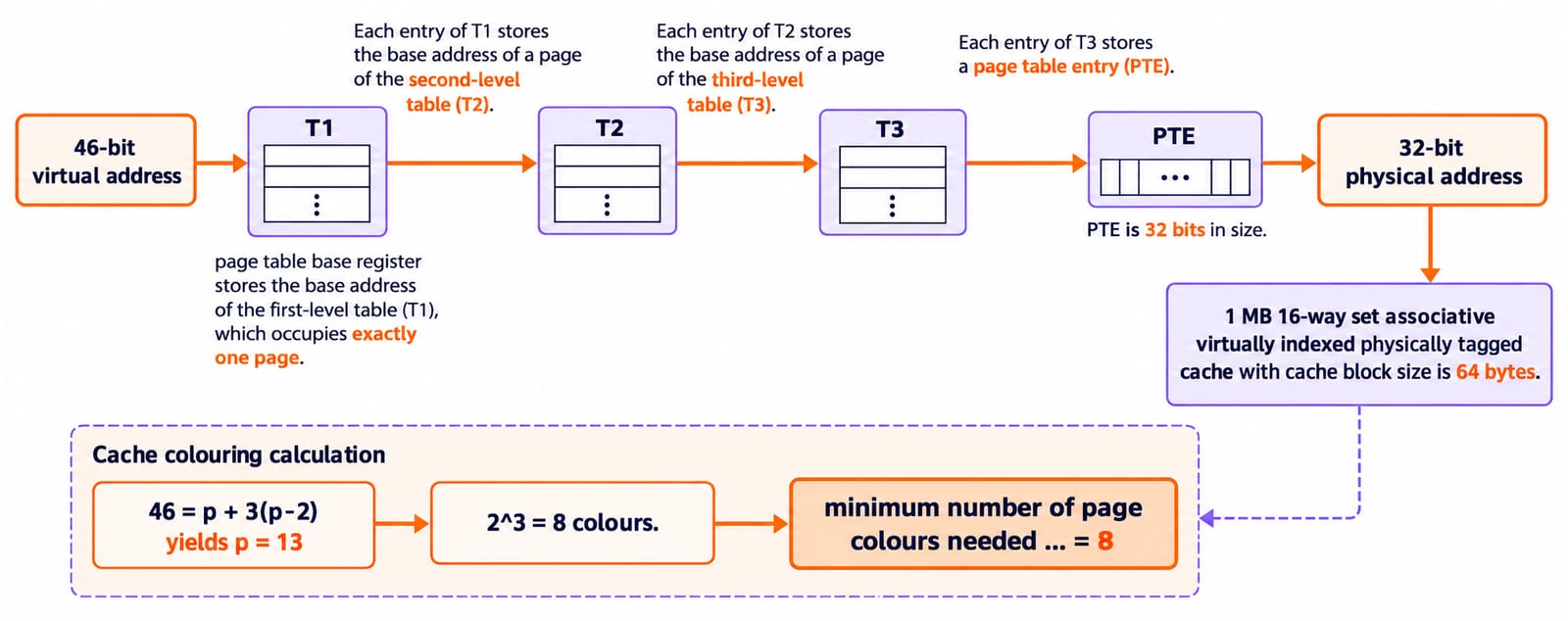
GATE, Computer Science, 2013; BARC, Computer Science, 2013
A computer uses 46-bit virtual address, 32-bit physical address, and a three-level paged page table organization. The page table base register stores the base address of the first-level table (T1), which occupies exactly one page. Each entry of T1 stores the base address of a page of the second-level table (T2). Each entry of T2 stores the base address of a page of the third-level table (T3). Each entry of T3 stores a page table entry (PTE). The PTE is 32 bits in size. The processor used in the computer has a 1 MB 16-way set associative virtually indexed physically tagged cache. The cache block size is 64 bytes.
What is the minimum number of page colours needed to guarantee that no two synonyms map to different sets in the processor cache of this computer?
A. 2
B. 4
C. 8
D. 16
Answer: C. 8.
With page size 2^p, 4-byte entries give 2^(p-2) entries, so 46 = p + 3(p-2) yields p = 13. The cache has 2^20 / (2^4 x 2^6) = 2^10 sets and 16 offset/index bits; three exceed the page offset, requiring 2^3 = 8 colours.
Question 10
UGC NET, Computer Science, 2023
Consider the following statements:
S1: LRU page replacement algorithm suffers from the Belady’s anomaly.
S2: Shortest remaining time first scheduling may cause starvation.
S3: Stack is shared by all threads in a process.
A. S1, S2 and S3 are true
B. S1, S3 are false and S2 is true
C. S1, S2 are false and S3 is true
D. S1, S2 and S3 are false
Answer: B. S1, S3 are false and S2 is true.
LRU avoids Belady's anomaly; short arrivals can starve an SRTF job. Threads have private stacks; only S2 is true.
Questions 11-12: trace page replacement without losing the order
Question 11
UGC NET, Computer Science, Paper 2 June, 2013
A job has four pages A, B, C, D and the main memory has two page frames only. The job needs to process its pages in following order ABACABDBACD. Assuming that a page interrupt occurs when a new page is brought in the main memory, irrespective of whether the page is swapped out or not. The number of page interrupts in FIFO and LRU page replacement algorithms are
A. 9 and 7
B. 7 and 6
C. 9 and 8
D. 8 and 6
Answer: C. 9 and 8.
FIFO faults at 1, 2, 4, 5, 6, 7, 9, 10, 11; LRU at 1, 2, 4, 6, 7, 9, 10, 11. The counts are 9 and 8; position 5 is the first divergence.
A | B | A | C | A | B | D | B | A | C | D | |
|---|---|---|---|---|---|---|---|---|---|---|---|
FIFO F1 | A | A | A | C | C | B | B | B | A | A | D |
FIFO F2 | B | B | B | A | A | D | D | D | C | C | |
FIFO result | F | F | H | F | F | F | F | H | F | F | F |
A | B | A | C | A | B | D | B | A | C | D | |
|---|---|---|---|---|---|---|---|---|---|---|---|
LRU F1 | A | A | A | A | A | A | D | D | A | A | D |
LRU F2 | B | B | C | C | B | B | B | B | C | C | |
LRU result | F | F | H | F | H | F | F | H | F | F | F |
Solved Q11.
Question 12
UGC NET, Computer Science, Paper 2 August, 2016
Consider the following page reference string :
1, 2, 3, 4, 2, 1, 5, 6, 2, 1, 2, 3, 7, 6, 3, 2, 1, 2, 3, 6
Which of the following options, gives the correct number of page faults related to LRU, FIFO, and optimal page replacement algorithms respectively, assuming 05 page frames and all frames are initially empty ?
A. 10, 14, 8
B. 8, 10, 7
C. 7, 10, 8
D. 7, 10, 7
Answer: B. 8, 10, 7.
LRU keeps 1 and 2 recent, then faults when 3 and 7 return outside the five-frame working set. FIFO replaces in arrival order; hits do not refresh that order. Optimal evicts 5 for 6 and 4 for 7 because neither victim is needed again. The independently traced totals are 8, 10 and 7.
Algorithm | Fault positions | Count |
|---|---|---|
LRU | 1, 2, 3, 4, 7, 8, 12, 13 | 8 |
FIFO | 1, 2, 3, 4, 7, 8, 10, 11, 12, 13 | 10 |
Optimal | 1, 2, 3, 4, 7, 8, 13 | 7 |
Solved Q12.
Score by concept family and choose the next step
Group misses by family: Q1-2 definitions, Q3-4 benefits, Q5-6 demand loading and address space, Q7-8 matching, Q9-10 translation and cross-OS facts, and Q11-12 replacement traces. Retry a family after two misses; review its named rule after one miss, and move on after zero.
Page Replacement MCQs: 12 Solved (FIFO, LRU, Optimal) owns the dedicated FIFO, LRU and Optimal drill. Questions 11-12 here test whether you can switch into trace mode inside a mixed virtual-memory set.
Virtual Memory & Demand Paging MCQs: 12 Solved PYQs focuses on page-fault behaviour, effective access time, thrashing and frame allocation. This set focuses on cross-concept switching through virtualization, cache colouring, matching and neighbouring OS facts.
Use the GATE Test Series for mixed practice or continue through GATE CS Exam Preparation.
Keep learning
Virtual Memory and Demand Paging MCQs: 12 solved questions with explanations
Virtual memory and demand paging MCQs for GATE, UGC NET and placement: address translation, page-table size, effective access time, thrashing, frames.
Updated 29 Oct 20268 min read105 viewsOperating System MCQs
JVM Architecture and Lifecycle MCQs: 12 Solved Java Questions with Explanations
Solve 12 published JVM questions, then use the explanations to separate bytecode, loading, execution, memory areas, reachability and runtime type checks.
Updated 17 Nov 20267 min readJava

Control Unit Design Cross-Concept MCQs: 12 Solved Questions with Explanations
Solve 12 published Control Unit Design questions covering address capacity, datapath scheduling, DRAM refresh, register widths, bitwise arithmetic and decoding. Each answer shows the decision or calculation that matters.
Updated 30 Oct 20267 min readComputer Organization MCQs

Cross-Concept Algorithm MCQs: 12 Solved Multi-Topic Questions with Explanations
Twelve solved cross-concept algorithm MCQs on design paradigms, Euclid's GCD, tournament comparisons, max flow, NP-completeness and red-black tree height.
Updated 23 Aug 20267 min readAlgorithms MCQs