

Types of Semaphores MCQs: 11 Solved Questions on P, V and Mutex
Solve 11 semaphore MCQs on counting-value arithmetic, option-order traps and a broken mutex trace. Each explanation shows the deciding equation or interleaving.
KnowledgeGate Team
Exam prep & CS education
Updated 31 Oct 20268 min read64 views

Semaphore MCQs look simple, but errors come from reversing P and V, rejecting a negative count, or trusting a variable named mutex. Solve these 11 MCQs before reading each explanation, using one ledger: S_final = S_initial - completed P operations + completed V operations. Review terms at CS Fundamentals, then calculate before checking options. Atomic operations, waiting queues, starvation, barriers, handoffs and the ten-process GATE 1997 mutex variant are worked in Semaphores and Process Ordering MCQs: 10 Solved Questions; counting-value questions instead require repeated equation checks, while the Coal India 2017 variant uses eight processes to test the same unmatched-signal defect at a different scale.
Lock the semaphore ledger before solving
A counting semaphore represents permits: P, wait, or down consumes one; V, signal, or up returns one. A negative extended count records waiting demand. A binary semaphore is 0 or 1, but exclusion still requires P(mutex) before the critical section and V(mutex) after it.
Start with S = 3. P1 executes P, so S = 2; P2 executes P, giving 1; P3 executes P, giving 0. P4 attempts P, producing -1 and blocking. P1 executes V, taking the count to 0 and waking P4; P4 consumes that release. P2 executes V
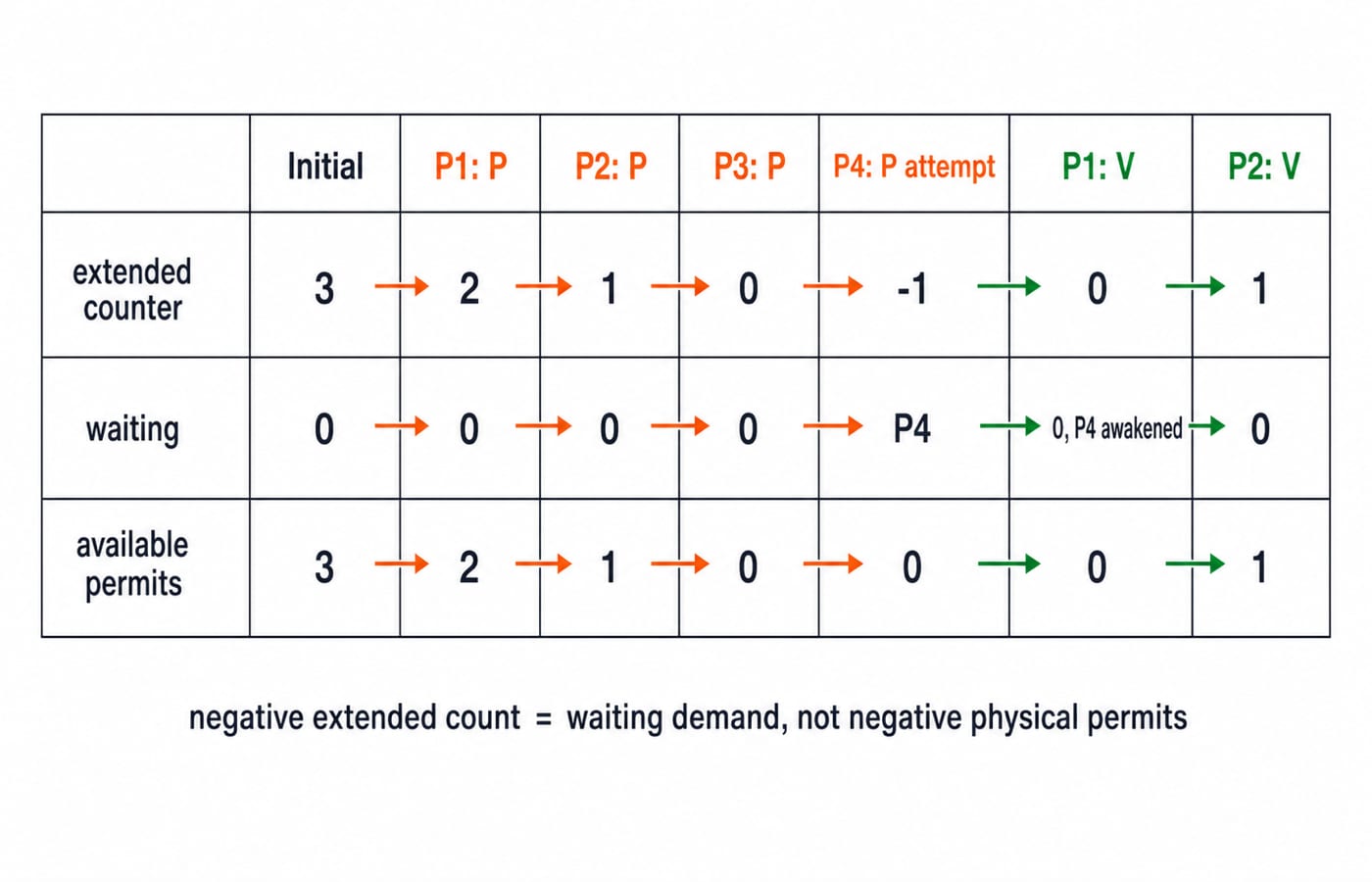
Types of semaphores MCQs 1-3: net change and option order
Find the net change as V - P, add it to the initial value, then map the result to the current options.
Question 1 (GATE 1998)
A counting semaphore was initialized to 10. Then 6 P (wait) operations and 4 V (signal) operations were completed on this semaphore. The resulting value of the semaphore is
A. 0
B. 8
C. 10
D. 12
Correct answer: B. 8.
Apply the signs: 10 - 6 + 4 = 8. The net change 4 - 6 = -2 also takes 10 to 8. Option 10 ignores the imbalance; 12 reverses it. Because the operations completed, no schedule is needed.
Question 2 (GATE 1998)
A counting semaphore was initialized to 10. Then 6 P (wait) operations and 4 V (signal) operations were completed on this semaphore. The resulting value of the semaphore is:
A. 0
B. 10
C. 12
D. 8
Correct answer: D. 8.
Recalculate: 10 - 6 + 4 = 8. Here 8 is D, not B. The reordered options test whether you carry the numerical result to the choices instead of remembering another version's letter.
Question 3 (GATE 1992)
At a particular time of computation the value of a counting semaphore is 7. Then 20 P operations and 15 V operations were completed on this semaphore. The new value of the semaphore will be
A. 42
B. 2
C. 7
D. 12
Correct answer: B. 2.
Compute 7 - 20 + 15 = 2. Equivalently, 15 - 20 = -5, then 7 - 5 = 2. An extended ledger may pass below zero to record waiting demand; the final 2 means two permits remain.
Types of semaphores MCQs 4-6: choose the operation set and solve for x
For a target, write final = initial - P + V. Test every statement in Question 4; isolate x in Questions 5 and 6.
Question 4 (ISRO 2017)
At particular time, the value of a counting semaphore is 10, it will become 7 after: (a) 3 V operations (b) 3 P operations (c) 5 V operations and 2 P operations (d) 2 V operations and 5 P operations Which of the following option is correct?
A. Only (b)
B. Only(d)
C. Both (b) and (d)
D. None of these
Correct answer: C. Both (b) and (d).
Evaluate each statement: (a) 10 + 3 = 13; (b) 10 - 3 = 7; (c) 10 + 5 - 2 = 13; (d) 10 + 2 - 5 = 7. Therefore both (b) and (d) reach 7. Operation order does not change this completed-count arithmetic.
Question 5 (ISRO 2017)
A counting semaphore was initialized to 7. Then 20 P (wait) operations and x V (signal) operations were completed on this semaphore. If the final value of semaphore is 5, then the value x will be
A. 0
B. 13
C. 18
D. 5
Correct answer: C. 18.
Write 7 - 20 + x = 5, so x = 5 - 7 + 20 = 18. Check: 7 - 20 + 18 = 5. The tempting 13 is the deficit after 20 waits, not the signals needed to finish at 5.
Question 6 (ISRO 2016, UGC NET 2023)
At a particular time of computation the value of a counting semaphore is 7. Then 20p operations and 'x' V operations were completed on this semaphore. If the Final value of semaphore is 5 ,x will be
A. 18
B. 22
C. 15
D. 13
Correct answer: A. 18.
Treat lowercase 20p as 20 P operations: 7 - 20 + x = 5, so x = 18, now at A. Here 22 ignores the equation, while 13 is only the post-wait deficit. Check: 7 - 20 + 18 = 5.
Types of semaphores MCQs 7-10: repeat without inheriting a letter
Repeated forms expose memorised option letters. Write a one-line equation even when the numbers look familiar.
Question 7 (ISRO 2015)
At a particular time of computation the value of a counting semaphore is 7. Then 20 P operations and 15 V operations were completed on this semaphore. The resulting value of the semaphore is :
A. 42
B. 2
C. 7
D. 12
Correct answer: B. 2.
Write 7 - 20 + 15 = 2. Option 42 adds everything, 12 reverses the signs, and 7 assumes equal waits and signals. Retain 2, not its letter.
Question 8 (UGC NET 2018)
At a particular time of computation, the value of a counting semaphore is 10. Then 12 P operations and "x" V operations were performed on this semaphore. If the final value of semaphore is 7, x will be
A. 8
B. 9
C. 10
D. 11
Correct answer: B. 9.
Set up 10 - 12 + x = 7, so x = 7 - 10 + 12 = 9. Verify: 10 - 12 + 9 = 7. Keeping the target in the equation avoids nearby distractors.
Question 9 (UGC NET 2019)
At a particular time of computation, the value of a counting semaphore is 7. Then 20 P (wait) operations and 15 V (signal) operations are completed on this semaphore. What is the resulting value of the semaphore?
A. 28
B. 12
C. 2
D. 42
Correct answer: C. 2.
Preserve the signs: 7 - 20 + 15 = 2. Questions 3 and 7 put 2 at B; here it is C. Option 12 comes from the reversed-sign calculation 7 + 20 - 15. Calculate, then map.
Question 10 (UGC NET 2019)
A counting semaphore is initialized to 8. 3 wait ( ) operations and 4 signal ( ) operations are applied. Find the current value of semaphore variable.
A. 9
B. 5
C. 1
D. 4
Correct answer: A. 9.
Calculate 8 - 3 + 4 = 9. Signals exceed waits by one, so the net change is +1. Option 5 stops after the waits and ignores four signals; the empty parentheses change nothing.
Types of semaphores MCQ 11: when an unmatched V breaks mutex
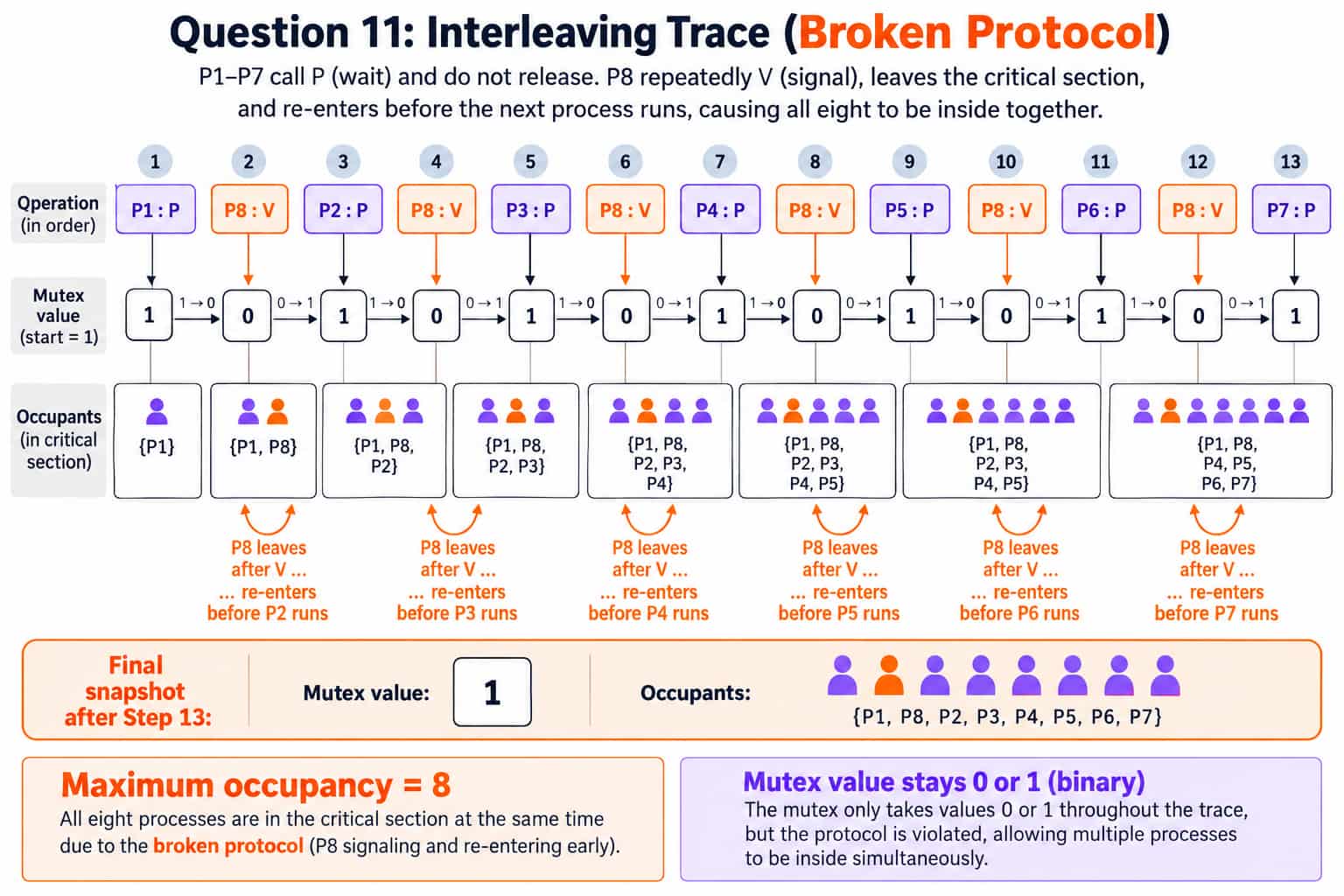
A correct pattern requires P(mutex) before CS and one matching V(mutex) afterwards. P8 begins with V(mutex), creating admission without first consuming it.
Question 11 (Coal India 2017)
Let each process Pi, i = 1 to 7 executes the following code.

repeat
    P(mutex);
    CS
    V(mutex);
forever
The process P8 executes the following code:
repeat
    V(mutex);
    CS
    V(mutex);
forever
What is the maximum number of processes that can be present in the critical section at any point of time?
Given that the initial value of binary semaphore variable “mutex” is 1.
A. 7
B. 8
C. 1
D. 10
Correct answer: B. 8.
A legal schedule reaches eight occupants. P1 waits and enters, then P8 signals and enters, and P2 consumes that signal. On each P8 loop, schedule one waiting process after P8's exit signal and another after its next leading signal. In order, admit P3 and P4, then P5 and P6, then P7; finally P8 re-enters while P1 through P7 remain paused. All eight processes are then in the critical section.
The semaphore value stays binary: it alternates between 0 and 1 and is 1 at the final snapshot, while the occupant count is 8. Option 1 assumes a valid protocol, 7 omits P8, and 10 exceeds the eight processes in the stem. Review Process Synchronization and Semaphores.
Separate binary and counting semaphore claims
Question to ask | Counting semaphore | Binary semaphore |
|---|---|---|
Value meaning | Available permits or extended waiting demand | Logical 0/1 state |
Typical use |
| One-at-a-time exclusion or event signalling |
| Consume one or block | Change 1 to 0 or block |
| Return one or wake a waiter | Release and possibly wake one waiter |
Safety condition | Correct initial count and balanced operations | Every entrant follows wait, CS, signal |
A mutex is ownership-aware; a semaphore may be signalled by another process. Identical ranges do not guarantee identical safety. Continue with Process Synchronization MCQs: 12 Solved Questions for critical-section practice.
Audit the five traps before counting the score
Trap | Wrong move | Correction |
|---|---|---|
Reversed signs |
| Use |
Intermediate as final | Stop after P | Apply both operation counts |
Letter memory | Recall an earlier option | Recompute, then map choices |
Negative means impossible | Reject an extended negative count | Read it as waiting demand in this model |
| Trust the variable name | Check that every process waits before CS |
Check in 20 seconds: write S0 - P + V, substitute, verify net change, then inspect option order. For code, list processes crossing or bypassing P
Short version and the next practice step
Keep this chain: P/wait consumes; V/signal returns; counting tracks permits; a negative extended count tracks waiting demand; binary is 0/1; exclusion still needs a correct wait-CS-signal protocol.
Retry missed arithmetic without options: write the equation, calculate, then map. Reconstruct Question 11 until all eight processes are accounted for. For broader revision, use Computer Science Fundamentals for Placements by Sanchit Sir. Now solve all 11 again, circling each sign first.
Keep learning

Types of Semaphores: Binary, Counting and Mutex with Worked Examples
Learn what semaphore values mean, when calls block, and how counting, binary and mutex primitives differ through resource, lost-update and buffer traces.
Updated 19 Nov 20266 min readOperating Systems
Semaphores and Process Ordering MCQs: 10 Solved Questions
Solve 10 semaphore MCQs with worked state traces for count arithmetic, waiting queues, forced alternation, stale reads, barriers and deadlock prevention.
Updated 29 Oct 20268 min readOperating System MCQs

Semaphores and Process Ordering in OS: P/V Traces, Worked Examples and GATE Traps
Learn one consistent semaphore convention, then trace ordering constraints, shared-variable updates, bounded-buffer permits, rendezvous, and deadlock step by step.
Updated 13 Oct 20265 min readOperating Systems

Process Synchronization in Operating Systems: Semaphores, Critical Sections and Worked Examples
Build process-synchronization reasoning from a lost update to critical-section rules, semaphore operations, a capacity-3 buffer trace and common failure patterns.
Updated 13 Aug 20267 min readOperating Systems