Unsupervised Learning and Clustering MCQs: 12 Solved Questions with Explanations
Solve 12 previous-year MCQs on learning paradigms, K-means, linkage and Kohonen maps, with compact explanations and two checked numerical examples.
KnowledgeGate Team
Exam prep & CS education
Updated 1 Aug 20268 min read61 views
Unsupervised learning and clustering recur in UGC NET Paper 2 and papers from ISRO, BEL, IBPS, DSSSB, MPPSC and Beltron. The traps are labels, similar algorithm names, K-means steps, distance metrics and Kohonen networks. The twelve previous-year questions below are drawn from roughly twenty that KnowledgeGate holds on this subtopic, and they cover every pattern that repeats. Attempt each one before reading its explanation, then practise the rest in the Unit 10 Artificial Intelligence learn module.
Related reading: perceptron MCQs and AI and ML syllabus.
Labelled versus unlabelled learning: supervised, unsupervised and reinforcement
Supervised learning maps inputs to known outputs using labelled pairs. Unsupervised learning gets no labels and finds structure on its own. Reinforcement learning uses reward and punishment. Memory hook: supervised has an answer key, unsupervised does not, and reinforcement gives marks after an action. For broader unit priorities, see UGC NET Computer Science High-Yield Topics.
Q1. Beltron Programmer 2025
What is the primary characteristic of unsupervised learning in machine learning?
(a) It analyzes data that has no associated labels.
(b) It requires both input and output values.
(c) It uses data with known labels for training.
(d) It learns by receiving feedback in the form of rewards.
Answer: (a). No associated labels is the defining clue. The algorithm must discover structure itself. Options (b) and (c) describe supervised learning, while (d) describes reinforcement learning.
Q2. Beltron Programmer 2025
Which of the following statements accurately describes the concept of supervised learning in machine learning?
(a) Data instances are clustered solely by inherent similarities without guidance.
(b) The system learns through trial and error based on feedback without labeled examples.
(c) The model identifies structure in data without predefined labels.
(d) The learning process involves mapping inputs to known outputs using labeled data.
Answer: (d). Known outputs and labelled data define supervised learning. Options (a) and (c) are unsupervised, while (b) is reinforcement learning. Treat Q1 and Q2 as one flash card for labels, no labels and rewards.
Q3. BEL 2023
Match the machine learning technique with its way of working.
Machine learning type | Methods |
|---|---|
I. Supervised learning | 1. Utilizes data that is not labelled and attempts to find patterns by clustering similar objects together |
II. Unsupervised learning | 2. Work on the principle of reward and punishment |
III. Reinforcement | 3. Utilizes a labelled dataset |
(a) I - 1; II - 3; III - 2
(b) I - 1; II - 2; III - 3
(c) I - 3; II - 2; III - 1
(d) I - 3; II - 1; III - 2
Answer: (d). Lock the easiest pair first: reinforcement uses reward and punishment, so III matches 2. That eliminates (b) and (c). Supervised uses a labelled dataset, so I matches 3, eliminating (a) and leaving (d).
Spot the unsupervised algorithm in a lineup
Keep a small scoreboard. Decision trees, K-nearest neighbors, regression, Naive Bayes, support vector machines and linear discriminant analysis are supervised. K-means, K-medians, hierarchical clustering and self-organizing maps are unsupervised. Expectation maximization is used to fit mixture models and supports soft clustering.
Q4. IBPS 2025
Which of the following is not a supervised machine learning algorithm?
(a) Decision Tree
(b) K-Nearest Neighbors
(c) Linear Regression
(d) K-Means Clustering
(e) Support Vector Machine
Answer: (d). Clustering is the giveaway: K-means works without class labels. Do not confuse it with K-nearest neighbors. K-NN uses the labels of nearby training points, so it is supervised.
Q5. DSSSB 2022
Which of the following is an unsupervised data mining algorithm?
(a) Decision Tree
(b) K-means
(c) Naïve Bayes
(d) Support Vector Machine
Answer: (b). Decision trees, Naive Bayes and SVM learn from labelled training examples. K-means only needs the data points and groups them by similarity, so it is the unsupervised choice.
Q6. BEL 2023
Which of the following machine learning algorithm does NOT use clustering?
(a) Linear Discriminant Analysis
(b) Expectation Maximization
(c) K-means
(d) K-Medians
Answer: (a). LDA uses class labels for supervised classification and dimensionality reduction. K-means and K-medians are clustering methods, while expectation maximization is used in Gaussian-mixture soft clustering. Notice the word NOT before choosing.
K-means mechanics: the loop and its family
The K-means loop has five steps:
Specify the number of clusters, K.
Randomly initialize K centroids.
Assign every point to its nearest centroid.
Recompute each centroid as the mean of its assigned points.
Repeat assignment and update until convergence.
K-means and K-medians are partitional because they produce K flat groups. Hierarchical methods build a nested tree through bottom-up merging or top-down splitting.
Q7. UGC NET 2023
Arrange the following steps in the correct sequence for applying an unsupervised learning technique such as K-means clustering to a data set:
(A) Randomly initialize cluster centroids
(B) Assign each data point to nearest cluster centroid
(C) Update the cluster centroids based on the mean of data points assigned to each cluster
(D) Specify the number of cluster (K) to partition the data into
(E) Repeat steps B and C until convergence criteria are met
Choose the correct answer from the options given below:
(a) (D), (A), (B), (C), (E)
(b) (A), (B), (C), (D), (E)
(c) (C), (B), (A), (D), (E)
(d) (D), (C), (A), (B), (E)
Answer: (a). K must be known before K centroids can be initialized. Assignment must happen before the centroid update because the update needs assigned points. The order is choose, initialize, assign, update, repeat. Open the solved UGC NET 2023 question.
Q8. Indian Space Research Organization 2023
Which of the following clustering technique is used by K-Means Algorithm:
(a) Hierarchical Technique
(b) Partitional technique
(c) Divisive
(d) Agglomerative
Answer: (b). K-means produces one flat partition into K groups, not a nested tree. Divisive and agglomerative are the two directions of hierarchical clustering, where linkage rules decide which clusters split or merge.
K-means worked by hand: recomputed centroids and Manhattan distance
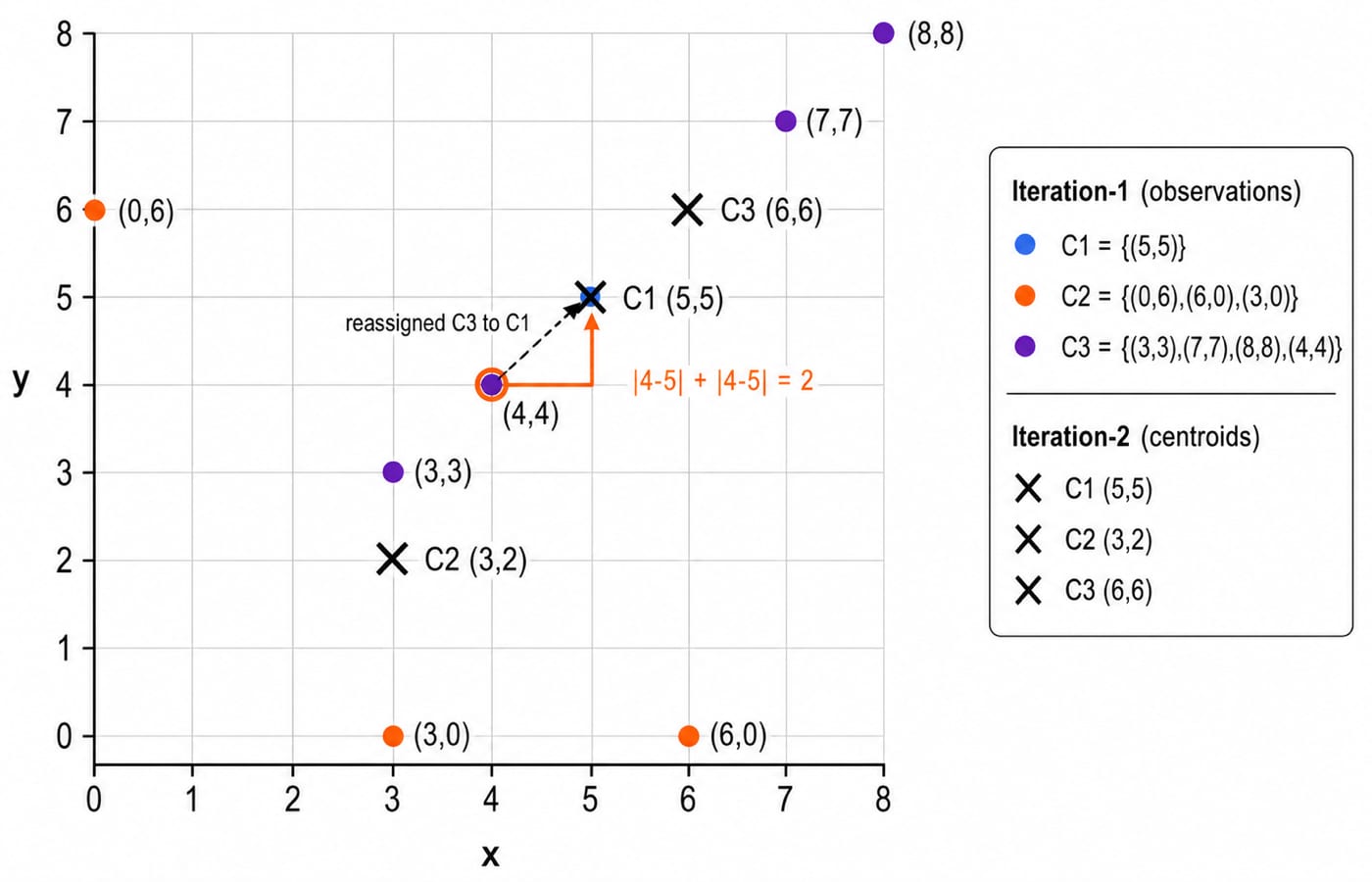
After iteration 1, suppose the eight observations are grouped as C1 = {(3,3), (5,5), (7,7)}, C2 = {(0,6), (6,0), (3,0)} and C3 = {(8,8), (4,4)}.
Recompute every centroid before measuring distance:
C1 = ((3+5+7)/3, (3+5+7)/3) = (5,5)
C2 = ((0+6+3)/3, (6+0+0)/3) = (3,2)
C3 = ((8+4)/2, (8+4)/2) = (6,6)
For (4,4), Manhattan distance to C1 is |4-5| + |4-5| = 2. The distances to C2 and C3 are |4-3| + |4-2| = 3 and |4-6| + |4-6| = 4. The point is currently in C3 but is nearest to C1's updated centroid, so iteration 2 reassigns it to C1. Euclidean distance to C1 would be √(1+1) = √2, which explains the main trap.
Q9. UGC NET 2019
K-mean clustering algorithm has clustered the given 8 observations into 3 clusters after 1st iteration as follows:
C1: {(3,3),(5,5),(7,7)}
C2: {(0,6),(6,0),(3,0)}
C3: {(8,8),(4,4)}
What will be the Manhattan distance for observation (4,4) from cluster centroid C1 in the second iteration?
(a) 2
(b) √2
(c) 0
(d) 18
Answer: (a). First update C1 to (5,5), then apply the requested metric: |4-5| + |4-5| = 2. Option (b) is the Euclidean distance to the same centroid, while (c) confuses the point with a centroid. Option (d) does not follow either distance formula. Open the solved UGC NET 2019 question.
Hierarchical clustering and the four linkage names
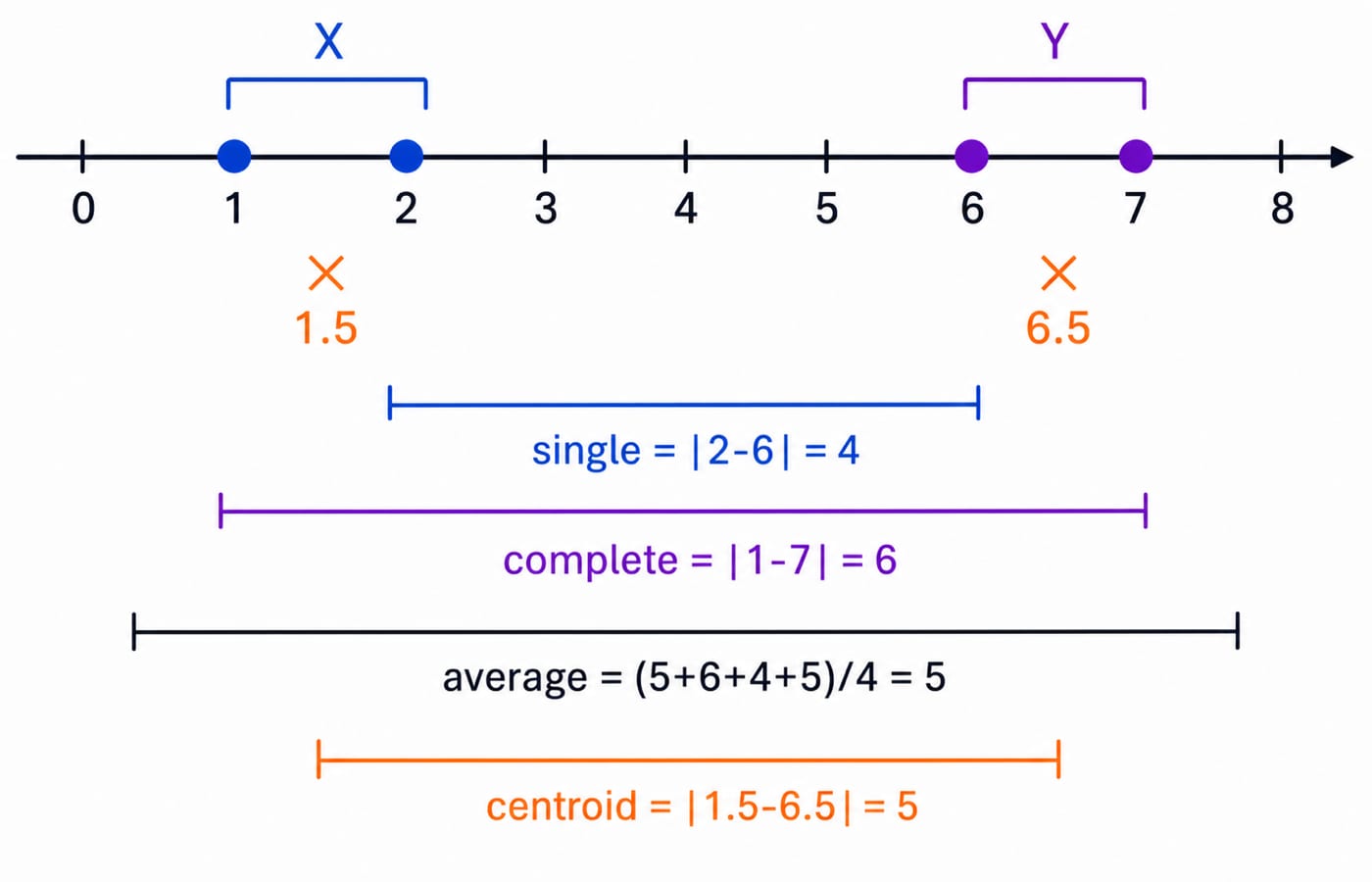
Hierarchical clustering repeatedly merges the closest clusters, but the meaning of closest depends on linkage. Single uses the minimum pairwise distance, complete uses the maximum, average uses the mean of all pairwise distances, and centroid uses the distance between centroids.
Take X = {1,2} and Y = {6,7} on a number line. Their cross-cluster distances are 5, 6, 4 and 5. Therefore single = |2-6| = 4, complete = |1-7| = 6, average = (5+6+4+5)/4 = 5, and centroid = |1.5-6.5| = 5. The same clusters produce four answers because each rule defines distance differently.
Q10. MPPSC 2025
Which of the following is not a most commonly used method for defining distance between clusters in linkage based clustering?
(a) Single linkage
(b) Average linkage
(c) Max linkage
(d) Centroid linkage
Answer: (c). The four standard names are single, complete, average and centroid linkage. The maximum-distance idea exists, but its standard name is complete linkage, not max linkage. In the number-line example, the maximum distance 6 is therefore the complete-linkage result.
Unsupervised neural networks: Kohonen and the SOM
Kohonen's self-organizing feature map, or SOM, is the unsupervised neural network to remember. It uses input similarity to organize nearby patterns into nearby map units, with no target labels.
Q11. UGC NET 2019
Which of the following is an example of unsupervised neural network?
(a) Back-propagation network
(b) Hebb network
(c) Associative memory network
(d) Self-organizing feature map
Answer: (d). A self-organizing map learns from inputs alone and places similar inputs near one another, so it performs label-free grouping. Back-propagation is the flagship supervised trainer. Hebb and associative-memory networks focus on pattern association and recall rather than SOM-style clustering. Open the solved UGC NET 2019 SOM question.
Q12. Indian Space Research Organization 2011
Which of the following is an unsupervised neural network?
(a) RBS
(b) Hopfield
(c) Back propagation
(d) Kohonen
Answer: (d). The Kohonen network is the self-organizing map from Q11, so both questions test the same pairing. Hopfield is an associative-memory network, while back propagation is a supervised training algorithm. When a stem combines unsupervised with neural network, look for Kohonen or SOM.
The short version and your next step
Labels present means supervised, labels absent means unsupervised, and rewards mean reinforcement.
K-means is unsupervised, while K-nearest neighbors and the classifier lineup are supervised.
The K-means loop is choose K, initialize, assign, update and repeat.
Recompute centroids before measuring distance, and read Manhattan versus Euclidean carefully.
The linkage names are single, complete, average and centroid; the neural-network answer is Kohonen's SOM.
About twenty previous-year questions on this subtopic sit in KnowledgeGate's practice set, and the three UGC NET ones above are solved step by step inside the NTA UGC NET Paper 2 course. Browse more UGC NET preparation courses and test series, then redo the two numerical traces, the centroid update that moves (4,4) into C1 and the four linkage distances on the number line, until you can reproduce both unaided.
Keep learning
Ecosystem Fundamentals MCQs: 10 Solved Questions on Meaning and Ecological Organisation
Solve 10 ecosystem MCQs with clear explanations of ecological organisation, productivity, sustainability, environmental ethics, energy balance and conservation.
8 Sep 20268 min readMCQ Practice

Architectural and Component Design MCQs: 12 Solved Questions
Solve 12 bank MCQs on software architecture, component roles, repositories, MVC, DFDs, structure charts and UML, each with a direct worked explanation.
Updated 6 Sep 20268 min readMCQ Practice

C++ Constructors MCQs: 12 Solved Object-Initialization Questions
Solve 12 published C++ constructor questions by tracing object creation, copy semantics, arrays, access, virtual rules, and dynamic allocation.
Updated 5 Sep 20267 min readMCQ Practice
Clipping Algorithms MCQs: 11 Solved Cohen-Sutherland and Cyrus-Beck Questions
Solve 11 clipping questions with fresh explanations, checked outcodes, line classifications, boundary intersections and a practical revision routine.
Updated 3 Sep 20268 min readMCQ Practice