Semaphores and Process Ordering in OS: P/V Traces, Worked Examples and GATE Traps
Learn one consistent semaphore convention, then trace ordering constraints, shared-variable updates, bounded-buffer permits, rendezvous, and deadlock step by step.
KnowledgeGate Team
Exam prep & CS education
Updated 13 Oct 20265 min read
Semaphore traces get confusing when the scheduler starts an inconvenient process and zero can mean either no permit or an event not yet signalled. Use one convention throughout: wait consumes an available permit and otherwise blocks; signal transfers a permit to a waiter or leaves it available. For critical-section requirements and primitive choice, use Process Synchronization in Operating Systems: Semaphores, Critical Sections and Worked Examples. For an ordering question, translate each precedence edge into a zero-initialised event, then trace every blocked wait and shared-state change.
Semaphore fundamentals: permits, atomic operations and initial values
A semaphore changes only through atomic wait and signal. wait(S) consumes a permit when S > 0; at 0, the caller blocks. signal(S) adds a permit, consumed on resumption or left available.
Some books store negative values for waiters. The blocking model is compatible, but never mix trace representations. P or down means wait; V or up means signal.
Use | Start | Meaning |
|---|---|---|
Binary semaphore |
| One permit maximum |
Counting semaphore |
| Available units |
Exclusion gate |
| One entrant |
Ordering event |
| Event absent |
Resource pool |
|
|
Mutexes impose ownership; semaphores need not be signalled by their waiter.
Process ordering with semaphores: translate every precedence edge
For A before B, set aDone = 0, put signal(aDone) after A, and wait(aDone) before B. Zero prevents an early pass.
s12 = 0; s23 = 0
P1: x = x + 2; signal(s12)
P2: wait(s12); x = 3*x; signal(s23)
P3: wait(s23); x = x - 4
The chain serialises all accesses without another mutex. For A -> C and B -> C, set aDone = bDone = 0. Each source signals; C waits on both. A and B may swap, but C follows both. One semaphore per edge exposes the guarantee.
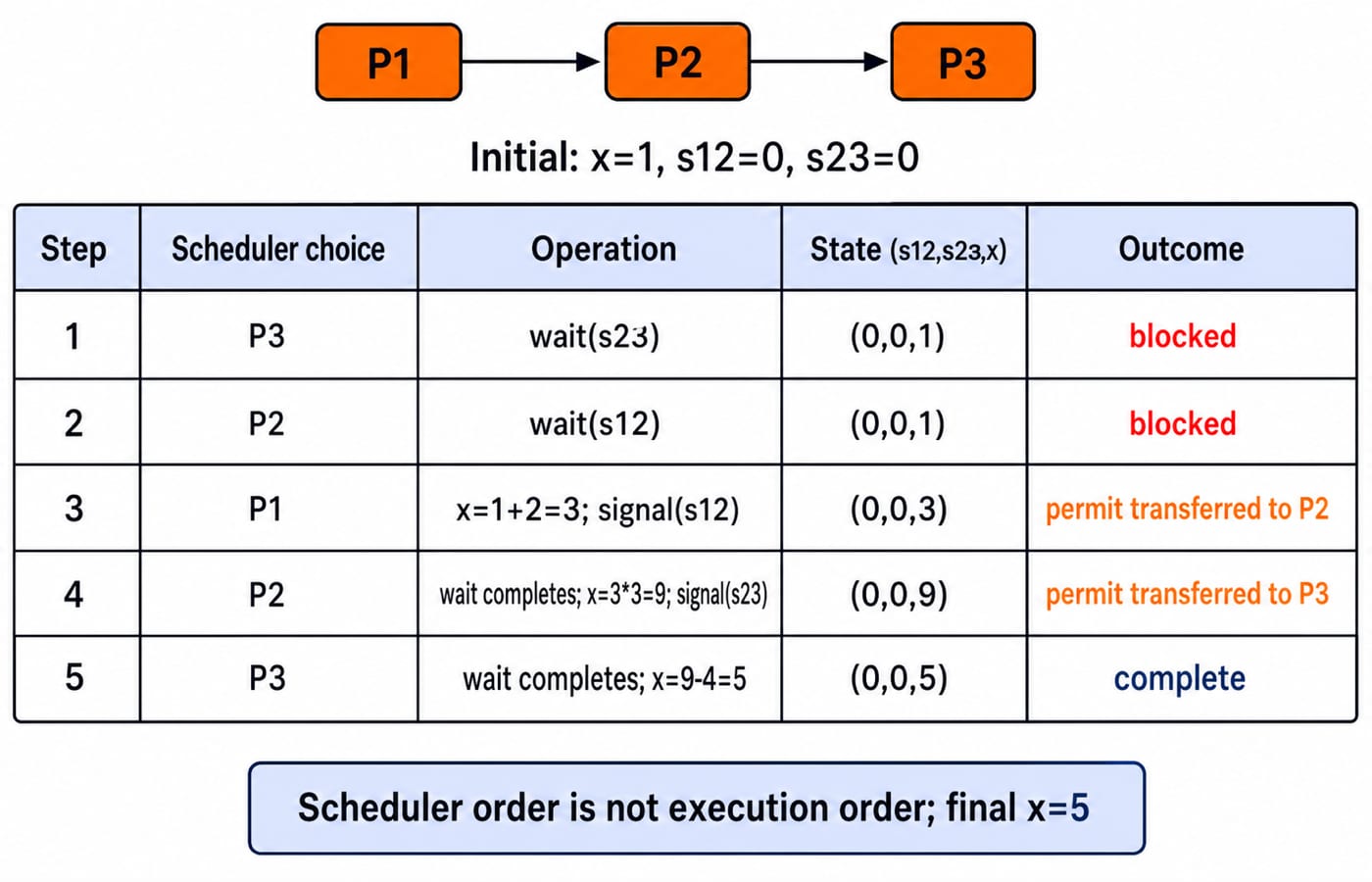
Worked semaphore trace: a hostile scheduler still gives x = 5
Start x = 1, s12 = 0, s23 = 0; schedule P3, P2, P1.
Scheduler step |
|
|
| Blocked or runnable processes |
|---|---|---|---|---|
| 0 | 0 | 1 | P3 blocked; P1, P2 ready |
| 0 | 0 | 1 | P2, P3 blocked; P1 ready |
| 0 | 0 | 3 | P2 wakes |
| 0 | 0 | 9 | P3 wakes |
| 0 | 0 | 5 | All complete |
The operation order is P1, P2, P3, and x = 5.
With only s12 wrongly set to 1, schedule P2, P3, P1. P2 passes: 1 -> 3; P3 follows: 3 -> -1; P1 finishes: -1 -> 1. Final value 1, not 5, proves the event must start at 0.
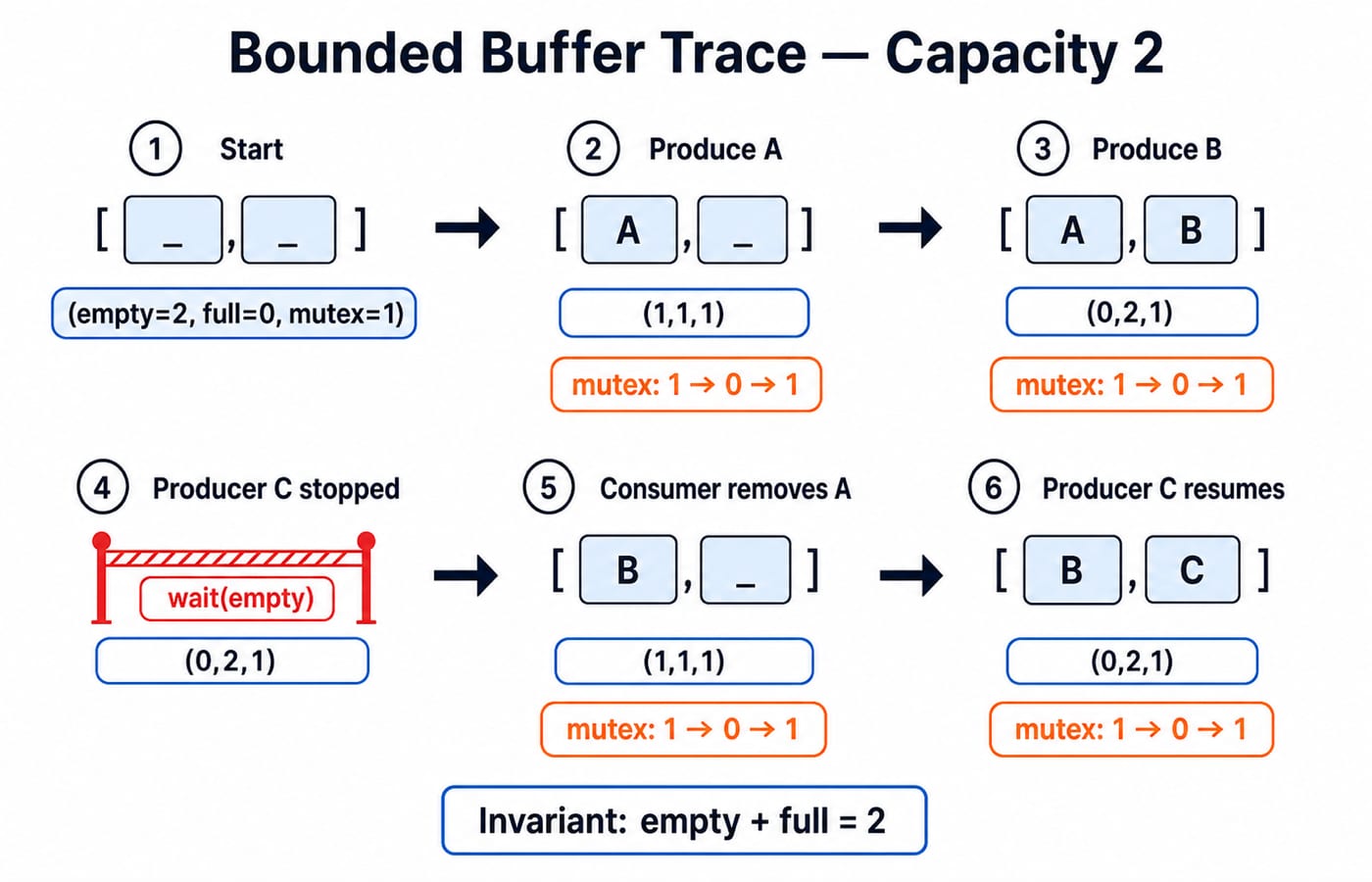
Counting semaphore worked example: a two-slot bounded buffer
For capacity 2, start empty = 2, full = 0, mutex = 1, buffer [].
Producer: wait(empty); wait(mutex); insert(item); signal(mutex); signal(full)
Consumer: wait(full); wait(mutex); remove(item); signal(mutex); signal(empty)
Completed event |
|
|
| Buffer |
|---|---|---|---|---|
Produce A | 1 | 1 | 1 |
|
Produce B | 0 | 2 | 1 |
|
Producer C waits | 0 | 2 | 1 |
|
Consumer removes A | 1 | 1 | 1 |
|
Awakened producer inserts C | 0 | 2 | 1 |
|
C consumes the permit when its wait completes. Every edit takes mutex: 1 -> 0 -> 1. empty prevents overflow, full prevents underflow, and mutex serialises updates. After operations, empty + full = 2.
Semaphore patterns: mutual exclusion, fan-in and rendezvous
Goal | Start | Placement | Guarantee |
|---|---|---|---|
Exclusion |
| Wait before, signal after | One entrant |
One-way order |
| Source signals; target waits | Source first |
Fan-in |
| Sources signal; C waits twice | Both before C |
Rendezvous |
| Each signals, then waits | Cross-ordering |
Let x = 10 and two processes run non-atomic x = x + 1. A mutex gives 10 -> 11 -> 12. Without it, both may read 10 and write 11. Only enclosed code is protected.
Use A1; signal(aDone); wait(bDone); A2 and B1; signal(bDone); wait(aDone); B2. This guarantees A1 before B2 and B1 before A2, but fixes neither the A1/B1 nor A2/B2 order. Signalling first avoids circular wait.
Semaphore traps: wrong initialisation, assumed fairness and circular wait
Trap | What goes wrong | Correction |
|---|---|---|
Ordering starts at | Target passes early | Start at |
Signal comes first | Event announced early | Signal after action |
Missing or extra signal | Block or invented permit | Audit all paths |
Integer used as a test | Check races | Use atomic |
Wake-up order assumed | False fairness | Use stated policy only |
Count conventions mixed | Bad trace | Choose one |
wait and signal are atomic; intervening statements are not. Implementations may block rather than spin. Wake-up order and starvation freedom need a stated policy. Binary semaphores need not enforce ownership.
Start s = t = 1. P1 waits on s, making s = 0; P2 waits on t, making t = 0. P1 then waits on t and P2 on s. Both block. Acquire s before t, or avoid holding one while awaiting another.
GATE-style semaphore questions: trace guarantees before arithmetic
Practice forms ask for an initial value, required precedence, a final shared value, a pass or block count, or deadlock and lost-wake-up detection. These are GATE-style forms, not an official blueprint.
Trace quickly: write initial values; stop at a wait on 0; treat each signal as a transfer or increment; record values only on execution; separate guaranteed from scheduler order. Check x = 5, wrong-initialisation x = 1, and [B,C] with (empty,full) = (0,2).
Continue with Process Synchronization MCQs: 12 Solved GATE Questions. Use GATE CS Exam Preparation to place P/V traces inside the wider Operating Systems syllabus.
Semaphores and ordering: the short version and next step
Remember five points: wait consumes or blocks; signal wakes or adds a permit; mutual exclusion starts at 1; a fresh ordering event starts at 0; every precedence edge needs a signal after its source and a wait before its destination. Keep resource counting separate from event ordering.
Now redraw P1 -> P2 -> P3, calculate 1 -> 3 -> 9 -> 5, and explain why s12 = 1 permits the wrong execution. Then replay (2,0,[]) to (0,2,[B,C]). Use GATE Guidance by Sanchit Sir for a sequenced Operating Systems route and timed practice.
Keep learning

Critical Section in Process Synchronization: Race Conditions and Correctness Worked Step by Step
See how two sensible updates to x can finish at 6, 7, or 8. The worked trace connects race conditions to mutual exclusion, progress, bounded waiting, and safe synchronization choices.
Updated 21 Oct 20266 min readOperating Systems
System Calls and Dual Mode in OS: Mode-Bit Trace, Worked Example and Exam Traps
Follow one read() call across the user-kernel boundary, calculate its stated overhead, and learn the distinctions that make system-call questions easier.
Updated 17 Oct 20265 min readOperating Systems
Round Robin Scheduling Explained: Gantt Charts, Waiting Time and GATE Traps
Learn a fixed Round Robin queue convention, trace staggered arrivals, calculate CT, TAT, WT and RT, and see how quantum size and context-switch cost change results.
Updated 9 Oct 20265 min read59 viewsOperating Systems
Paging and TLB Explained: Address Translation, EMAT and Exam Traps
Follow one virtual address from its VPN through the TLB to a physical frame, then calculate page-table size, TLB reach and effective memory access time.
Updated 4 Oct 20266 min readOperating Systems