Three-Address Code, Quadruples and Triples for GATE: Intermediate Code Generation Solved
Translate a repeated arithmetic expression into six TAC instructions, then align every instruction with its quadruple and triple representation.
KnowledgeGate Team
Exam prep & CS education
Updated 31 Aug 20265 min read53 views
Intermediate-code questions usually ask you to translate an expression or count its instructions and temporaries. The arithmetic is simple, but representation details cause mistakes: a unary minus still needs an instruction, and a triple names results by position. An occurrence-by-occurrence translation maps each TAC instruction to one quadruple row and one triple row.
Related reading: compiler phase MCQs and compiler fundamentals.
What three-address code means
Three-address code, or TAC, breaks a complex operation into simple statements. A typical binary instruction has one result and two operands:
x = y op zThat gives at most three addresses: x, y and z. It does not mean that every instruction must contain exactly three. A unary operation uses a result and one operand, while a copy has only a source and a destination.
Common TAC forms include:
x = y op z
x = op y
x = y
goto L
if x relop y goto L
Compilers also use forms for indexed arrays, addresses, pointers, parameters, calls and returns. The central rule for expression questions is that each TAC instruction performs at most one operator. The syntax tree fixes the evaluation dependencies before TAC is emitted; Parsing in Compiler Design: Top-Down and Bottom-Up Explained explains how that tree is built.
Worked three-address code
Translate this expression without first eliminating its repeated subexpression:
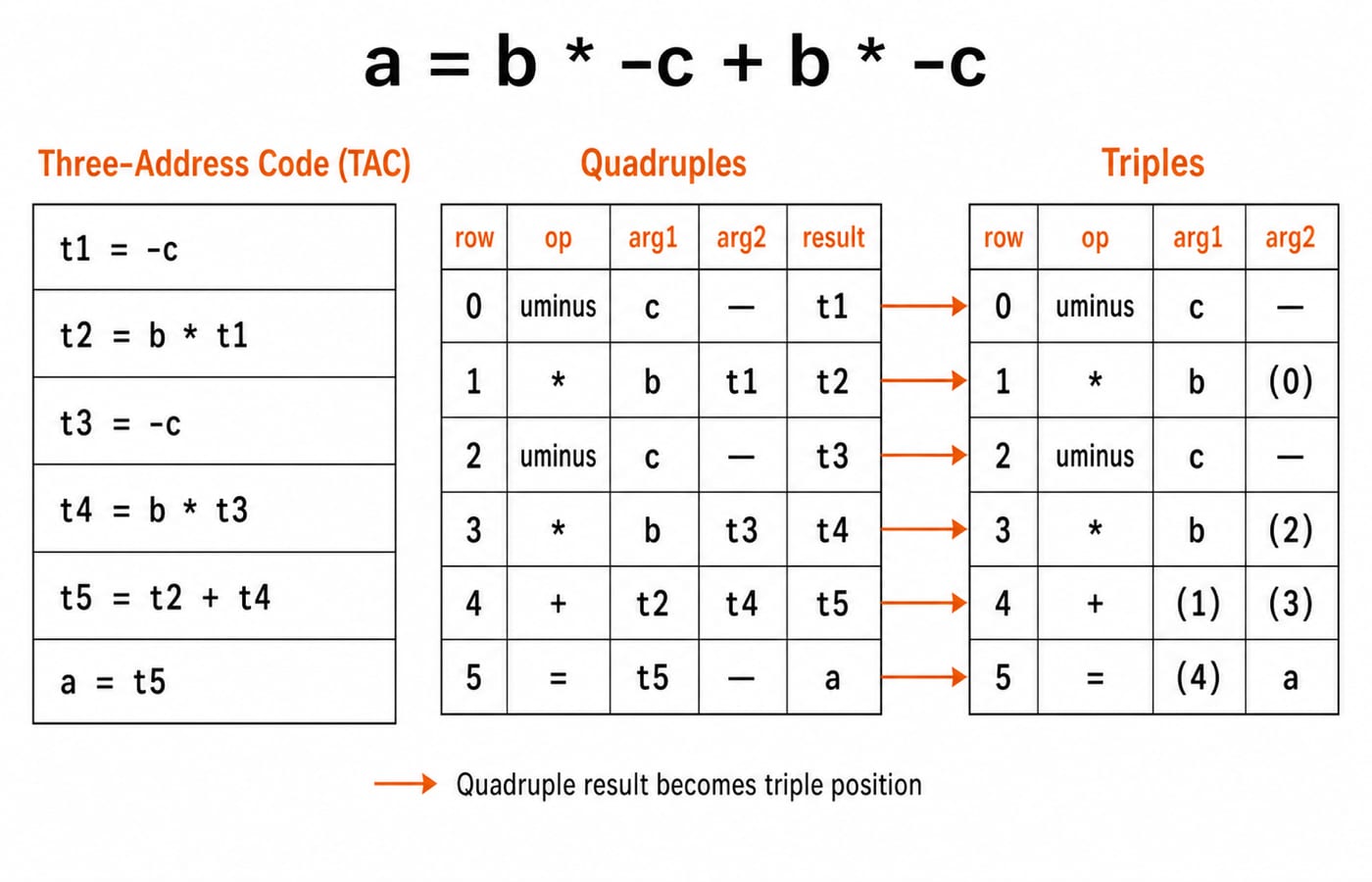
a = b * -c + b * -cBoth occurrences of unary -c and both multiplications are represented separately. A direct TAC sequence is:
t1 = -c
t2 = b * t1
t3 = -c
t4 = b * t3
t5 = t2 + t4
a = t5
Count the operations carefully:
two unary minus occurrences produce instructions 1 and 3
two multiplication occurrences produce instructions 2 and 4
one addition produces instruction 5
one final assignment produces instruction 6
The result is 6 TAC instructions and 5 temporaries. The final assignment is an instruction, but it stores into source variable a and creates no sixth temporary. An optimizer could later notice that b * -c repeats, but this unoptimized sequence preserves the expression tree occurrence by occurrence.
Quadruples name every result
A quadruple stores four fields:
(op, arg1, arg2, result)For unary minus and assignment, the unused second argument is written _. The six TAC instructions become:
Index | op | arg1 | arg2 | result |
|---|---|---|---|---|
0 | minus | c | _ | t1 |
1 | * | b | t1 | t2 |
2 | minus | c | _ | t3 |
3 | * | b | t3 | t4 |
4 | + | t2 | t4 | t5 |
5 | = | t5 | _ | a |
Each intermediate result has an explicit name in the result field. If an optimizer moves a row while preserving its data dependencies, references such as t1 and t4 still name the same values. That explicit naming makes quadruples convenient for code movement, though each instruction carries a result field.
Triples name a result by its position
A triple stores only three fields:
(op, arg1, arg2)There is no explicit result field. The value produced by row 0 is called (0), the value from row 1 is called (1), and so on. For assignment, this convention puts the source value in arg1 and the destination in arg2:
Index | op | arg1 | arg2 |
|---|---|---|---|
0 | minus | c | _ |
1 | * | b | (0) |
2 | minus | c | _ |
3 | * | b | (2) |
4 | + | (1) | (3) |
5 | = | (4) | a |
Row 1 uses the value from row 0. Row 4 adds the results of rows 1 and 3. Row 5 copies row 4's result into a.
Triples save one field per row, but a position is now also a value's name. Moving an instruction changes its position and can force every reference to that position to be renumbered. Indirect triples address this weakness by maintaining a separate list of pointers to triple rows. The pointer order can change without moving or renumbering the triples themselves.
Counting drills from the same expression
The unoptimized expression has five operator occurrences inside the right-hand expression: two unary minuses, two multiplications and one addition. Those create five intermediate computations and five temporaries. The assignment to a adds one more instruction but no temporary, giving 6 and 5 respectively.
For N represented instructions, a quadruple table has N result fields. A triple table omits those N fields and refers to intermediate results by row position instead. That is the direct space trade-off the examiner is testing.
Do not blindly equate the number of syntax-tree operators with the number of temporaries in every translation scheme. A direct store into the final target can avoid a new temporary, and a later optimization can remove repeated computations. State whether you are translating the original expression or optimized code before counting.
Grammar actions generate TAC during syntax-directed translation, before later passes optimize the representation without changing program meaning.
Traps and common GATE question forms
A unary minus is an operator, so t1 = -c consumes a complete TAC instruction. The final copy a = t5 is also an instruction even though it creates no temporary. These two facts explain many off-by-one answers.
Keep the field layouts distinct. A quadruple is (op, arg1, arg2, result). A triple is (op, arg1, arg2), with the row position serving as the missing result name. Triples cannot be freely reordered like quadruples because their back-references depend on row numbers.
Common stems ask for the TAC of an expression, the number of instructions or temporaries, the correct quadruple or triple table, or the representation most suitable for code movement.
For exact wording from a particular year, consult the paper and answer key on the official GATE portal of the organising IIT.
Short version and next step
TAC permits one operator per instruction. Quadruples store (op, arg1, arg2, result) and keep intermediate names stable when rows move. Triples store (op, arg1, arg2) and use row positions as names, so direct reordering requires renumbering. Indirect triples add a pointer layer.
Write all three forms for one expression with a unary operator and another with a repeated subexpression. Then practise the count-and-representation questions in GATE Guidance by Sanchit Sir, and use the GATE preparation category for the wider Compiler Design sequence.
Keep learning

Cyber Threats and Malware Attacks: Types, Attack Vectors, and Worked Security Problems
Learn to distinguish malware classes, map attacks to the CIA triad, and solve password, cipher, and key-count numericals. The guide also covers common attack vectors and a safe way to study Indian cyber law.
Updated 24 Oct 20266 min readGATE Strategy & Roadmap

Cyber Safety and Security: Information Security and Cyber Law with Worked Examples
Learn information security as an applied subject. Classify security failures, work Caesar and RSA examples, separate common attacks, and revise India's cyber-law framework.
Updated 22 Oct 20266 min readGATE Strategy & Roadmap

Internet & Web Technology for GATE: Syllabus Boundary, Weightage Method and Prep Order
Treat Internet and Web Technology as an overlap area, not a promised standalone subject. Build scope, paper-audit, URL-tracing and subnetting skills in a 12-session plan.
Updated 18 Oct 20265 min readGATE Strategy & Roadmap
How to Use Practice Exams and Past Papers with Spaced Repetition
Turn practice exams and past papers into a spaced revision system. Learn how to analyse mistakes, schedule reattempts, and fit mocks into a weekly study plan.
15 Oct 20266 min readGATE Strategy & Roadmap