

Theory of NP-Completeness: Concepts, Certificate Checks and a Worked Reduction
Learn what P, NP, NP-hard and NP-complete mean. Verify a clique certificate, then follow a complete 3-SAT to CLIQUE reduction with both proof directions.
KnowledgeGate Team
Exam prep & CS education
Updated 19 Nov 20265 min read

P, NP, NP-hard and NP-complete blur together when a proof demands a certificate, the right reduction direction and both halves of an if-and-only-if argument. A size-3 clique can be verified, and a three-clause 3-SAT instance can be reduced to a nine-vertex CLIQUE instance with its assignment recovered.
NP-completeness begins with decision problems and polynomial time
A decision problem outputs yes or no. CLIQUE(G,k) asks whether G has a clique of size at least k; finding the largest clique is the optimisation version. These classes use the decision form.
Class | Meaning |
|---|---|
| Decision problems solvable in polynomial time by a deterministic algorithm |
| Decision problems whose yes instances have certificates verifiable in polynomial time |
| Problems to which every problem in |
| Problems that are both in |
P is a subset of NP, and whether P = NP remains unknown. A polynomial-time algorithm for one NP-complete problem would solve every problem in NP in polynomial time. NP means nondeterministic polynomial time, not "non-polynomial". The GATE CS Exam Preparation category connects Algorithms and Theory of Computation.
NP certificate verification: a size-3 CLIQUE
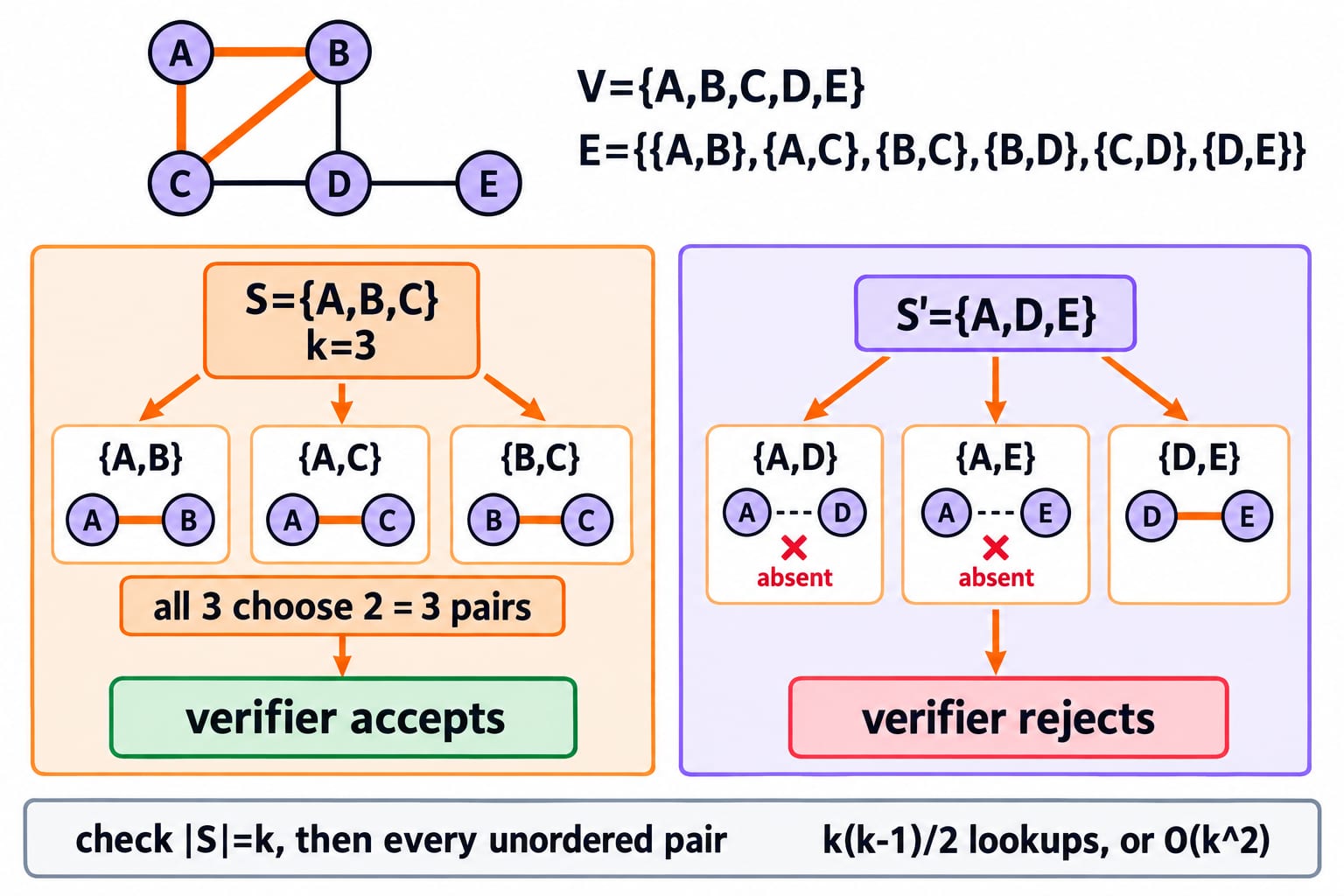
Take V={A,B,C,D,E}, E={{A,B},{A,C},{B,C},{B,D},{C,D},{D,E}} and k=3. For S={A,B,C}, all 3 choose 2 = 3 pairs, {A,B}, {A,C} and {B,C}, are in E, so the verifier accepts.
For S'={A,D,E}, {D,E} exists, but {A,D} and {A,E} do not, so it rejects. Generally, check |S|=k, then every unordered pair. An adjacency matrix needs k(k-1)/2 lookups, or O(k^2). This proves only that CLIQUE is in NP.
An NP-completeness proof has two obligations
To prove target problem B is NP-complete:
Show
Bis inNPwith a certificate and polynomial-time verifier.Map known NP-complete problem
AtoBin polynomial time, provingxis yes forAif and only iff(x)is yes forB.
The direction is A <=p B: a solver for B could solve hard source A after conversion. Reducing B to A does not make B hard. The conversion must be polynomial, but need not find an assignment or clique.
Worked reduction from 3-SAT to CLIQUE
Let
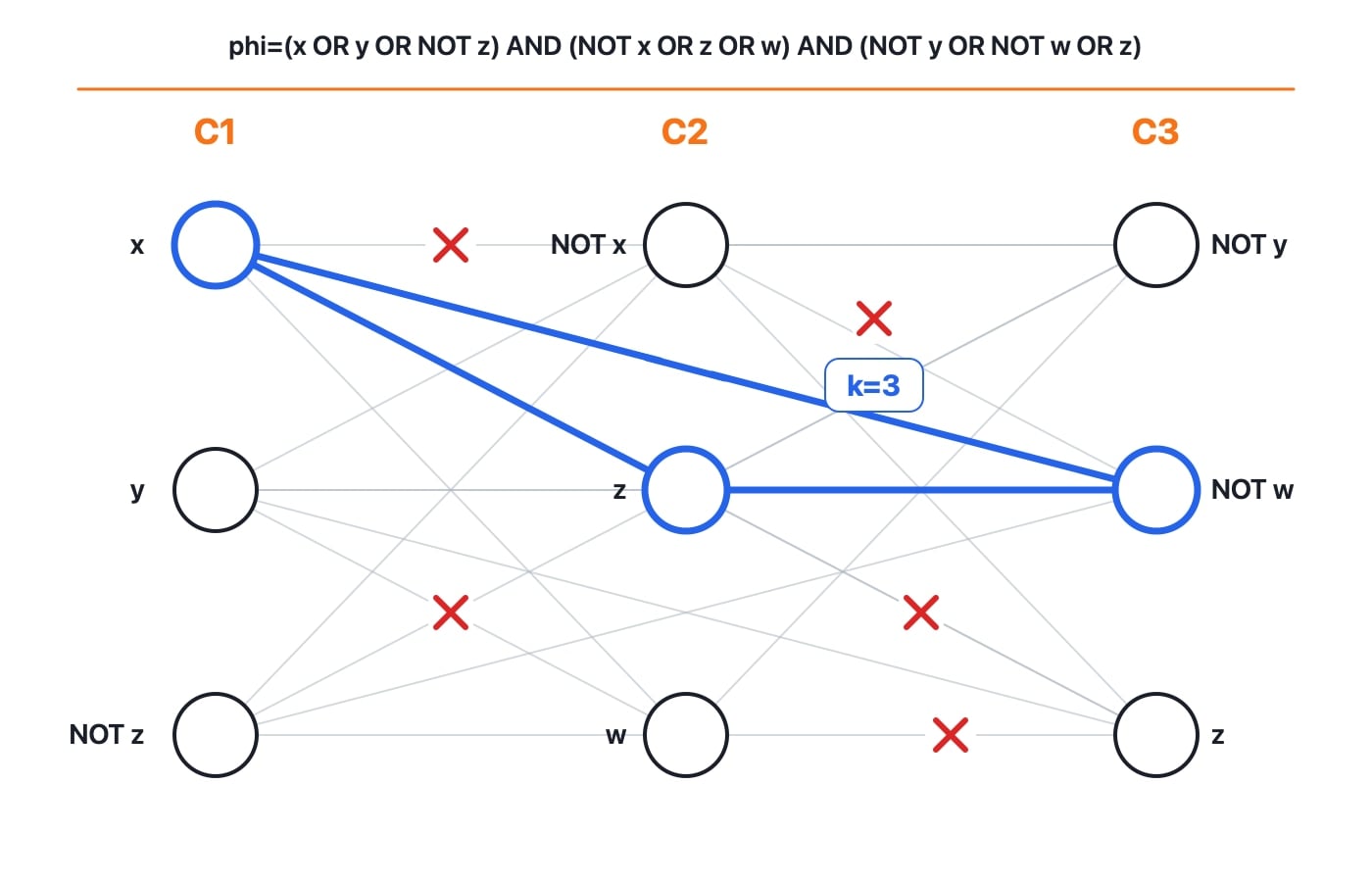
phi=(x OR y OR NOT z) AND (NOT x OR z OR w) AND (NOT y OR NOT w OR z).
Call the clauses C1, C2, C3 and set k=m=3. Make one vertex per literal occurrence:
C1:x,C1:y,C1:NOT zC2:NOT x,C2:z,C2:wC3:NOT y,C3:NOT w,C3:z
Connect cross-clause vertices whose literals are not complements. Add no edges within clauses. Between C1 and C2, the 9 possible pairs lose (x,NOT x) and (NOT z,z), leaving 7 edges. Between C1 and C3, remove (y,NOT y) and (NOT z,z), leaving 7. Between C2 and C3, remove (w,NOT w), leaving 8. Result: 9 vertices and 7+7+8=22 edges.
K={C1:x,C2:z,C3:NOT w} is a clique. Its vertices come from distinct clauses, and x, z, NOT w are pairwise consistent, so all three edges exist. The assignment x=True, y=False, z=True, w=False satisfies every clause. For graph terminology, see Graph Theory: Euler, Hamiltonian, Coloring for GATE CS.
Why the 3-SAT-to-CLIQUE reduction works
If phi is satisfiable, choose one true literal from each clause. The vertices are in different clause columns, and no two selected literals are complements. Every pair is connected, so they form an m-clique.
Conversely, an m-clique has at most one vertex from each clause because same-clause vertices lack edges. Exactly m vertices select one literal per clause. Complements cannot both appear because their edge is omitted, so the selections extend to a satisfying assignment.
For m three-literal clauses, the construction makes 3m vertices and at most 9m(m-1)/2 edges. This is O(m^2). CLIQUE is in NP, and 3-SAT reduces to it in polynomial time, so CLIQUE is NP-complete.
NP-completeness exam questions: rapid checks
The issued GATE 2026 CS syllabus names asymptotic complexity and greedy, dynamic programming and divide-and-conquer under Algorithms, and undecidability under Theory of Computation. It does not name P, NP or NP-completeness, so treat these as concept checks, not a claim about marks or frequency.
A problem in
Pis also inNP: true.A problem proved NP-hard but not proved in
NPis NP-complete: false.3-SAT <=p XandXinNPproveXNP-complete: true.X <=p 3-SATalone provesXNP-hard: false.
Dynamic Programming Explained: 0/1 Knapsack teaches a polynomial-time method for a specific recurrence. NP-completeness classifies decision problems through reductions. Turing Machines and Decidability Explained asks whether a problem is computable at all. Hard, slow and undecidable are not synonyms.
NP-completeness traps and corrections
Trap: NP problems cannot be solved in polynomial time. Correction:
Pis contained inNP; whether every NP problem is inPis unknown.Trap: Showing a target is in
NPfinishes the proof. Correction: hardness still needs a correctly directed reduction from a known NP-complete problem.Trap: Using an optimisation problem in a decision-class proof. Correction: state the threshold form first, such as "is there a clique of size at least 3?"
Trap: A reduction gives both problems the same running time. Correction: it transfers yes/no solvability with polynomial overhead, not identical algorithms.
Theory of NP-completeness in the short version
Checklist: use a decision problem; state the certificate; bound its verifier; reduce a known hard source to the target; prove both directions and bound the construction.
Here S={A,B,C} passes three edge checks. The formula gives 9 vertices, 22 edges and k=3; its highlighted clique gives x=True, y=False, z=True, w=False. Use GATE Guidance by Sanchit Sir for complexity, algorithms and theory in a structured CS sequence.
Self-test for psi=(a OR b OR c) AND (NOT a OR b OR d): find the vertex count and k. Which candidate, {C1:a,C2:b} or {C1:a,C2:NOT a}, forms a clique?
Answer: 6 vertices and k=2. {C1:a,C2:b} is a 2-clique; {C1:a,C2:NOT a} is not an edge because the literals conflict.
Go deeper with the full courseAlgorithms
Keep learning

Complexity Theory in Theory of Computation: P, NP, NP-Completeness and Worked Examples
Build complexity theory from input encoding upwards, then test each idea through a verified certificate and a complete 9-vertex reduction graph.
Updated 24 Aug 20266 min read50 viewsTheory of Computation
CTET Eligibility, Paper 1 vs Paper 2, and Lifetime Certificate Validity
Understand which CTET paper matches your teaching goal, how eligibility is verified, and why a lifetime certificate still does not guarantee appointment.
Updated 6 Nov 20264 min readCTET & UPTET
CTET Qualifying Marks and Certificate Validity
Understand the CTET pass threshold, how category concessions are applied, why the certificate lasts for life, and when another attempt is worth taking.
Updated 29 Oct 20265 min readCTET & UPTET

Functional Completeness in Digital Logic: NAND, NOR and Worked Examples
Learn what makes a Boolean operator set complete, how NAND and NOR recover a standard basis, and how to verify a four-gate NAND construction.
Updated 2 Oct 20266 min read83 viewsDigital Logic