System Calls and Dual Mode MCQs: 12 Solved Questions with Explanations
Test your understanding of the user/kernel boundary with 12 system-call and dual-mode MCQs. Each answer shows why the correct option works and why the distractors fail.
KnowledgeGate Team
Exam prep & CS education
Updated 7 Sep 20267 min read
System calls and dual mode feel simple until an examiner reverses a mode switch or mixes software interrupts with privileged instructions. System-call questions range from interface basics to interrupt handling and clarify the user/kernel boundary. KnowledgeGate has over 40 questions available in the practice bank, so attempt each item before opening its explanation.
Related reading: operating system basics and process creation MCQs.
System calls: purpose and categories
A system call is a controlled request from a user program to the kernel. It provides protected services without granting arbitrary access to hardware or global OS state.
Q1. Primary purpose of a system call, TPSC 2024
Question: What is the primary purpose of a system call in an operating system ?
A. Run arbitrary user code with full system access
B. Request access to system resources and services in a controlled manner
C. Communicate directly with hardware devices without OS intervention
D. Manage other processes and control system behavior
Answer: B. Controlled access protects hardware and shared OS state. Option D is too narrow because system calls also cover files, devices, communication and information maintenance.
Open the TPSC 2024 solved question.
Q2. System-call categories, DSSSB 2023
Question: Which of the following is NOT a system call category?
A. Process Control
B. Device Manipulation
C. File Manipulation
D. Data Compilation
Answer: D. Process control, device manipulation and file manipulation are standard categories. Compilation is done by software such as a compiler, not by an OS system-call category.
Open the DSSSB 2023 solved question. Use Operating System Basics and Structure MCQs for the broader kernel, shell, abstraction, process-state, and context-switch map. Q7, Q9, and Q12 also appear there as brief orientation checks; here they anchor a deeper progression through system-call categories, waiting and exit status, parameter passing, and interrupt decisions.
Process-control system calls: waiting and termination status
At t=0 ms, P41 requests a 20 ms wait and moves from running to blocked. At t=20 ms, the timer moves it to ready. A dispatch at t=23 ms means 23 - 20 = 3 ms in the ready queue. It later terminates with status 0, conventionally indicating success.
Q3. Wait-for-time operation, DSSSB 2024
Question: Which of the following system call include ‘wait for time’ operation command in Operating System?
A. Process Control
B. Device Management
C. File Management
D. Communications
Answer: A. A wait-for-time request suspends and later resumes a process. It changes execution state, so it belongs to process control, not device, file or communication management.
Open the DSSSB 2024 solved question.
Q4. Successful program completion, UGC NET 2014
Question: Which of the following is the correct value returned to the operating system upon the successful completion of a program ?
A. 0
B. 1
C. - 1
D. Program do not return a value.
Answer: A. By convention, exit status 0 reports successful completion to the operating system. Non-zero values identify failure conditions chosen by the program or its environment.
Open the UGC NET 2014 solved question.
System-call arguments: exec and parameter passing
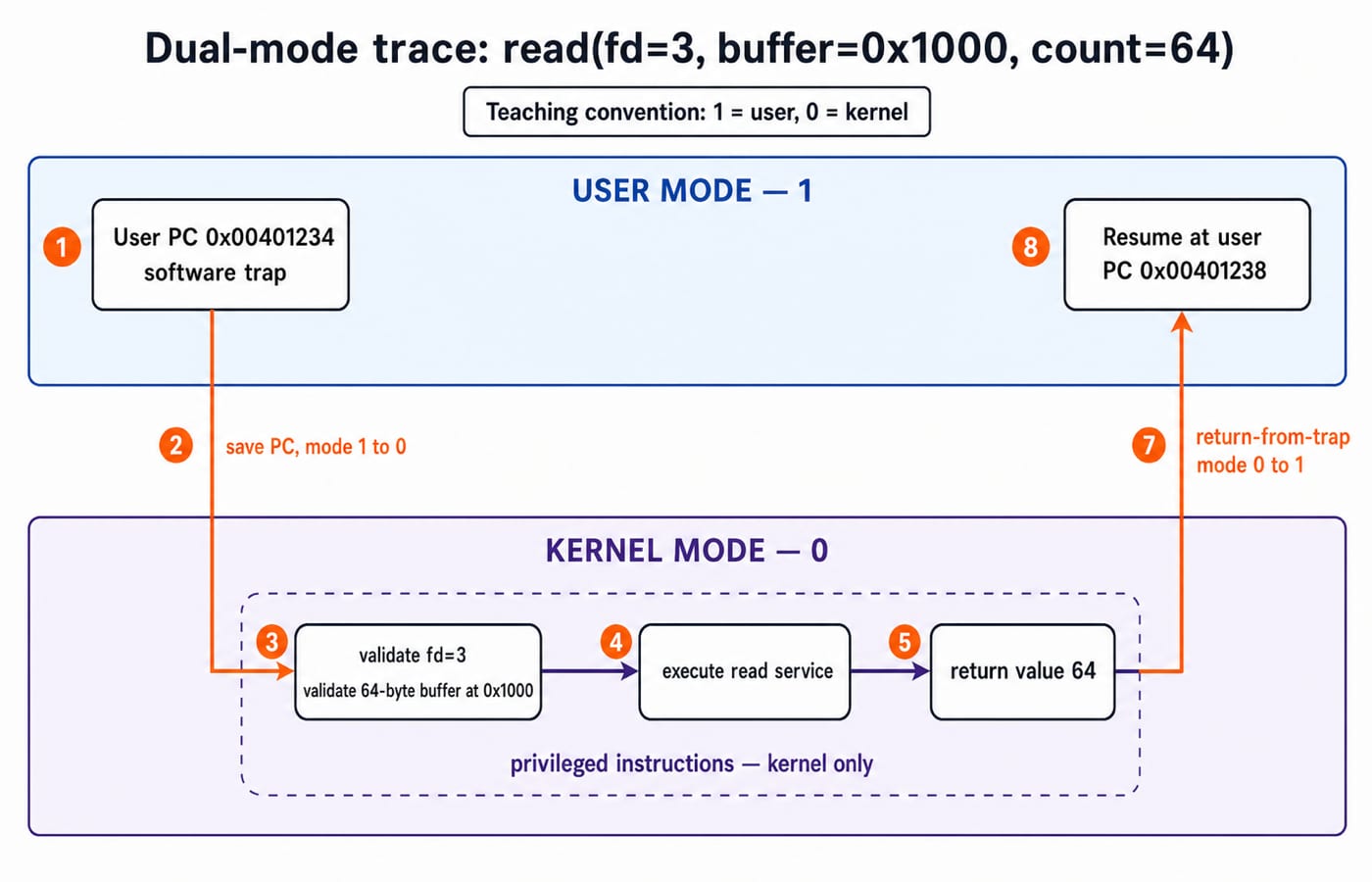
For read(fd=3, buffer=0x1000, count=64), registers hold 3, 0x1000 and 64. A block scheme stores [3, 0x1000, 64] at 0x2000 and passes that address; a stack scheme pushes the same values. A complete read returns 64. Registers are fast but finite, while memory blocks and stacks support longer lists.
Q5. Loading an executable, UPPSC Polytechnic Lecturer 2022
Question: Which of the following system calls transforms an executable binary file into a process?
A.
forkB.
execC.
ioctlD.
longjmp
Answer: B. exec replaces the current process image with the specified executable. It does not create a second process, the role associated with fork.
Open the UPPSC Polytechnic Lecturer 2022 solved question.
Q6. Passing any number of parameters, UGC NET 2019
Question: Which of the following methods are used to pass any number of parameters to the operating system through system calls?
A. Registers
B. Block or table in main memory
C. Stack
D. Block in main memory and stack
Answer: D. "Any number" rules out registers because their count is limited. A main-memory block or the stack can represent a longer list, so the combined option is correct.
Open the UGC NET 2019 solved question.
System-call entry: software interrupts and kernel service
A user program cannot execute protected I/O directly. It uses a controlled trap or software interrupt to enter an OS handler in privileged mode. A processor may provide a dedicated system-call instruction, but the conceptual result is protected kernel service.
Q7. Why a processor needs a software interrupt, GATE 2001
Question: A processor needs software interrupt to
A. Test the interrupt system of the processor
B. Implement co-routines
C. Obtain system services which need execution of privileged instructions
D. Return from subroutine
Answer: C. A software interrupt is the controlled gateway to services that may need privileged instructions. It is not primarily for testing interrupts, implementing coroutines or returning from a subroutine.
Open the GATE 2001 software-interrupt solved question.
Q8. How system calls are invoked, UGC NET 2015
Question: System calls are usually invoked by using
A. a software interrupt
B. polling
C. an indirect jump
D. a privileged instruction
Answer: A. A software interrupt establishes the controlled transition to an operating-system handler. Polling and an indirect jump do not create a protected privilege transition, and a user program cannot issue an arbitrary privileged instruction.
Open the UGC NET 2015 solved question.
Dual mode: privileged instructions and the mode-bit trace
Use the teaching convention mode bit 1 = user and mode bit 0 = kernel; actual encodings are architecture-specific. The request starts at user PC 0x00401234, enters the kernel, returns 64, and resumes at 0x00401238, which is 0x00401234 + 4 here.
Q9. Returning from privileged mode, GATE 2001
Question: A CPU has two modes-privileged and non-privileged. In order to change the mode from privileged to non-privileged
A. A hardware interrupt is needed
B. A software interrupt is needed
C. A privileged instruction (which does not generate an interrupt) is needed
D. A non-privileged instruction (which does not generate an interrupt) is needed
Answer: C. The OS uses a controlled privileged return instruction to restore non-privileged execution. An interrupt provides entry to a privileged handler, not the controlled return to user execution described here.
Open the GATE 2001 mode-transition solved question.
Q10. Identifying privileged instructions, UGC NET 2024
Question:
Which of the following statements are TRUE about Privileged Instructions?
(A) It can only be executed by the Operating System kernel and not by user applications.
(B) It is designed to perform operations that can directly affect the hardware or system state such as I/O operations or changing memory management setting.
(C) User applications can execute privileged instructions if they have to correct permissions, set by the Operating System.
(D) It usually executed in user mode to ensure the safety and security of the system.
Choose the correct answer from the options given below:
A. (A) and (B) Only
B. (A), (B) and (C) Only
C. (B) and (C) Only
D. (B), (C) and (D) Only.
Answer: A. Statements (A) and (B) are true. Statement (C) confuses permission to request a kernel service with permission to execute privileged instructions directly, while statement (D) puts those instructions in the wrong mode.
Open the UGC NET 2024 solved question.
Interrupt handling: blocked processes and signal handlers
Interrupt context and handler context differ. An interrupt enters the kernel, which may resume the process or block it and schedule another. For a Unix signal, the kernel arranges delivery before a user-installed handler runs in user mode.
Q11. What the OS may do after an interrupt, GATE 1997
Question: When an interrupt occurs, an operating system
A. ignores the interrupt
B. always changes state of interrupted process to 'blocked' and schedules another process
C. always resumes execution of interrupted process after processing the interrupt
D. may change the state of interrupted process to 'blocked' and schedule another process
Answer: D. "May" matters because the decision depends on the interrupt source and process state. The OS may resume the process or block it and schedule another, so neither "always" option is valid.
Open the GATE 1997 solved question.
Q12. Unix signal-handler execution mode, GATE 2005, Information Technology
Question: A user level process in Unix traps the signal sent on a Ctrl-C input, and has a signal handling routine that saves appropriate files before terminating the process. When a Ctrl-C input is given to this process, what is the mode in which the signal handling routine executes?
A. kernel mode
B. superuser mode
C. privileged mode
D. user mode
Answer: D. The kernel receives and prepares delivery of Ctrl-C, but the installed signal handler executes as the user-level process in user mode. "Superuser" describes account privilege, not a CPU execution mode.
Open the GATE 2005 Information Technology solved question.
The short version: diagnose your score and continue
The system-call interface includes process control, termination status, argument passing, and executable loading. Protected transfer, dual mode, and interrupt handling involve software interrupts, privileged instructions, and signal delivery.
10 to 12 correct: move to timed mixed OS practice.
7 to 9 correct: redraw the mode trace, then redo Q5 to Q10.
0 to 6 correct: rebuild OS basics before attempting this set again.
If process creation or exec caused trouble, work through Operating Systems Threads and Process Creation MCQs. Use the GATE CS Exam Preparation category as the broader practice map, or follow GATE Guidance by Sanchit Sir for a structured full-syllabus route.
System calls are controlled requests, software traps enter protected service code, privileged instructions stay in kernel mode, and a controlled return restores user execution.
Keep learning
Segmentation and Hybrid MCQs: 10 Solved OS Questions with Explanations
Solve ten memory-management MCQs, then check the keyed answers, short reasoning paths, distractor traps, and worked address calculations.
Updated 3 Oct 20267 min readOperating System MCQs
Paging and TLB MCQs: 12 Solved Questions with Step-by-Step Explanations
Solve 12 Paging and TLB MCQs in a sequence that builds from page-table basics to address splits, TLB coverage, timing and fragmentation.
Updated 28 Sep 20268 min readOperating System MCQs
OS Types & Evolution MCQs: 12 Solved Questions with Explanations
Solve 12 published OS Types & Evolution questions. Each answer identifies the clue that separates batch, multiprogramming, time sharing and other OS models.
Updated 25 Sep 20268 min read83 viewsOperating System MCQs
Multilevel Paging MCQs: 12 Solved Questions with Explanations
Solve 10 MCQs and two NATs on multilevel paging. Each answer works through the address bits, table capacity or access-time path that decides the result.
Updated 24 Sep 20268 min readOperating System MCQs