Recursion and Stack MCQs: 12 Solved Questions on Calls, Outputs and Unwinding
Solve 12 published recursion and stack MCQs by tracing activation records, return values, print order, reversal and two-call recursion step by step.
KnowledgeGate Team
Exam prep & CS education
27 Aug 20268 min read
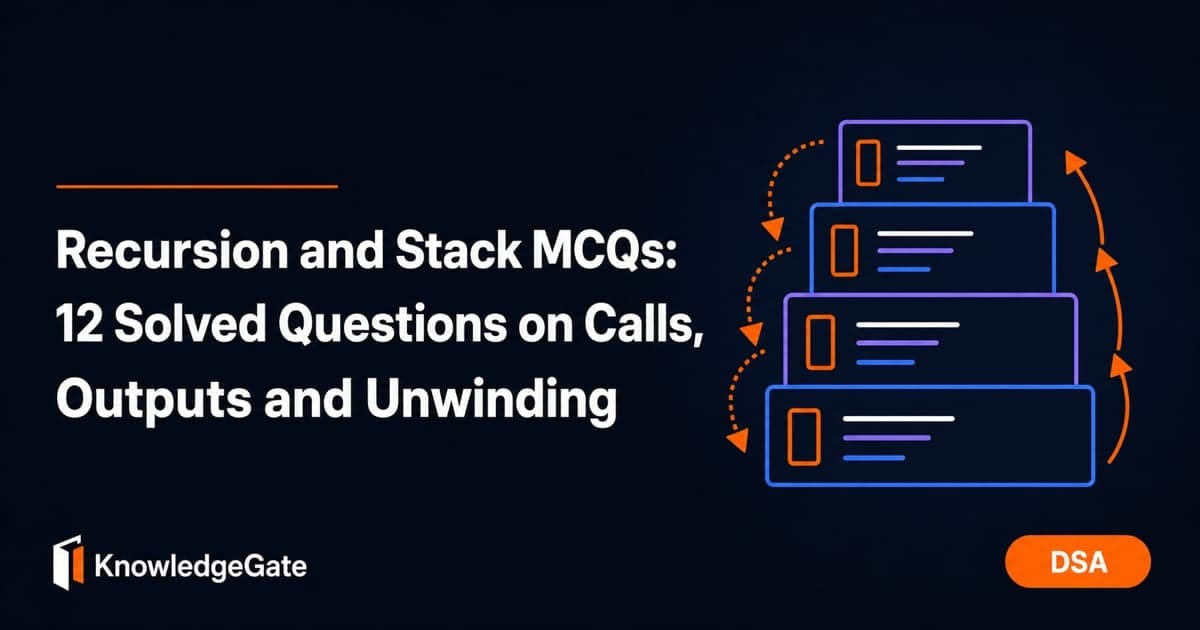
Recursion questions are rarely lost on the definition. Marks disappear when you mix up work done before a recursive call with work done after it, or forget that pending calls return in last-in, first-out order. Base-case drills teach termination; stack-focused recursion problems demand that you track what each suspended frame stores and exactly when it resumes. These mechanics are central to GATE CS Exam Preparation. Activation records, return-value recurrences, output order, digit reversal, explicit stacks and binary recursion all follow one routine: mark the base case, write the argument at every call, record each action before descent, then unwind frames from the top.
Recursion and stack MCQs: activation records and implementation
The call stack is a last-in, first-out collection of activation records with return addresses, parameters and locals. In main -> sum(3) -> sum(2) -> sum(1) -> sum(0), returns run from sum(0) to sum(3), so a stack fits recursion. Use Data Structures MCQs for wider practice.
Q1. Which structure implements recursive procedures?
Kendriya Vidyalaya Sangathan 2017 | Solve this question
Recursive procedures are implemented using:A. String
B. Queue
C. Stack
D. Linked ListAnswer: C. Stack.
New calls finish before their callers resume. Thus the return order sum(0), sum(1), sum(2), sum(3) is last-in, first-out.
Q2. Recursive versus non-recursive time and space
UGC NET 2015 | Solve this question
In general, in a recursive and non-recursive implementation of a problem (program):A. Both time and space complexities are better in recursive than in non-recursive program.
B. Both time and space complexities are better in non-recursive than in recursive program.
C. Time complexity is better in recursive version but space complexity is better in non-recursive version of a program.
D. Space complexity is better in recursive version but time complexity is better in non-recursive version of a program.Answer: B. The non-recursive program is better in general.
Iteration usually avoids call overhead and pending records. It tends to use less space and constant-factor time, but not a better asymptotic class: both factorial versions do n multiplications, while recursion retains up to n frames.
Q3. What the stack stores during recursion
Bihar STET 2025 | Solve this question
In the context of recursion, what is the purpose of the "stack" data structure?A. To store variables and function calls for backtracking
B. To store only variables
C. To store only function calls
D. To store loop countersAnswer: A. Variables and function calls for backtracking.
An activation record stores control and call-specific data. The sum(3) frame remembers n = 3 and where to continue after sum(2) returns, enabling unwinding.
Recursive return-value MCQs: reduce arguments before adding answers
Track current arguments, work at this level and next arguments. Reach the base case before collapsing additions.
Q4. Sum the binary remainders of 513
GATE 2011 | Solve this question
Consider the following recursive C function that takes two arguments.
unsigned int foo(unsigned int n, unsigned int r) {

    if (n>0) return ((n%r) + foo(n/r, r));

    else return 0;

}
What is the return value of the function foo when it is called as foo(513, 2)?A. 9
B. 8
C. 5
D. 2Answer: D. 2.
The rows (n, n % 2, n / 2) are (513,1,256), (256,0,128), (128,0,64), (64,0,32), (32,0,16), (16,0,8), (8,0,4), (4,0,2), (2,0,1), (1,1,0). The middle column totals 1 + 0 + 0 + 0 + 0 + 0 + 0 + 0 + 0 + 1 = 2, matching 513 = 512 + 1 = (1000000001)_2.
Q5. Sum the even numbers from 100 to 2
UGC NET 2016 | Solve this question
What is the value returned by the function f given below when n = 100?
let f(int n)
{
  if (n == 0) then return n;
  else
    return n + f(n - 2);
}A. 2550
B. 2556
C. 5220
D. 5520Answer: A. 2550.
Expand f(100) = 100 + 98 + 96 + ... + 2 + f(0), where f(0) = 0. The 50 positive terms give 2(1 + 2 + ... + 50) = 2 x (50 x 51 / 2) = 2550; zero adds nothing.
Q6. Recursive multiplication after swapping arguments
Accenture 2025 | Solve this question
What will be the output of the following pseudo code?
For input a = 8 & b = 9.
function (input a, input b)
If (a < b)
return function (b, a)
elseif (b != 0)
return (a + function (a, b - 1))
else
return 0A. 56
B. 88
C. 72
D. 65Answer: C. 72.
First, function(8,9) -> function(9,8). Then G(b) = 9 + G(b-1), G(0) = 0, gives eight 9s: G(8) = 9 x 8 = 72; the swap adds nothing.
Recursion output MCQs: descent order versus unwind order
Output before a call occurs on descent; output after it occurs on unwind. Two calls surround the print with complete subtraces. The full recursion and stack practice set reinforces these rules; Q7, Q8, Q10 and Q11 require output tracing, branching, binary conversion and reversal.
Q7. Printing binary remainders before recursion
What does the following function print for n = 25?
void fun(int n)
{
     if (n == 0)
        return;
    printf("%d", n%2);
    fun(n/2);
}A. 11001
B. 10011
C. 11111
D. 00000Answer: B. 10011.
The arguments are 25, 12, 6, 3, 1, 0. Printing before descent gives 1, 0, 0, 1, 1, or 10011; the opposite order gives binary 11001.
Q8. Two recursive branches around one print
What will be the output of following program?
#include <stdio.h>
void recursion(int n)
{    if(n > 0)
{ recursion(n-2);
 printf("%d ", n); recursion(n - 2); }
 }
int main()
{
recursion(6);
 return 0;
}A. 4 2 6 2 4 2 2
B. 2 4 2 6 2 4 2
C. 2 6 4 2 4 6 2
D. None of theseAnswer: B. 2 4 2 6 2 4 2.
Let S(n) = S(n-2), n, S(n-2) and S(0) be empty. Thus S(2) = 2, S(4) = 2 4 2, and S(6) = 2 4 2 6 2 4 2; two calls duplicate the trace.
Q9. Printing digits before and after unwinding
BEL 2007 | Solve this question
Study the following programme
// precondition : x >= 0
public void demo(int x)
{
System.out.print(x % 10);
if( (x / 10) != 0 )
{
demo(x / 10);
}
System.out.print(x % 10);
}
Which of the following is printed as a result of the call demo (1234)?A. 1441
B. 3443
C. 12344321
D. 43211234Answer: D. 43211234.
Trace each frame without combining the two print phases:
frame x | digit before call | next x | digit after return |
|---|---|---|---|
1234 | 4 | 123 | 4 |
123 | 3 | 12 | 3 |
12 | 2 | 1 | 2 |
1 | 1 | none | 1 |
Descent prints 4 3 2 1; unwinding prints 1 2 3 4, giving 43211234. The deepest frame prints before and after its skipped branch, producing the middle 11.
Stack operation MCQs: reversal, binary conversion and recursion type
A stack reverses encounter order: the last item pushed is popped first. Apply this below.
Q10. Printing a number's binary representation with a stack
Following is C like pseudo code of a function that takes a number as an argument, and uses a stack S to do processing.
void fun (int n)
{
    Stack S; // Say it creates an empty stack S
    while (n > 0)
    {
          // This line pushes the value of n%2 to stack S
          push (&S, n%2);
          n = n/2;
    }
    // Run while Stack S is not empty
    while (!isEmpty(&S))
        printf("%d ", pop(&S)); // pop an element from S and print it
}
What does the above function do in general?A. Prints binary representation of n in reverse order
B. Prints binary representation of n
C. Prints the value of Logn
D. Prints the value of Logn in reverse orderAnswer: B. Prints binary representation of n.
For n = 13, division pushes 1, 0, 1, 1; popping gives 1, 1, 0, 1, or binary 1101. Printing without the stack gives the reverse, 1011.
Q11. Reversing the word knowledge
Consider the following pseudo code that uses a stack:
declare a stack of characters
while ( there are more characters in the word to read )
{
read a character
push the character on the stack
}
while ( the stack is not empty )
{
pop a character off the stack
write the character to the screen
}
What is output for input “knowledge”?A. knowegdge
B. egdelwonk
C. lwonkwgde
D. none of the aboveAnswer: B. egdelwonk.
Push k, n, o, w, l, e, d, g, e, with final e on top. Pop e, g, d, e, l, w, o, n, k to get egdelwonk; last-in, first-out reverses input.
Q12. Classifying two-call Fibonacci recursion
BEL 2023 | Solve this question
The following C function is an example of what type of recursion?
int f(int n)
{
if(n==1)
return 1;
else if(n==0)
return 0;
else
return(f(n-1)+f(n-2));
}A. Binary
B. Tail
C. Linear
D. HeadAnswer: A. Binary.
Each non-base call creates f(n-1) and f(n-2), so the recursion is binary. Also, f(4) = f(3) + f(2) = (f(2) + f(1)) + (f(1) + f(0)) = (1 + 1) + (1 + 0) = 3; it is not tail recursion because addition remains.
Recursion and stack MCQ traps: a four-check solving method
Do not match words such as stack or binary. Trace first.
Check | Common failure | Correction |
|---|---|---|
Base case | Passing | Stop at return |
Argument change | Replacing the update | Write |
Action position | Mixing phases | Before is descent; after is unwind |
Number of calls | Treating two as one | Expand both |
Check values: foo(513,2) has ten frames but two 1-bits, f(100) has 50 positive terms, recursion(6) duplicates S(4), and demo(1234) prints four digits down and four up.
The short version: practise the trace, then widen the data-structures set
Locate the base case, record descent arguments, mark work around calls, then unwind last-in, first-out. This handles return values, output order and stacks. For an organised sequence, use GATE Guidance by Sanchit Sir. Next try Binary Tree MCQs. Trace one frame at a time.
Keep learning
Array Basics and Operations MCQs: 12 Solved Questions with Explanations
Attempt 12 published array MCQs, then check concise explanations for indexing, address arithmetic, search, shifting costs, and rotation.
25 Oct 20267 min readData Structures MCQs
Other Array Types MCQs: 10 Solved Questions with Explanations
Work through 10 live MCQs and learn how index alignment, logical size, physical capacity, sparse storage, and 1-based heap arithmetic determine each answer.
Updated 24 Oct 20267 min readData Structures MCQs
3D and Multidimensional Array MCQs: 10 Solved Questions with Explanations
Solve ten multidimensional-array questions with lower-bound normalisation, address formulas, array transformations, and careful step-by-step traces.
Updated 20 Oct 20268 min readData Structures MCQs
1D and 2D Array Addressing MCQs: 12 Solved Questions
Solve 12 array-address questions step by step, from negative lower bounds and 1D offsets to row-major, column-major, triangular and tri-diagonal storage.
Updated 16 Oct 20268 min readData Structures MCQs