Operating System Structure and Interface MCQs: 12 Solved Questions
Test your understanding of OS architecture, booting, and user interfaces with 12 answered MCQs. Each explanation shows the rule that separates the correct option from its distractors.
KnowledgeGate Team
Exam prep & CS education
5 Sep 20267 min read
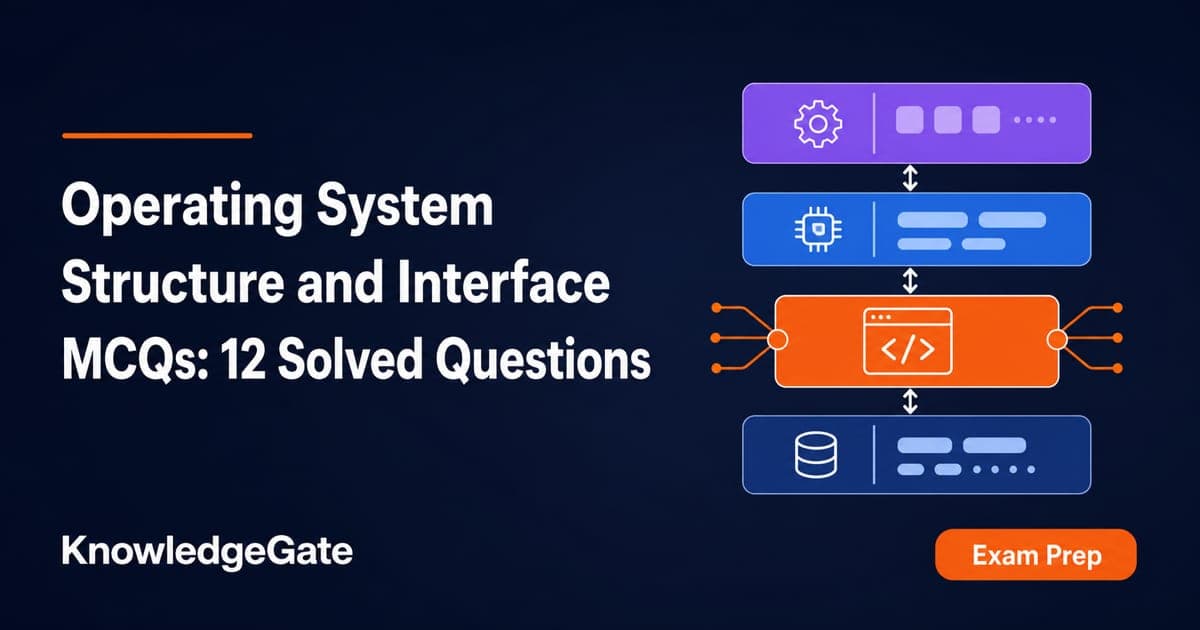
Terms such as CLI, microkernel, bootstrap loader, and layered design often look familiar. The trap in an MCQ is identifying the precise responsibility, classification, or sequence being tested. The key is to separate related ideas and apply the right rule under exam pressure, without relying on recognition alone.
How to use these OS structure and interface MCQs
Attempt all 12 before reading an answer. Record the option, then tag every miss as architecture, boot sequence, or user interface. Architecture covers abstractions and kernel design, boot sequence follows control from firmware to the kernel, and user interface covers command interpreters, GUIs, and CLIs.
Open the linked question page after each attempt to compare its full explanation with your reasoning. If the wider foundation is weak, start with OS Basics MCQs: 12 Solved Questions. The GATE category places this topic inside a complete GATE CS plan.
OS abstractions and layered structure
Q1. Hardware abstractions, GATE 1999
Listed below are some operating system abstractions (left column) and the hardware components or mechanisms (right column) that they abstract. Which of the following matching of pairs is correct? A. Thread 1. Interrupt B. Virtual address space 2. Memory C. File system 3. CPU D. Signal 4. Disk
A. A-2, B-4, C-3, D-1
B. A-1, B-2, C-3, D-4
C. A-3, B-2, C-4, D-1
D. A-4, B-1, C-2, D-3
Answer: C. A-3, B-2, C-4, D-1. A thread represents CPU execution, a virtual address space abstracts memory, and a file system abstracts disk storage. A signal supplies an interrupt-like notification, so D maps to 1. Only option C contains all four mappings; see the full worked solution.
Q2. Layered operating-system design, MPPSC 2025
Which operating system structure allows for the operating system to be broken into a number of layers, each built on top of lower layers, with the bottom layer being the hardware?
A. Monolithic structure
B. Layered approach
C. Microkernel
D. Security layer
Answer: B. Layered approach. The hardware forms the bottom layer, and each higher layer uses services exposed by lower ones. That hierarchy is the defining clue. A monolithic kernel keeps many services together in kernel space, while a microkernel moves non-essential services out of the core.
Microkernel size and client-service communication
Q3. Two claims about microkernels, DSSSB 2022
Which of the following statements is/are true about microkernel? (i) This method reduces the size of the kernel. (ii) This approach was used to develop the Mach operating system at Carnegie Mellon University.
A. Only (i)
B. Only (ii)
C. Both (i) and (ii)
D. Neither (i) nor (ii)
Answer: C. Both (i) and (ii). Moving services into user space reduces the resident kernel core, so statement (i) is true. The smaller core retains fundamental mechanisms while other facilities run as user-space services. Mach is the microkernel example named in statement (ii), so the truth pattern is T, T, which selects the option encoding both claims.
Q4. Microkernel communication endpoints, UGC NET 2022
The main function of a microkernel is to provide a communication facility between the _____ program and the various _____ that are also running in user space.
A. Virtual, Processes
B. System, Processes
C. Client, Services
D. Virtual, Services
Answer: C. Client, Services. A client program requests an operating-system service, the microkernel carries the message, and a user-space service responds. Processes is too broad for the service endpoint named by this model, while Virtual does not identify the requester.
Monolithic and hybrid kernel classification
Q5. Linux and Windows kernel types, DSSSB 2021
Which of the following are monolithic kernel systems?
I. Linux
II. Windows
A. Only I
B. Only II
C. Both I and II
D. Neither I nor II
Answer: A. Only I. Classify the two systems separately. Linux keeps core services in kernel space, so it remains monolithic even though loadable modules can be inserted or removed. Windows combines architectural elements and is conventionally classified as hybrid, making statement II false. Module support tests extensibility, not the user-space boundary that defines a microkernel.
Q6. OS X kernel architecture, RSSB 2022
What type of kernel architecture does OS X use?
A. Monolithic kernel with modules
B. Microkernel
C. Monolithic kernel
D. Hybrid kernel
Answer: D. Hybrid kernel. XNU combines Mach-derived primitives with BSD components inside one kernel architecture. The Mach side contributes low-level mechanisms, while the BSD side supplies familiar operating-system facilities. Because the design deliberately blends these traditions, it is classified as hybrid rather than as a pure microkernel or pure monolithic kernel. In an MCQ, focus on where services run and how components cooperate, not just the kernel's feature list.
Bootstrap loader and kernel-loading order
Q7. Program that starts computer software, MPPSC 2025
The __________ is a program whose function is to start the computer-software when power is turned on.
A. Dynamic RAM
B. Static RAM
C. Read Only Memory
D. Bootstrap Loader
Answer: D. Bootstrap Loader. DRAM, SRAM, and ROM are memory categories, but the stem asks for a program that performs an action. The bootstrap loader locates and loads the operating-system kernel, then transfers control to it.
Q8. Three-step boot order, UGC NET 2022
Select the correct order of events after power is initialized on a system.
A. Bootstrap loader is loaded from the disk
B. Kernel is loaded onto the memory
C. Firmware ROM loads boot block
Choose the correct answer from the options given below:
A. B,C,A
B. C,A,B
C. A,B,C
D. A,C,B
Answer: B. Order C, A, B. Follow the event labels given in the stem: firmware ROM loads the boot block (C), the bootstrap loader is then loaded from disk (A), and the loader places the kernel in memory (B). The sequence is C -> A -> B, which eliminates options A, C, and D.
Command interpreters, Unix, Bash, GUI, and CLI
Q9. Command-interpreter responsibility, Hexaware 2023
What is the main function of the command interpreter?
A. to provide the interface between the API and application program
B. to handle the files in the operating system
C. to get and execute the next user-specified command
D. none of the mentioned
Answer: C. to get and execute the next user-specified command. When a user enters ls, the interpreter parses the command, launches the relevant program, and waits for or reports the result. File handling may be requested by that program, but it is not the interpreter's defining function.
Q10. Unix user interface, MPPSC 2024
Unix is an operating system with the following type of user Interface-
A. Voice-based Interface
B. Natural Language Interface
C. Command-based Interface
D. Touch-based Interface
Answer: C. Command-based Interface. The Unix shell accepts typed commands, so command-based is the intended classification. Graphical environments can run on Unix systems, but the historical interface tested by this item is the command interface.
Q11. Purpose of /bin/bash, IBPS 2024
What is the primary purpose of /bin/bash in Linux systems?
A. To manage disk partitions
B. To execute shell commands and shell scripts
C. To configure network interfaces
D. To store system log files
E. To compile C programs automatically
Answer: B. To execute shell commands and shell scripts. /bin/bash can accept an interactive command such as pwd, or run commands stored in script.sh. The distractors describe jobs handled by other tools or services that Bash may launch but does not replace.
Q12. GUI versus CLI
What differentiates a GUI from a CLI?
A. GUI uses text, CLI uses graphics
B. GUI is slower, CLI is faster
C. GUI uses graphics, CLI uses text commands
D. GUI is outdated, CLI is modern
Answer: C. GUI uses graphics, CLI uses text commands. The reliable distinction is the form of interaction, not an absolute claim about speed. A user might click a folder icon in a GUI but type cd folder in a CLI.
Answer-pattern recap and an honest score diagnosis
Keep four patterns in one concept map. Architecture maps thread -> CPU, virtual address space -> memory, file system -> disk, and signal -> interrupt. Linux is monolithic, Windows and OS X are hybrid, and a microkernel carries client-to-service messages. Booting follows firmware ROM -> boot block -> bootstrap loader -> kernel in memory. A command interpreter executes commands, Bash handles commands and scripts, a GUI uses graphics, and a CLI uses text commands.
Misses in Q1-Q6 point to weak abstraction or kernel-classification boundaries; misses in Q7-Q8 point to boot-order confusion; misses in Q9-Q12 point to interface classification. Reattempt only the failed cluster, then continue with the broader Operating System MCQs practice hub.
The next practice step
Choose the track that matches your goal. For full-subject exam sequencing, GATE Guidance by Sanchit Sir includes Operating System and Introduction to OS in its live curriculum. For placement interview revision across OS, DBMS, and networks, use CS Fundamentals for Placements by Sanchit Sir.
Whichever track you use, redo only the missed questions after 48 hours. Before selecting an option, state the governing rule aloud or write it in one line. That recall step shows whether you understand the concept or merely remember the previous answer.
Keep learning
Segmentation and Hybrid MCQs: 10 Solved OS Questions with Explanations
Solve ten memory-management MCQs, then check the keyed answers, short reasoning paths, distractor traps, and worked address calculations.
Updated 3 Oct 20267 min readOperating System MCQs
Paging and TLB MCQs: 12 Solved Questions with Step-by-Step Explanations
Solve 12 Paging and TLB MCQs in a sequence that builds from page-table basics to address splits, TLB coverage, timing and fragmentation.
Updated 28 Sep 20268 min readOperating System MCQs
OS Types & Evolution MCQs: 12 Solved Questions with Explanations
Solve 12 published OS Types & Evolution questions. Each answer identifies the clue that separates batch, multiprogramming, time sharing and other OS models.
Updated 25 Sep 20268 min read83 viewsOperating System MCQs

Multilevel Paging MCQs: 12 Solved Questions with Explanations
Solve 10 MCQs and two NATs on multilevel paging. Each answer works through the address bits, table capacity or access-time path that decides the result.
Updated 24 Sep 20268 min readOperating System MCQs