Windows Design & Architecture MCQs: 9 Solved MCQs and 1 Dual-Mode Scenario
Attempt nine Windows architecture MCQs, then solve a dual-mode scenario. Each answer separates product lineage, internal boundaries and Win32 mechanisms.
KnowledgeGate Team
Exam prep & CS education
Updated 16 Aug 20267 min read
Older Windows architecture questions are difficult because they mix three layers: the Windows 9x versus Windows NT family split, user mode versus kernel mode, and named Win32 compatibility or API mechanisms. Memorising isolated abbreviations makes their choices look interchangeable. Attempt the nine multiple-choice questions below before reading any answer, then work the written dual-mode scenario at the end. The nine carry UGC NET, UP Police and Beltron Programmer attributions, and every answer names the rule that decides it instead of restating the winning option. Place the set inside the wider UGC NET CS Exam Preparation sequence as you practise.
1. Windows design and architecture: build the three-layer map first
Layer | What it covers |
|---|---|
Family and execution model | Windows 95 versus the NT line |
Internal boundary | User mode, kernel mode, virtual memory and HAL |
Compatibility or API mechanism | WOW32, OLE, CreateFile and console flags |
Windows 95 is MS-DOS-based Windows 9x. It uses cooperative multitasking for 16-bit Windows applications and preemptive scheduling for 32-bit Win32 applications. Windows XP is NT-line and had 32-bit and 64-bit editions. WOW32 runs 16-bit Windows applications on 32-bit Windows. WOW64 runs 32-bit applications on 64-bit Windows.
For legacy products, answer the historical architecture named, not a current release. If kernel, system call or memory manager still blur together, revise OS Basics MCQs: 12 Solved (GATE/NET) first.
2. Windows lineage MCQs: MS-DOS dependence and multitasking
Question 1. NT-family kernel independence
Which of the following operating systems supports a full 32-bit or 64-bit kernel without being dependent on MS-DOS?
A.
Windows 95B.
Windows Millennium EditionC.
Windows 98D.
Windows XP
Answer: D. Windows XP. XP is NT-family. Windows 95, Windows 98 and Windows Millennium Edition are Windows 9x products with MS-DOS boot or compatibility dependencies. This describes historical lineage, not current support.
Question 2. Mixed 16-bit and 32-bit multitasking
Which of the following operating systems runs on top of MS-DOS and supports both 16-bit cooperative multitasking and 32-bit preemptive multitasking?
A.
Windows XPB.
Windows 95C.
Windows 7D.
Windows 10
Answer: B. Windows 95. Its 16-bit applications cooperate, while 32-bit Win32 applications are scheduled preemptively. XP, 7 and 10 are NT-line, not MS-DOS-based Windows 9x.
3. Windows 2000 internals MCQs: Unicode and hardware dependence
Question 3. Windows 2000 character set
The character set used in Windows 2000 operating system is __________ .
A.
8 bit ASCIIB.
Extended ASCIIC.
16 bit UNICODED.
12 bit UNICODE
Answer: C. 16 bit UNICODE. An 8-bit unit has 2^8 = 256 possible bit patterns. A 16-bit code unit has 2^16 = 65,536, and Windows 2000 uses such units internally. This does not limit modern Unicode to 65,536 code points.
Question 4. Least portable Windows 2000 component
A part of Windows 2000 operating system that is not portable is
A.
Device ManagementB.
Virtual Memory ManagementC.
Processor ManagementD.
User Interface
Answer: B. Virtual Memory Management. Historically, its implementation follows processor-specific MMU behaviour, page-table formats and address translation. The HAL isolates much of the wider system from platform details, but this historical answer does not make every modern memory manager wholly non-portable.
4. Windows compatibility and networking MCQs: WOW32 and XP drivers
Question 5. WOW32 compatibility environment
WOW32 is a :
A.
Win 32 API library for creating processes and threads.B.
Special kind of file system to the NT name space.C.
Kernel-mode objects accessible through Win 32 API.D.
Special execution environment used to run 16 bit Windows applications on 32-bit machines.
Answer: D. WOW32 runs 16-bit Windows applications on 32-bit Windows, using API translation or thunking between the old application and the 32-bit system. It is neither WOW64 nor a filesystem or kernel-object category.
Question 6. Windows XP network and transport-driver statements
Which of the following statements/s is/are true?
(i) Windows XP supports both peer-peer and client-server networks.
(ii) Windows XP implements Transport protocols as drivers that can be loaded and unloaded from the system given dynamically.
Choose the correct answer from the code given below:
Code:
A.
(i) onlyB.
(ii) onlyC.
Neither (i) nor (ii)D.
Both (i) and (ii)
Answer: D. Both (i) and (ii). Windows XP supports workgroup peer-to-peer and domain client-server use. Modular transport-protocol drivers can be installed, bound or unbound, and removed.
5. Win32 API MCQs: files, console input and OLE
Question 7. CreateFile behaviour
Beltron Programmer 2025
What is the purpose of the CreateFile() system call in Windows operating system?
A.
It is used to copy files from one location to another.B.
It opens an existing file but cannot create new files.C.
It only creates new files in a directory.D.
It can create a new file or open an existing one.
Answer: D. CreateFile() is a Win32 API function controlled by its creation disposition. CREATE_NEW = 1 creates only if absent, OPEN_EXISTING = 3 opens only if present, and OPEN_ALWAYS = 4 opens or creates. It is not restricted to one action.
Question 8. SetConsoleMode input flags
Beltron Programmer 2025
Which of the following is a valid mode flag used with SetConsoleMode() for input consoles?
A.
ENABLE_PROCESSED_OUTPUTB.
ENABLE_EXTENDED_FLAGSC.
ENABLE_BUFFERED_MODED.
ENABLE_PROCESSED_INPUT
Marked answer: D. On the flag definitions, B and D are both valid. ENABLE_PROCESSED_INPUT = 0x0001 and ENABLE_EXTENDED_FLAGS = 0x0080 are both legitimate input-console mode flags. A, ENABLE_PROCESSED_OUTPUT, applies to a screen-buffer handle rather than an input handle, and C, ENABLE_BUFFERED_MODE, is not a documented flag at all. With two defensible options the item does not work cleanly as a single-select, so decide it by the flag definitions and expect D if it reappears.
Question 9. OLE expansion and behaviour
Windows operating systems support the OLE concept. What does OLE stand for?
A.
Object Locking and EnhancementB.
Object Linking and EmbeddingC.
Object Locking and EmbeddingD.
Object Linking and Enhancement
Answer: B. Object Linking and Embedding. If a spreadsheet object shows B2 = 42, an embedded copy keeps that snapshot. A linked object retains its source relationship, so a source change to B2 = 57 can refresh the linked value to 57. The embedded value remains 42 unless edited separately.
6. Windows 7 dual-mode architecture: solve the scenario
Question 10. User mode, kernel mode and HAL
MCA entrance practice question
An IT consultant is explaining the stability of Windows 7 to a client. The client is worried that a single crashing application (like a web browser) might crash the entire operating system. The consultant needs to explain the architectural separation between user applications and core system services.
Describe the Dual-Mode Architecture of Windows 7. How do the User Mode and Kernel Mode work together to ensure system stability, and what is the role of the Hardware Abstraction Layer (HAL) in this architecture?
This one asks for a written answer, not a single option. Build it in four parts:
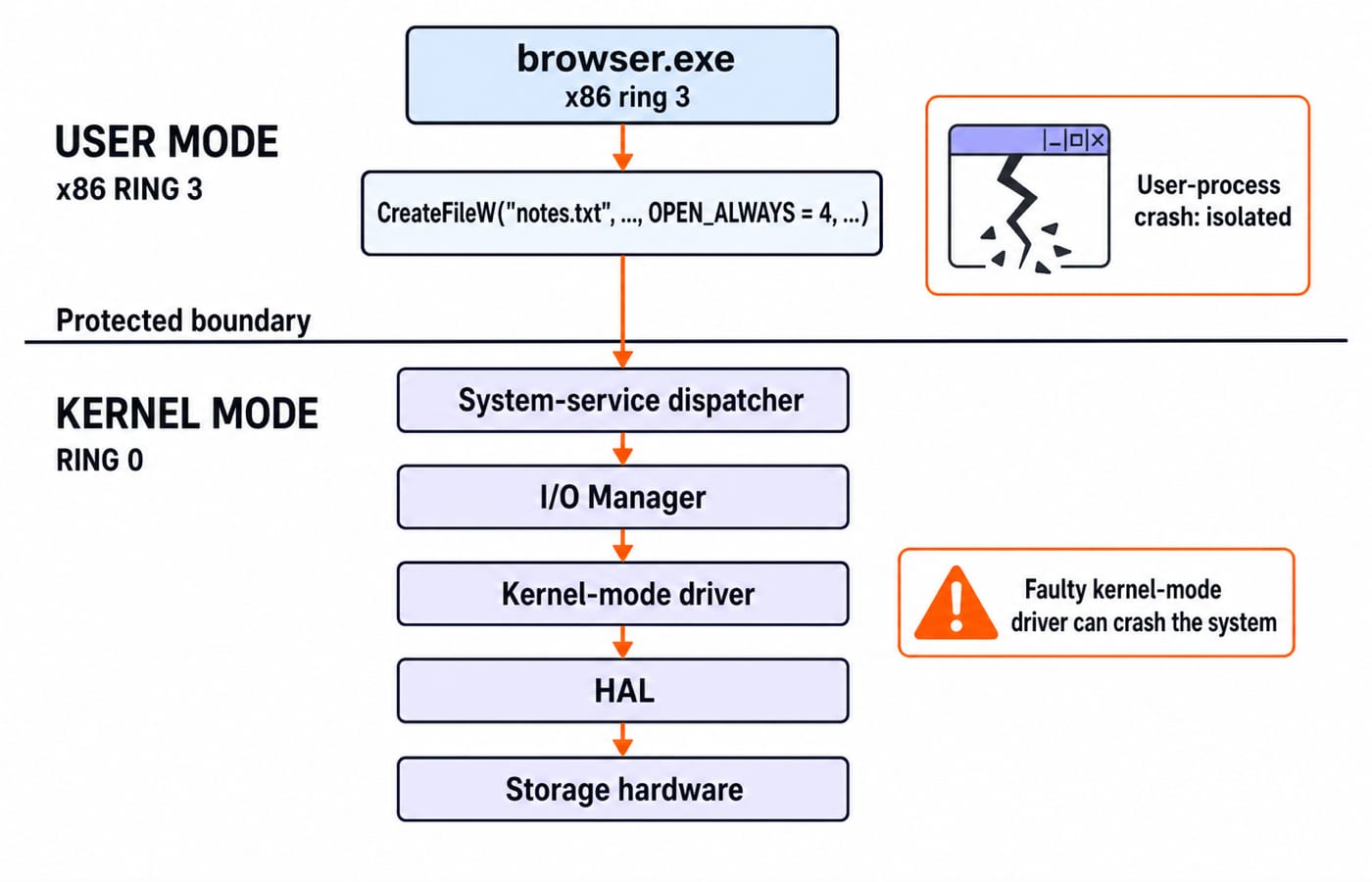
On x86 and x64, user application code runs at
ring 3; kernel code runs atring 0.A browser has a private virtual address space and cannot directly access kernel-reserved memory or hardware. An ordinary crash is normally isolated to that process.
CreateFileW("notes.txt", ..., OPEN_ALWAYS = 4, ...)starts in user mode, crosses the system-service boundary, and follows the kernel I/O path to a driver.The HAL sits between platform-specific hardware details and the kernel or drivers. It supports hardware abstraction and portability, but it does not isolate one user process from another.
Kernel-mode code shares privileged system space, so a faulty driver can still corrupt or crash the operating system. Dual mode improves isolation, but cannot prevent every crash.
7. Windows design and architecture answer audit and next practice step
Question | Marked answer | Verified answer | Decisive rule |
|---|---|---|---|
Q1 | D | D | XP is NT-line |
Q2 | B | B | Windows 95 mixes 16-bit cooperative and 32-bit preemptive multitasking |
Q3 | C | C | 16-bit Unicode code units |
Q4 | B | B | Virtual memory follows MMU and page-table details |
Q5 | D | D | WOW32 runs 16-bit apps on 32-bit Windows |
Q6 | D | D | Both XP statements |
Q7 | D | D | Creation disposition controls create or open |
Q8 | D | B+D valid | Two valid input flags |
Q9 | B | B | Object Linking and Embedding |
Q10 | None | Four-part written answer | User and kernel boundary plus HAL |
Sort misses into three buckets: lineage and execution model, Q1 to Q2; internals and compatibility, Q3 to Q6; Win32 APIs and the architecture boundary, Q7 to Q10. After 48 hours, reattempt only missed objective items and rewrite the Q10 four-part response from memory in 120 to 150 words.
Continue with NTA-UGC-NET Paper - 2 for NET-oriented system software or NIACL AO IT Specialist 2026 for the specialist-exam route. The broader Operating System MCQs hub adds mixed-topic practice. Treat Q8 as ambiguous rather than a clean single-select, and explain the decisive rule on every reattempt.
Keep learning
Segmentation and Hybrid MCQs: 10 Solved OS Questions with Explanations
Solve ten memory-management MCQs, then check the keyed answers, short reasoning paths, distractor traps, and worked address calculations.
Updated 3 Oct 20267 min readOperating System MCQs
Paging and TLB MCQs: 12 Solved Questions with Step-by-Step Explanations
Solve 12 Paging and TLB MCQs in a sequence that builds from page-table basics to address splits, TLB coverage, timing and fragmentation.
Updated 28 Sep 20268 min readOperating System MCQs
OS Types & Evolution MCQs: 12 Solved Questions with Explanations
Solve 12 published OS Types & Evolution questions. Each answer identifies the clue that separates batch, multiprogramming, time sharing and other OS models.
Updated 25 Sep 20268 min read83 viewsOperating System MCQs
Multilevel Paging MCQs: 12 Solved Questions with Explanations
Solve 10 MCQs and two NATs on multilevel paging. Each answer works through the address bits, table capacity or access-time path that decides the result.
Updated 24 Sep 20268 min readOperating System MCQs