

Symmetric Key Cryptography MCQs: 12 Solved Block and Stream Cipher Questions
Solve 12 symmetric key cryptography questions covering AES, DES, key count, cipher modes, parameter matching and a full columnar transposition trace.
KnowledgeGate Team
Exam prep & CS education
Updated 17 Nov 20267 min read
Symmetric-key questions mix four levels that look similar under time pressure: the shared-key model, classical substitution or transposition, block-cipher construction, and modes that make a block cipher behave like a stream. The trap is usually category confusion, not difficult computation. Keep DES, AES, feedback modes and the columnar-transposition trace separate as you solve. Mark one option before reading each explanation. GATE CS Exam Preparation places these questions inside a broader revision route.
Symmetric key cryptography facts to fix before solving
Term | What it means |
|---|---|
Symmetric cryptography | One shared secret is used by each communicating pair. |
Block cipher | Transforms data in fixed-size blocks. |
Stream cipher | Combines data with a generated keystream. |
Mode | Defines how repeated block-cipher calls process a longer message. |
Key counting is the first calibration. If N = 8 people must communicate privately, every unordered pair needs one secret key:
C(8,2) = 8 x 7 / 2 = 28.
It is not 8 x 7 = 56, because that counts (A,B) and (B,A) separately even though they are the same communicating pair. In general, the count is N(N - 1)/2.
Also keep two construction facts ready. AES is a symmetric block cipher, while DES uses a Feistel structure. CFB is not a separate cipher. It is a mode that lets a block cipher work as a self-synchronising stream cipher.
Symmetric key MCQs 1-3: shared keys, inverse operations and key count
Question 1 (ISRO 2009)
Advanced Encryption Standard (AES) is based on
A. Asymmetric key algorithm
B. Symmetric key algorithm
C. Public key algorithm
D. Key exchange
Correct answer: B. Symmetric key algorithm.
Explanation: AES uses the same secret key for encryption and decryption, so it is symmetric. It encrypts data and is neither a public-key scheme nor a key-exchange protocol. Therefore B fits.
Question 2 (DSSSB 2022)
Which of the following statements is/are true?
(i) In a secret-key encryption/decryption technique, the same key is used by both parties.
(ii) In a secret-key encryption/decryption technique, the decryption algorithm is the inverse of the encryption algorithm.
A. Only (i)
B. Only (ii)
C. Both (i) and (ii)
D. Neither (i) nor (ii)
Correct answer: C. Both (i) and (ii).
Explanation: Statement (i) defines the shared-secret model. Statement (ii) states correctness: for a valid key, decryption reverses encryption and recovers plaintext. The implementations need not use identical steps. Both are true.
Question 3 (UGC NET 2018)
Suppose that everyone in a group of N people wants to communicate secretly with (N-1) other people using symmetric key cryptographic system. The communication between any two persons should not be decodable by the others in the group. The number of keys required in the system as a whole to satisfy the confidentiality requirement is
A. N(N - 1)
B. N(N-1)/2
C. 2N
D. (N-1)^2
Correct answer: B. N(N-1)/2.
Explanation: Each unordered pair needs one key. Counting N - 1 partners per person records each pair twice, so divide by 2. For N = 8, 8 x 7 / 2 = 28, confirming B.
Symmetric key MCQs 4-6: modes, algorithm families and classical ciphers
Question 4 (DSSSB 2021)
Which of the following is not a Cipher mode in Cryptography?
A. Electronic Code Book Mode
B. Cipher Feedback Mode
C. Stream Cipher Mode
D. Cipher Block Chaining Mode
Correct answer: C. Stream Cipher Mode.
Explanation: ECB, CFB and CBC are named block-cipher modes. A stream cipher is a cipher class, not a mode named "Stream Cipher Mode". Stream-like operation does not change that category.
Question 5 (RSSB 2022)
Which of the following is not a symmetric key cryptography algorithm?
A. RC4
B. Blowfish
C. Diffie–Hellman
D. DES
Correct answer: C. Diffie–Hellman.
Explanation: RC4 is a symmetric stream cipher. Blowfish and DES are symmetric block ciphers. Diffie-Hellman performs key agreement, not symmetric encryption. Establishing a key is different from encrypting a message.
Question 6 (ISRO 2011)
An example of poly-alphabetic substitution is
A. P-box
B. S-box
C. Caesar cipher
D. Vigenere cipher
Correct answer: D. Vigenere cipher.
Explanation: Caesar uses one fixed alphabet, so it is monoalphabetic. Vigenere varies the shift with a repeating key and uses multiple alphabets. P-boxes permute positions, while S-boxes substitute inside cipher rounds.
Symmetric key MCQs 7-9: Feistel structure, avalanche effect and CFB
Question 7 (ISRO 2013)
Which of the following encryption algorithms is based on the Fiestal structure?
A. Advanced Encryption Standard
B. RSA public key cryptographic algorithm
C. Data Encryption Standard
D. RC4
Correct answer: C. Data Encryption Standard.
Explanation: The standard spelling is Feistel. DES splits a block into halves, then applies a round function, XOR and a swap. AES uses substitution-permutation, RSA is public-key cryptography, and RC4 is a stream cipher.
Question 8 (ISRO 2020)
Avalanche effect in cryptography refers
A. Large changes in cipher text when the keyword is changed minimally
B. Large changes in cipher text when the plain text is changed
C. Large impact of keyword change to length of the cipher text
D. None of the above
Correct answer: A. Large changes in cipher text when the keyword is changed minimally.
Explanation: A includes a minimal input change and a large ciphertext change. Good diffusion also seeks a large change after one plaintext bit changes. B omits the minimal-change condition, while C wrongly changes ciphertext length.
Question 9 (UGC NET 2022)
Which mode is a block cipher implementation as a self-synchronizing stream cipher ?
A. Cipher Block Chaining Mode,
B. Cipher Feedback Mode
C. Electronic Codebook Mode
D. Output Feedback Mode
Correct answer: B. Cipher Feedback Mode.
Explanation: CFB feeds previous ciphertext into the block cipher and emits stream-sized segments. The receiver regains alignment after enough segments, so CFB is self-synchronising. OFB is stream-like, but its state follows generated output and cannot resynchronise from ciphertext.
Symmetric key MCQs 10-12: DES order, block sizes and transposition
Question 10 (UGC NET 2019)
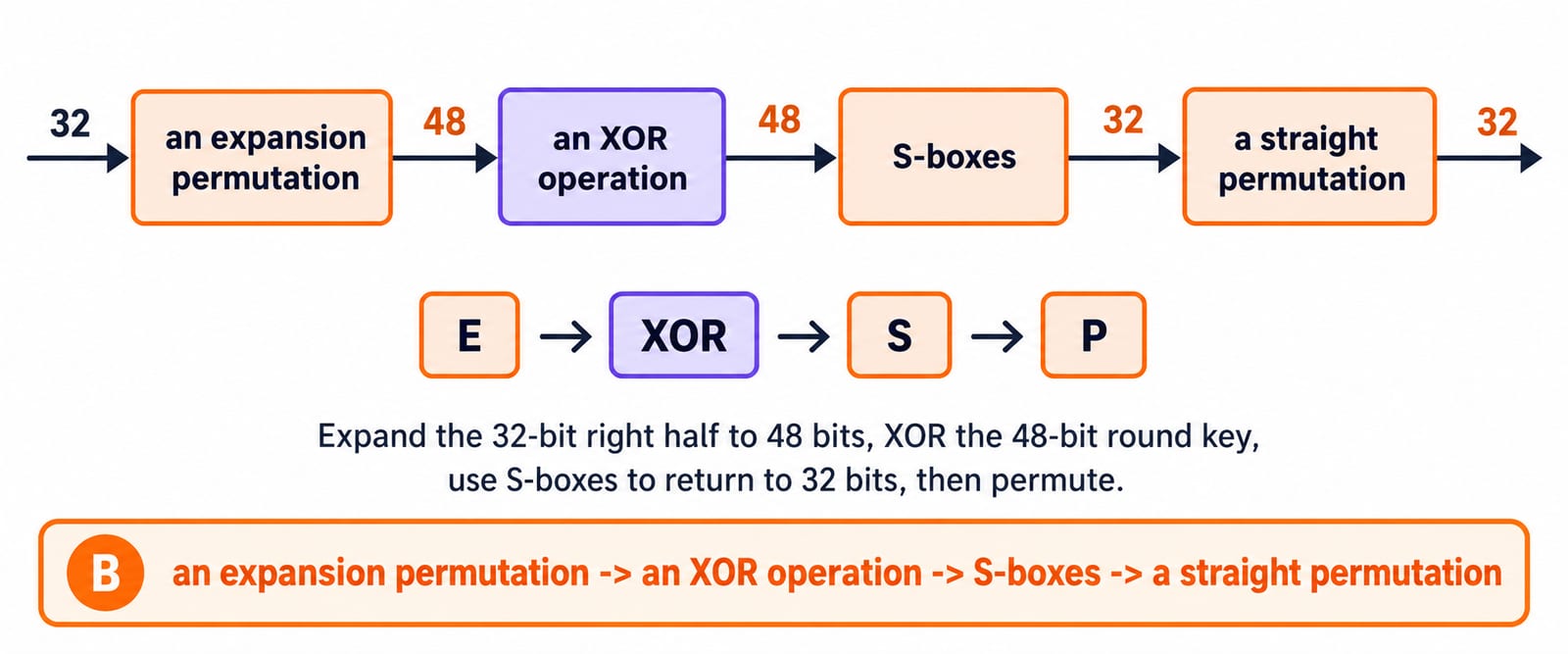
The Data Encryption Standard (DES) has a function consists of four steps. Which of the following is correct order of these four steps?
A. an expansion permutation, S-boxes, an XOR operation, a straight permutation
B. an expansion permutation, an XOR operation, S-boxes, a straight permutation
C. a straight permutation, S-boxes, an XOR operation, an expansion permutation
D. a straight permutation, an XOR operation, S-boxes, an expansion permutation
Correct answer: B. an expansion permutation, an XOR operation, S-boxes, a straight permutation.
Explanation: Expand the 32-bit right half to 48 bits, XOR the 48-bit round key, use S-boxes to return to 32 bits, then permute. The sizes are 32 -> 48 -> 48 -> 32 -> 32, giving E -> XOR -> S -> P.
Question 11 (UGC NET 2018)
Match the following symmetric block ciphers with their block and key sizes:
List I: (a) DES; (b) IDEA; (c) Blowfish; (d) AES.
List II: (i) 64-bit block and 32- to 448-bit key; (ii) 64-bit block and 64-bit key field; (iii) 128-bit block and 128-, 192- or 256-bit key; (iv) 64-bit block and 128-bit key.
Choose the correct code:
A. (a)-(iv); (b)-(ii); (c)-(i); (d)-(iii)
B. (a)-(ii); (b)-(iv); (c)-(i); (d)-(iii)
C. (a)-(ii); (b)-(iv); (c)-(iii); (d)-(i)
D. (a)-(iv); (b)-(ii); (c)-(iii); (d)-(i)
Correct answer: B. (a)-(ii); (b)-(iv); (c)-(i); (d)-(iii).
Explanation: Match AES to (iii): 128-bit blocks and 128, 192 or 256-bit keys. Blowfish is (i): 64-bit blocks and 32 to 448-bit keys. IDEA is (iv): 64-bit blocks and 128-bit keys. DES is (ii): 64-bit blocks with a 64-bit key field, of which 56 bits are effective and 8 are parity bits.
Question 12 (UGC NET 2015)
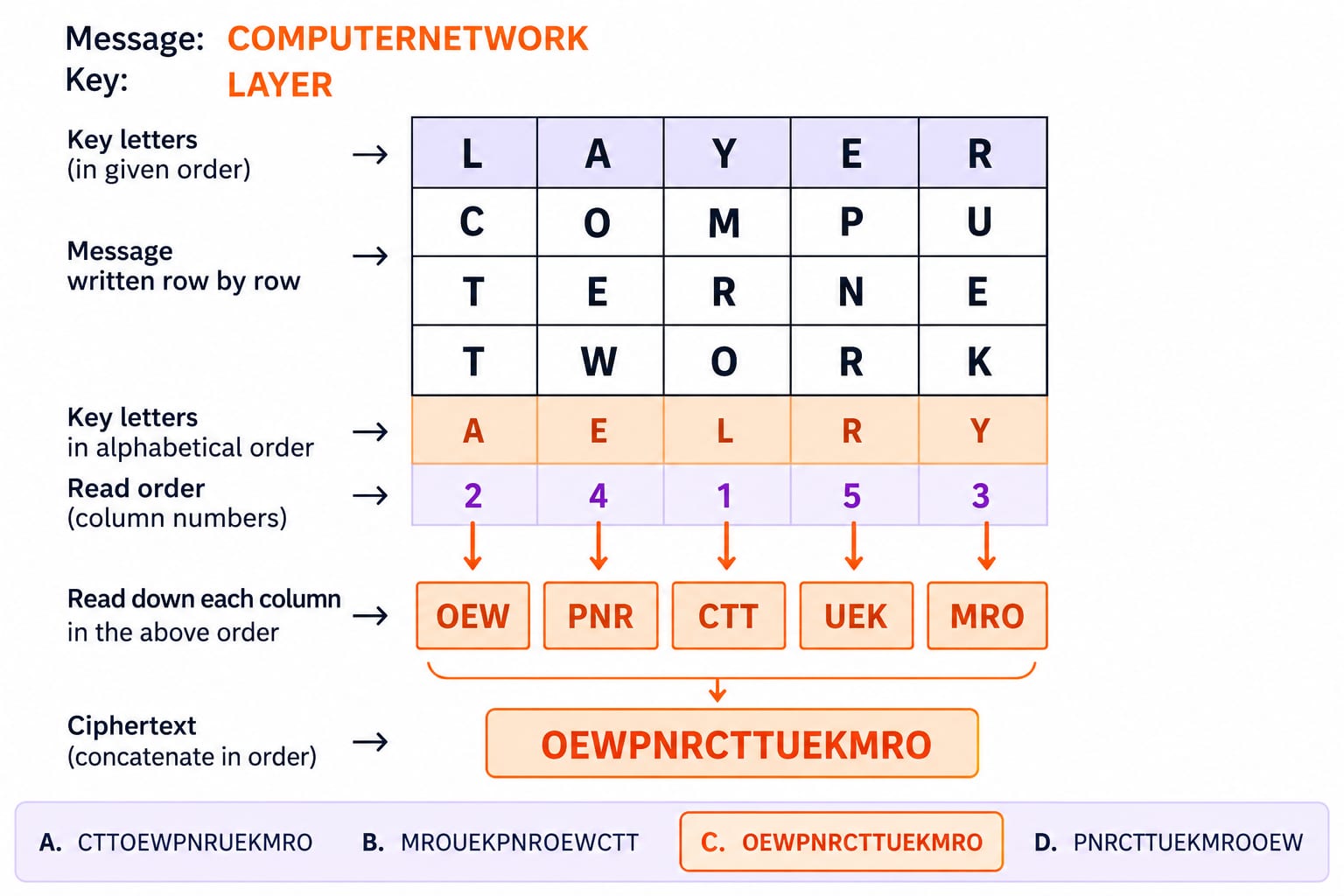
A message "COMPUTERNETWORK" encrypted (ignore quotes) using columnar transposition cipher with a key "LAYER". The encrypted message is :
A. CTTOEWMROPNRUEK
B. MROUEKCTTPNROEW
C. OEWPNRCTTUEKMRO
D. UEKPNRMROOEQCTT
Correct answer: C. OEWPNRCTTUEKMRO.
Explanation: Write the message row by row under the key:
L | A | Y | E | R |
|---|---|---|---|---|
C | O | M | P | U |
T | E | R | N | E |
T | W | O | R | K |
Alphabetical key order is A, E, L, R, Y, so read columns 2, 4, 1, 5, 3:
OEW | PNR | CTT | UEK | MRO
Concatenation gives OEWPNRCTTUEKMRO, exactly option C.
The traps these 12 symmetric cipher questions expose
Trap | Questions and remedy |
|---|---|
Shared key versus key exchange | Q1 and Q5: separate encryption from agreement. |
Ordered pair versus unordered pair | Q3: use |
Cipher family versus mode | Q4 and Q9: label the category first. |
Monoalphabetic versus polyalphabetic | Q6: count the substitution alphabets. |
Feistel steps and diffusion | Q7, Q8 and Q10: recall |
Block size versus key size | Q11: match the unmistakable AES row first. |
For Q12, write the grid. Mental rearrangement causes avoidable errors.
For 60-second elimination, label each option as an algorithm, mode, construction or property. Write one invariant, such as pairs = N(N-1)/2, DES F: E -> XOR -> S -> P, or CFB = ciphertext feedback. Reject wrong-category options before calculating.
For wider practice across the subject, work through Computer Networks MCQs. The Computer Networks guide gives you the subject map around network security and cryptography.
Symmetric key cryptography: the next practice step
Redo Q3, Q9, Q10, Q11 and Q12 without looking at the answers. They test key scaling, stream-like modes, DES data flow, parameter matching and an actual encryption trace. Write the invariant or intermediate values before selecting an option.
Use GATE Guidance by Sanchit Sir for the sequenced Computer Networks route, then use GATE Test Series: Mocks & Topic-wise Tests for timed checking.
The short version: first decide whether the question asks about the shared-key model, an algorithm, a mode, a property or a calculation. Most distractors belong to the neighbouring category.
Keep learning
Physical Security and Cryptography Basics: Controls, Ciphers and Worked Examples
Connect physical and logical security through Lab L-07. Learn layered controls, calculate residual risk, trace XOR, compare SHA-256 outputs and choose the right primitive.
Updated 25 Oct 20265 min readDSA & Algorithms
Network Security and Cryptography in Computer Networks: How Ciphers, Key Exchange, and TLS Actually Work
Cipher internals for computer networks: ECB vs CBC block modes, HMAC construction, square-and-multiply RSA, a Diffie-Hellman man-in-the-middle, and TLS.
Updated 2 Sep 202611 min read72 viewsComputer Networks
Asymmetric Key Cryptography MCQs: 12 Solved Public Key Questions
Test public and private key roles across 12 solved MCQs, then use a small RSA example and mistake map to lock in the rules.
Updated 14 Nov 20268 min readComputer Networks MCQs

Linear Block Codes MCQs: 12 Solved Questions with Explanations
Attempt 12 linear block code questions, nine of them previous-year, then check each answer with short working on Hamming codes, parity, XOR closure and syndrome decoding.
Updated 30 Oct 20268 min readComputer Networks MCQs