

Asymmetric Key Cryptography MCQs: 12 Solved Public Key Questions
Test public and private key roles across 12 solved MCQs, then use a small RSA example and mistake map to lock in the rules.
KnowledgeGate Team
Exam prep & CS education
Updated 14 Nov 20268 min read
The challenge is deciding whose key does what. A public key can encrypt for confidentiality, while its owner keeps the matching private key secret. In a signature flow, the direction changes.
Attempt all 12 before reading the explanations. Each question heading links to its source page, where the original item and answer are available.
1. The one key-pair model to hold before you start
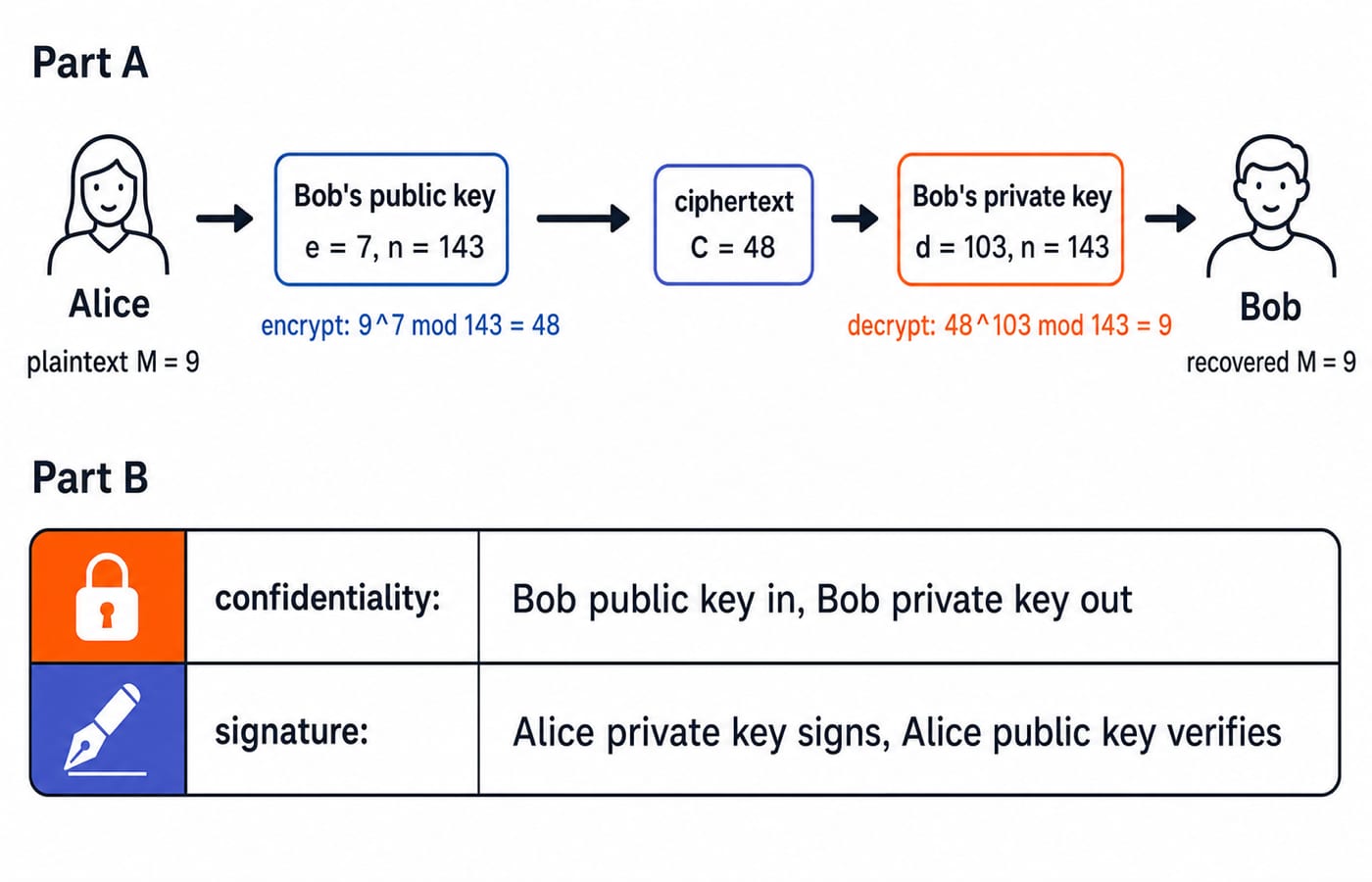
Alice sends a confidential message to Bob. She encrypts with Bob's public key, and Bob decrypts with Bob's private key. Bob owns the pair, distributing the public key but keeping the private key secret.
Say the owner before choosing: Bob's public key in, Bob's private key out. Knowing the public key should not expose the related private key.
For a signature, the signer uses their private key and verification uses that signer's public key. This stops the mistake that private means "decrypt only."
2. Questions 1 to 3: identify public and private key roles
Q1
NIACL AO IT Specialist 2025
In asymmetric encryption, which key is used to encrypt the message before sending?
(a) Sender's private key
(b) Receiver's public key
(c) Sender's public key
(d) Receiver's private key
(e) Shared secret key
Answer: (b). The phrase "before sending" implies confidentiality for the receiver. Anyone may know the receiver's public key, but only the receiver should possess the matching private key that reverses the encryption. Option (a) is the signature-flow trap, while option (e) describes symmetric encryption. That preserves secrecy.
Q2
RSSB Basic Computer Instructor 2025
Public key encryption uses multiple keys. One key is used to encrypt data, while another is used to decrypt data. The key used to encrypt data is called the ___ key, while the key used to decrypt data is called the ___ key.
(a) Encryption, decryption
(b) Encryption, public
(c) Public, private
(d) Private, public
Answer: (c). In the confidentiality flow described here, Bob's public key encrypts and Bob's private key decrypts. "Public" and "private" describe how the related keys are distributed and protected, not two unrelated algorithms. Do not extend this direction blindly to digital signatures. Keep the task context explicit.
Q3
UGC NET 2014
Which one of the following is true for asymmetric-key cryptography?
(a) Private key is kept by the receiver and public key is announced to the public.
(b) Public key is kept by the receiver and private key is announced to the public.
(c) Both private key and public key are kept by the receiver.
(d) Both private key and public key are announced to the public.
Answer: (a). The public key is useful because it can be shared, while secrecy of the paired private key is the security boundary. Bob owns both keys, but only his private key must remain undisclosed. That ownership nuance makes option (c) tempting but misleading. Option (a) captures distribution correctly.
3. Questions 4 to 6: trace sender, receiver, encryption and decryption
Keep Alice as sender and Bob as receiver: Bob's public key in, Bob's private key out.
Q4
UPPSC Polytechnic Lecturer 2023
In a standard asymmetric-key (public-key) encryption exchange, a sender encrypts a message using the receiver's public key. The matching private key needed to decrypt that message is kept by
(a) sender
(b) receiver
(c) sender and receiver
(d) More than one of the above
(e) None of the above
Answer: (b). Alice encrypts with Bob's public key, so the matching private key belongs to Bob. Sharing that private key with Alice would destroy the one-owner property that provides confidentiality. The sender-and-receiver option is therefore the closest trap. Bob alone should be able to reverse Alice's encryption.
Q5
UGC NET 2021
A message is encrypted using public key cryptography to send a message from sender to receiver. Which one of the following statements is True?
(a) Sender encrypts using receiver’s public key
(b) Sender encrypts using his own public key
(c) Receiver decrypts using sender’s public key
(d) Receiver decrypts using his own public key
Answer: (a). Alice selects Bob's public key so that only Bob's matching private key can recover the plaintext. Option (d) fails on one exact word: Bob does perform the decryption, but he needs his private key, not his public key. Ownership stays with Bob throughout the exchange.
Q6
ISRO 2008
A public key encryption system
(a) allows anyone to decode the transmissions
(b) allows only the correct sender to decode the data
(c) allows only the correct receiver to decode the data
(d) does not encode the data before transmitting it
Answer: (c). In the confidentiality use case, only Bob has the private key needed to decode the ciphertext sent by Alice. "Correct receiver" means the holder of that matching private key. Public availability of Bob's encryption key does not give everyone the ability to decrypt. This matters.
4. Questions 7 to 9: recognise the system, its algorithms and its limits
Q7
RSSB Basic Computer Instructor 2025
What is an encryption system that uses two keys: a public key that everyone can have and a private key for only the recipient?
(a) Encryption
(b) IDS
(c) Security Audit software
(d) Public Key Encryption
Answer: (d). Its defining feature is a related two-key pair, one distributable and one secret. An IDS monitors activity, and security-audit software evaluates controls. Neither is an encryption construction. "Encryption" alone is too broad because symmetric systems also encrypt. Always look for the stated key architecture first.
Q8
NIACL AO IT Specialist 2020
______ is not a public key cryptosystem.
(a) El Gamal
(b) Rabin
(c) AES
(d) RSA
Answer: (c). AES is a symmetric block cipher. It uses the same secret key for encryption and decryption. ElGamal, Rabin and RSA are public-key families. The trap is to classify every familiar cryptographic name as asymmetric without checking its key model. Ask whether one key or two are used.
Q9
ISRO 2023
Asymmetric encryption is not suitable for
(a) Confidentiality
(b) Authentication
(c) Key Exchange
(d) Prevention of Denial of Service
Answer: (d). Public-key techniques support confidentiality, authentication mechanisms and key establishment, but they do not guarantee availability. A denial-of-service attack targets resources or reachability. Its prevention needs controls such as filtering, rate limits, redundancy and capacity planning, not encryption alone. Separate confidentiality controls from availability controls every time.
5. Questions 10 to 12: PKI, RSA key selection and the ECB trap
Q10
ISRO 2025
Which of the following defines format for Public Key Infrastructure?
(a) X.25
(b) X.509
(c) IEEE 802.11
(d) IEEE 802.3
Answer: (b). X.509 specifies the certificate format used in public-key infrastructure. X.25 is a packet-switched networking standard, IEEE 802.11 covers wireless LANs, and IEEE 802.3 covers Ethernet. The other options are networking standards, not the required PKI certificate format. Match each standard to the object it defines.
Q11
NIACL AO IT Specialist 2020
In RSA:
1. p and q are chosen as very large prime numbers.
2. Compute n = p x q and phi(n) = (p - 1) x (q - 1).
Later, e is chosen as the encryption exponent. How is e selected?
(a) e is chosen as a relative prime to q
(b) e is chosen as a relative prime to p
(c) e is chosen as a relative prime to ϕ(n)
(d) e is chosen as a relative prime to n
Answer: (c). The intended products are n = p x q and phi(n) = (p - 1) x (q - 1). RSA requires 1 < e < phi(n) and gcd(e, phi(n)) = 1. Being coprime to p, q or n alone is not the stated selection rule.
Q12
ISRO 2018
Which one of the following algorithms is not used in asymmetric-key cryptography?
(a) RSA Algorithm
(b) Diffie-Hellman Algorithm
(c) Electronic Code Book Algorithm
(d) None of the above
Answer: (c). RSA is an asymmetric algorithm, and Diffie-Hellman is a public-key key-agreement method. Electronic Codebook, usually called ECB, is a mode for block ciphers and is commonly discussed with symmetric ciphers. It is not an asymmetric algorithm. The option's wording is therefore imprecise, but its classification is clear.
6. Worked RSA anchor: make the key rule numerical
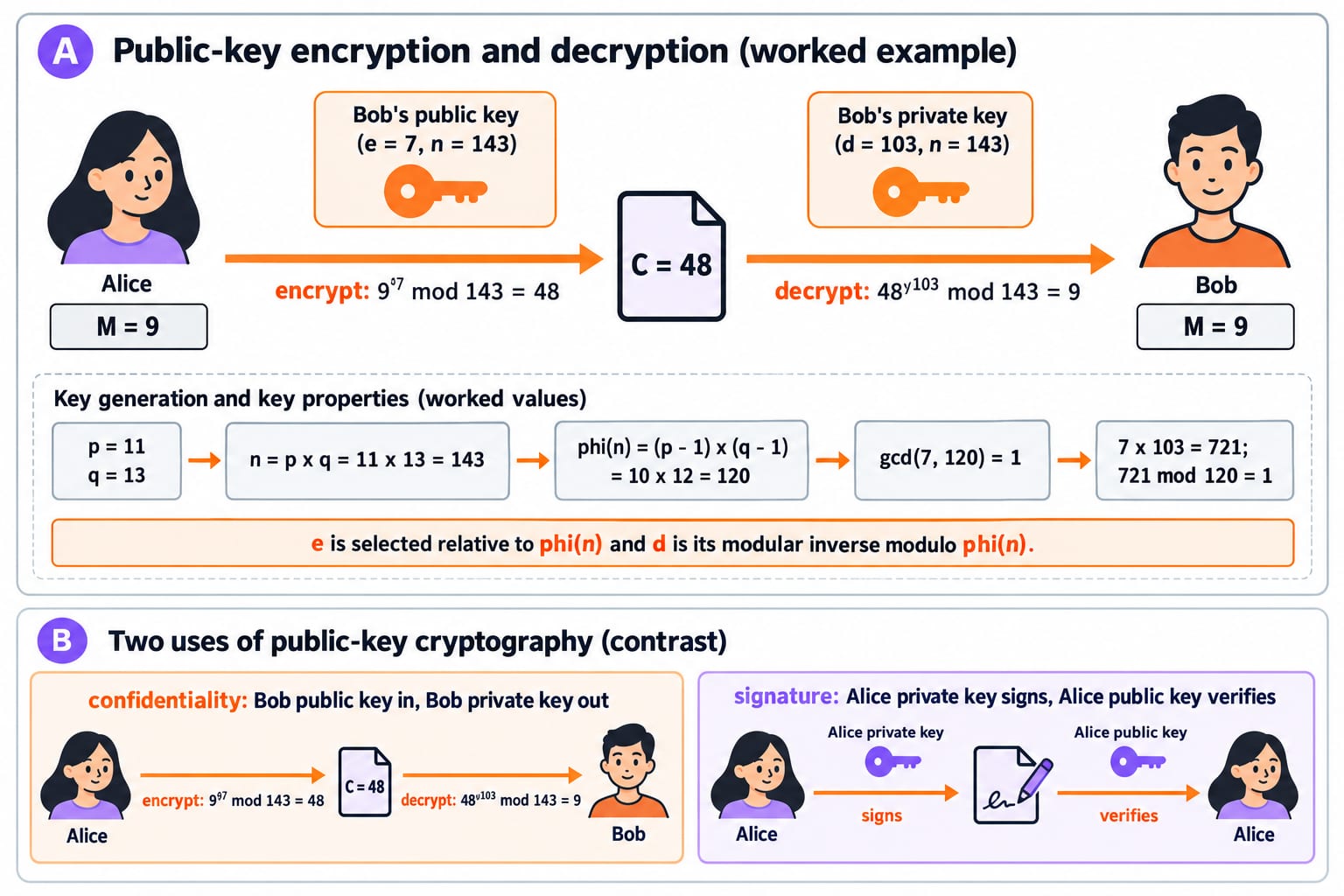
Choose p = 11 and q = 13. Then:
n = p x q = 11 x 13 = 143phi(n) = (p - 1) x (q - 1) = 10 x 12 = 120Choose
e = 7becausegcd(7, 120) = 1.Choose
d = 103because7 x 103 = 721and721 mod 120 = 1.
Encrypt M = 9. Repeated squaring gives 9^2 mod 143 = 81 and 9^4 mod 143 = 126. Since 7 = 4 + 2 + 1, C = 9^7 mod 143 = (126 x 81 x 9) mod 143 = 48.
For decryption, the residues for powers 2, 4, 8, 16, 32, 64 are 16, 113, 42, 48, 16, 113. Since 103 = 64 + 32 + 4 + 2 + 1, M = (113 x 16 x 113 x 16 x 48) mod 143 = 9.
These tiny primes are only for arithmetic demonstration. In RSA, e is selected relative to phi(n), and d is its modular inverse modulo phi(n). For deeper key-generation, modular-inverse, and exponentiation practice, RSA Algorithm MCQs: 12 Solved Questions with Step-by-Step Explanations owns the RSA calculation track; this set focuses on key roles, PKI, and distinguishing asymmetric from symmetric constructions.
7. Mistake map and a 12-point self-check
Trap | Why it tempts you | Replacement rule |
|---|---|---|
Sender's private for receiver's public | "Private" sounds safer | Confidentiality uses Bob's public key |
Private key shared | Both keys form a pair | Its owner keeps it secret |
AES or ECB called asymmetric | Both are cryptography terms | AES is symmetric; ECB is a mode |
Encryption stops denial of service | Security is confused with availability | Use filtering, rate limits and redundancy |
Score 10 to 12: revise the key-flow diagram once. Score 7 to 9: redo Q1 to Q6. Score 0 to 6: read the Computer Networks foundation, then reattempt without the answer key.
8. Short version and the next practice set
Keep three lines in memory: a public key can be distributed, a private key stays with its owner, and confidentiality uses the receiver's key pair.
For structured GATE study, use GATE Guidance by Sanchit Sir. For placement-focused CS fundamentals, use CS Fundamentals for Placements by Sanchit Sir. The CS Fundamentals category is the broader route. Then test your key-flow discipline on Computer Networks TCP/UDP Transport Layer MCQs.
Keep learning
Symmetric Key Cryptography MCQs: 12 Solved Block and Stream Cipher Questions
Solve 12 symmetric key cryptography questions covering AES, DES, key count, cipher modes, parameter matching and a full columnar transposition trace.
Updated 17 Nov 20267 min readComputer Networks MCQs

Cloud Deployment Models: Public, Private, Community and Hybrid with a 60-VM Worked Example
Learn a four-question method to classify cloud deployment models, then carry one 60-VM workload through public, private, community, and hybrid designs.
Updated 11 Sep 20265 min readComputer Networks

Symmetric, Antisymmetric and Asymmetric Relation MCQs: 11 Solved Questions
Solve 11 relation MCQs with clear tests for symmetry, antisymmetry and asymmetry. Each answer identifies the exact pair, loop or implication that decides it.
Updated 29 Oct 20268 min read169 viewsDiscrete Mathematics MCQs
Cryptography Fundamentals and Cryptosystems: RSA, Security Goals and Exam Traps
Build a clean mental model of cryptography, then follow Caesar and toy RSA calculations step by step. The guide also separates encryption, hashing, MACs and signatures.
Updated 10 Nov 20266 min readUGC NET Computer Science