

Network Layer Protocols MCQs: 12 Solved Questions on ARP, ICMP, RARP and IPv6
Practise 12 MCQs on ARP, RARP, ICMP, ping, traceroute, IPv4 Protocol values and IPv6. Each explanation isolates the decisive exam cue.
KnowledgeGate Team
Exam prep & CS education
Updated 16 Nov 20267 min read
ARP, RARP, ICMP and IGMP sit close in the syllabus, but solve different address, control and multicast problems. Solve these 12 questions before reading the answers, especially during GATE Computer Science preparation. The explanations isolate the protocol direction, packet field or diagnostic cue that decides each answer.
ARP direction and the local-link broadcast
ARP starts with a known IPv4 address and discovers the MAC address needed for local-link delivery.
Question 1 (IBPS 2024)
What is the primary function of the ARP in an IPv4 local network?
A. To assign IP addresses dynamically
B. To resolve domain names into IP addresses
C. To determine the MAC address corresponding to an IP address
D. To encrypt network communication
E. To forward packets between different networks
Answer: C. A is 192.168.10.5/24 with MAC 02:00:00:00:00:05; B is 192.168.10.9/24 with MAC 02:00:00:00:00:09. A knows B's IP but needs its MAC for Ethernet, so it sends an ARP request and caches B's reply. DHCP assigns configuration. DNS resolves names. Encryption is separate. Routers forward between networks.
Question 2
An ARP request packet includes which one of the following as a destination Mac address?
A. Mac address of receiver system.
B. A broadcast address 255.255.255.255.
C. A broadcast address FF.FF.FF.FF.FF.FF.
D. Mac address of the local router.
Answer: C. With the same A and B, A lacks B's MAC, so the Ethernet destination is FF:FF:FF:FF:FF:FF. The value 255.255.255.255 is an IPv4 broadcast, not a MAC field. Practise deciding whether a target is local with these subnetting and IP-addressing MCQs.
Reverse mapping and the four-protocol match
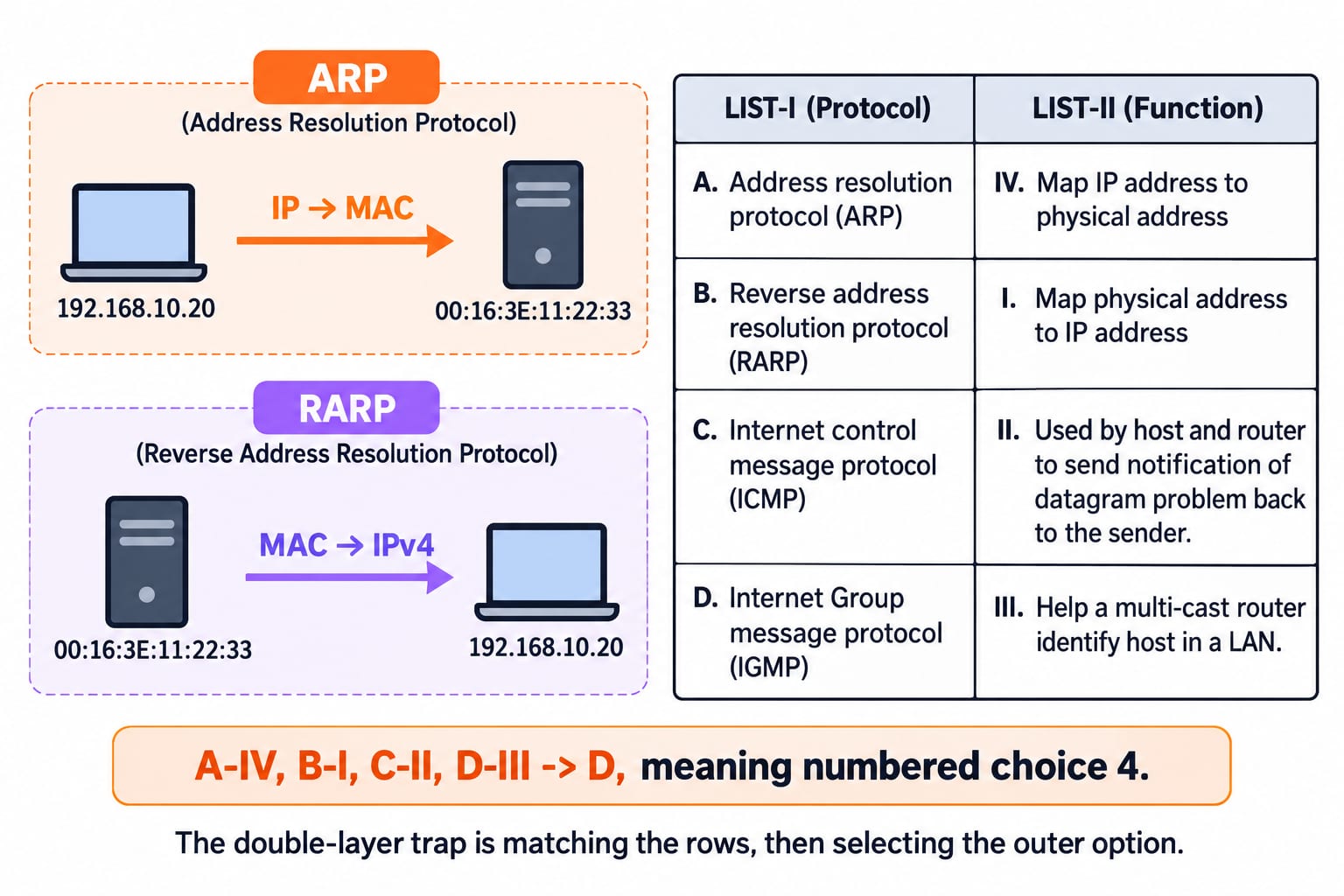
Keep the directions separate: ARP is IP to MAC; the reverse-mapping question is MAC to IPv4.
Question 3 (UGC NET 2019)
What is the name of the protocol that allows a client to send a broadcast message with its MAC address and receive an IP address in reply?
A. ARP
B. DNS
C. RARP
D. ICMP
Answer: C. Given MAC 00:16:3E:11:22:33, a reply of 192.168.10.20 maps MAC to IPv4, the RARP direction here. ARP asks for a MAC when the IP is known.
Question 4 (UGC NET 2025)
Match the LIST-I with LIST-II
LIST-I (Protocol) | LIST-II (Function) |
|---|---|
A. Address resolution protocol (ARP) | I. Map physical address to IP address |
B. Reverse address resolution protocol (RARP) | II. Used by host and router to send notification of datagram problem back to the sender. |
C. Internet control message protocol (ICMP) | III. Help a multi-cast router identify host in a LAN |
D. Internet Group message protocol (IGMP) | IV. Map IP address to physical address. |
Choose the correct answer from the options given below:
1. A-I, B-II, C-III, D-IV
2. A-II, B-I, C-IV, D-III
3. A-IV, B-II, C-III, D-I
4. A-IV, B-I, C-II, D-III
A. 1
B. 2
C. 3
D. 4
Answer: D, meaning numbered choice 4. ARP maps IP to physical, A-IV. RARP maps physical to IP, B-I. ICMP reports datagram problems, C-II. IGMP supports multicast membership, D-III. The double-layer trap is matching the rows, then selecting the outer option.
ICMP as control and error reporting
ICMP reports network-layer conditions and supports diagnostics. It does not repair a route, guarantee delivery or replace TCP.
Question 5 (KVS 2013)
Internet Control Message Protocol (ICMP)
Which of the following is/are true about ICMP?
A. Allows gateways to send error control messages to other gateways or hosts.
B. Provides communication between the Internet Protocol software on one machine and the Internet Protocol software on another.
C. Only reports error conditions to the original source; the source must relate errors to individual application programs and take action to correct the problem.
D. All these
Answer: D. In this item, A covers error messages, B covers communication between IP implementations, and C puts action on the source. The trap: ICMP reports a condition; it does not correct it.
Question 6
Which protocol is used to send a destination network unknown message back to originating hosts?
A. TCP
B. ARP
C. ICMP
D. BootP
Answer: C. Suppose 192.0.2.10 sends toward 203.0.113.25. Router 10.0.0.1 has no usable route for 203.0.113.0/24, so it sends an ICMP destination-unreachable-style report back toward 192.0.2.10.
Ping and traceroute without the usual shortcuts
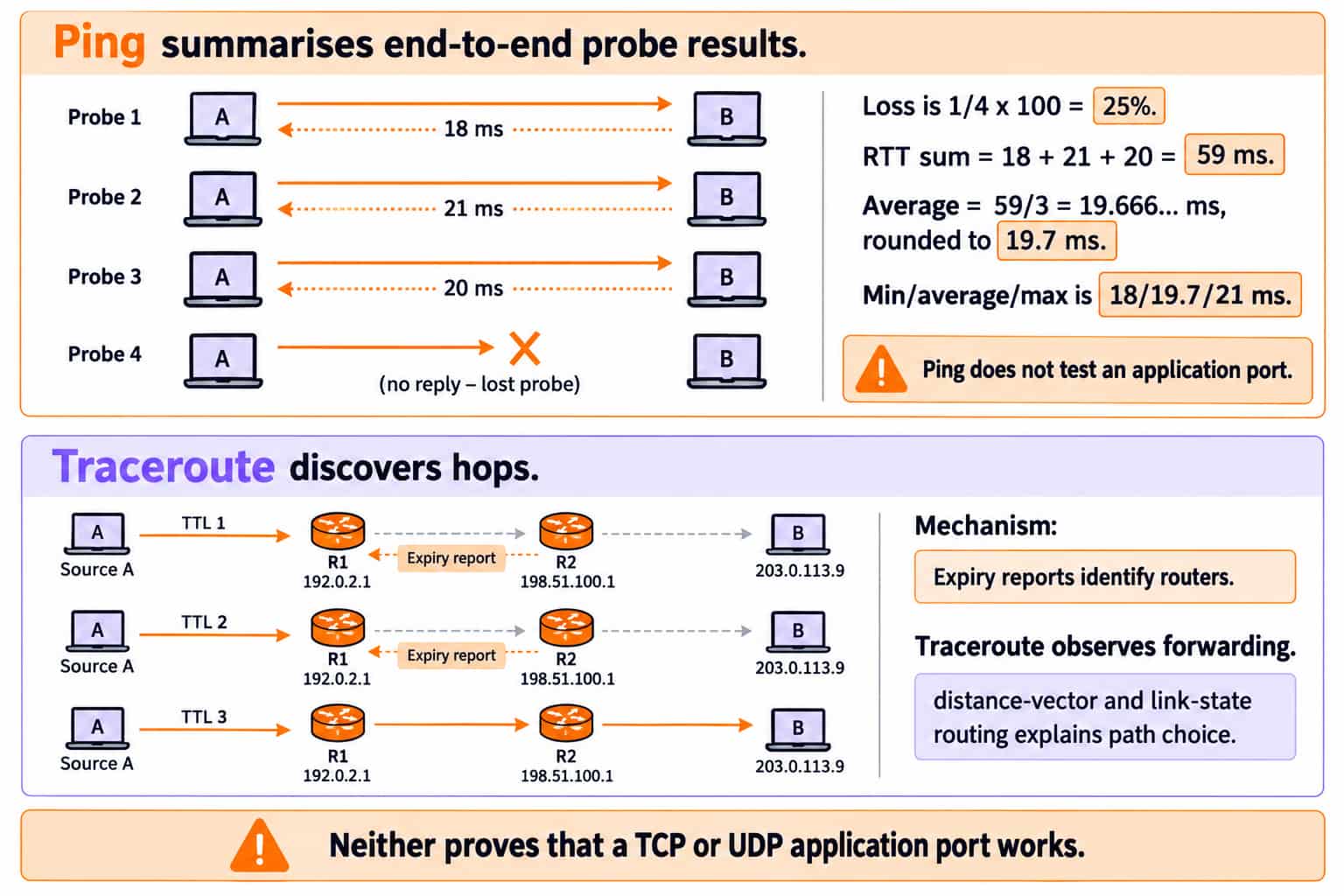
Ping summarises end-to-end probe results. Traceroute discovers hops. Neither proves that a TCP or UDP application port works.
Question 7 (BPSC 2023)
Which of the following is true with regard to the ping command?
A. Ping stands for Packet Internet Generator.
B. The ping command checks port-level connectivity between source and destination endpoints.
C. Ping summarises packet loss and round-trip delay between two IP endpoints.
D. More than one of the above
E. None of the above
Answer: C. Four probes are sent; three return at 18, 21 and 20 ms. Loss is 1/4 × 100 = 25%. RTT sum = 18 + 21 + 20 = 59 ms. Average = 59/3 = 19.666... ms, rounded to 19.7 ms. Min/average/max is 18/19.7/21 ms. B is wrong because ping does not test an application port.
Question 8 (GATE 2005)
Traceroute reports a possible route that is taken by packets moving from some host A to some other host B. Which of the following options represents the technique used by traceroute to identify these hosts
A. By progressively querying routers about the next router on the path to B using ICMP packets, starting with the first router
B. By requiring each router to append the address to the ICMP packet as it is forwarded to B. The list of all routers en-route to B is returned by B in an ICMP reply packet
C. By ensuring that an ICMP reply packet is returned to A by each router en-route to B, in the ascending order of their hop distance from A
D. By locally computing the shortest path from A to B
Answer: A, the closest option. A sends probes with TTL 1, 2 and 3. They expire at R1, 192.0.2.1, then R2, 198.51.100.1; TTL 3 reaches B, 203.0.113.9. Expiry reports identify routers. No router appends a route list, and A computes no shortest path. Traceroute observes forwarding; distance-vector and link-state routing explains path choice.
ICMP packet rules and the IPv4 Protocol field
For a header question, split the hexadecimal string into bytes and count carefully. Then distinguish protocols carried directly over IP from applications carried over UDP.
Question 9
Which of the following is false about an ICMP packet?
A. ICMP messages are encapsulated in IP packets.
B. ICMP reports an error message to the original source.
C. ICMP cannot be used to determine the round-trip time for an IP datagram between two endpoints.
D. ICMP does not correct errors; it simply reports them.
Answer: C. Ping uses ICMP Echo Request and Echo Reply messages, and the sender can measure the elapsed time between a request and its reply. The absolute claim that ICMP cannot support a round-trip-time measurement is therefore false. ICMP messages are carried inside IP packets, and error reporting does not itself correct the underlying fault.
Question 10 (GATE 2025)
A machine receives an IPv4 datagram. The protocol field of the IPv4 header has the protocol number of a protocol X. Which ONE of the following is NOT a possible candidate for X?
A. Internet Control Message Protocol (ICMP)
B. Internet Group Management Protocol (IGMP)
C. Open Shortest Path First (OSPF)
D. Routing Information Protocol (RIP)
Answer: D. The IANA protocol registry gives ICMP 1, IGMP 2 and OSPF 89, so IP can name them directly. The IANA service-name registry puts RIP on UDP port 520. Thus IP names UDP, protocol 17, not RIP.
IPv6 translation fields and false-statement traps
Solve these according to the stated model. In each case, one decisive option is enough.
Question 11 (BPSC 2023)
Which of the following is NOT a step in the Header Translation procedure (IPv6 → IPv4)?
A. The IPv6 mapped address is changed to an IPv4 address by extracting the rightmost 32 bits.
B. The value of the IPv6 priority field is discarded.
C. The IPv6 flow label is considered.
D. More than one of the above.
E. None of the above.
Answer: C. In the item's model, ::ffff:192.0.2.33 carries 192.0.2.33 in its rightmost 32 bits, which demonstrates A. The flow label is treated as ignored rather than considered, so C is the requested NOT step.
Question 12 (Coal India 2017)
Which of the following statements about IPv6 is FALSE?
A. IPSec support is an integral part of IPv6.
B. IPv6 has no way to distinguish delay-sensitive packets from bulk data transfers.
C. In comparison to IPv4, IPv6 has improved header structure with less processing overhead.
D. IPv6 routers no longer have to fragment packets.
Answer: B. The absolute “no way” makes B false. Traffic Class 0xB8 and Flow Label 0x12345 visibly show fields for differentiated-flow information. The answer does not require treating A as a current implementation rule.
The short version and the next practice step
Cue in the question | Protocol or field to recall |
|---|---|
Known IPv4 address, need local MAC | ARP |
Known MAC, need IPv4 address in the reverse-mapping question | RARP |
Network error or diagnostic report | ICMP |
Multicast group membership | IGMP |
IPv4 header byte 10 after the fixed opening fields | Protocol field |
Hop discovery through increasing TTL | traceroute mechanism using expiry reports |
Run one packet-role pass after the first attempt. For every miss, label the unknown as an address, link-layer destination, control report, IPv4 payload protocol or hop-discovery mechanism. Rebuild the cue table from memory, then continue theory with GATE Guidance by Sanchit Sir and use the GATE Test Series for timed practice.
Keep learning
ARP, DHCP and ICMP for GATE: The Three Support Protocols and How They Are Tested
Fix the job, layer and packet flow of ARP, DHCP and ICMP. Then use six GATE-style scenarios to practise choosing the right support protocol without guesswork.
Updated 19 Sep 20266 min read62 viewsGATE Strategy & Roadmap
IPv4 Basics MCQs: 10 Solved Network Layer Questions with Explanations
Solve 10 IPv4 and Network Layer MCQs, then verify each answer through field widths, layer counts and a connected hexadecimal-header calculation.
Updated 15 Nov 20268 min readComputer Networks MCQs
IPv4 and Network Layer Protocols: Complete Guide with Worked Examples for GATE CS
Build a clear picture of IPv4, its support protocols and the header calculations that matter in GATE CS. Includes a complete fragmentation example.
Updated 23 Aug 20266 min read67 viewsComputer Networks
Routing Protocols in Computer Networks: Distance Vector, Link State, RIP, OSPF, BGP with Worked Examples
Build routing from the control plane to Internet-wide policy. Compare how RIP, OSPF, and BGP carry updates, use ports and timers, react to failure, and create common GATE CS traps.
Updated 29 Oct 20265 min read66 viewsComputer Networks